You don’t need another generic list of “top YouTube niche ideas.” What you actually need to know is: Is anyone actually searching for this? Can I realistically compete? Will this make money - or waste 6 months of content?
Most guides just give you generic lists. You end up bouncing between Google Trends, vidIQ, and competitor channels, still guessing if you made the right call.
Stop guessing. Whether you're launching a channel or scouting creators for a campaign, niche research is a process, not a lottery. Here are 7 proven ways to validate your YouTube niche and spot real opportunities before you hit record.
Key Takeaways
- Niche research is a marketing intelligence task: Finding a YouTube niche isn't just for creators — it directly informs influencer selection, content strategy, and competitive positioning for brands.
- Start with demand validation: Use Google Trends in "YouTube Search" mode and the YouTube search bar to confirm that real audiences are actively searching for your niche before committing.
- Competitor gap analysis is your fastest shortcut: Analyzing what top channels in your space are not covering reveals the exact content gaps your brand or creator partner can own.
- CPM data matters for ROI: High-CPM niches (personal finance, digital marketing, SaaS) attract premium advertisers — critical context when evaluating influencer partnerships or brand channel monetization.
- The winning formula: Niche = Audience Demand + Manageable Competition + Monetization Fit. All three must align.
- Automate the research: Manually tracking niche trends, competitor channels, and comment sentiment across YouTube is time-consuming — AI-powered research tools can compress weeks of analysis into hours.
What Is a YouTube Niche and Why Marketers Should Care
A YouTube niche is a focused content category that targets a specific audience with a specific type of content. Instead of "fitness," a niche is "home workouts for busy moms over 40." Instead of "tech," it's "budget smartphone reviews for college students."
For content creators, a niche helps the YouTube algorithm understand who to show your videos to. For marketers, a niche is a targeting signal — it tells you exactly which audience a channel reaches, how engaged they are, and whether they match your customer profile.
📌 Note: YouTube's algorithm doesn't just rank videos — it categorizes channels. A channel with a clear niche gets recommended to the right audience consistently. A channel without one gets recommended to no one reliably.
When you're evaluating influencer partnerships, a creator's niche is more predictive of campaign performance than their subscriber count. A 50,000-subscriber channel in the "SaaS tools for freelancers" niche will outperform a 500,000-subscriber general tech channel for a B2B software brand — every time.
Method 1: Use the YouTube Search Bar as a Niche Validator
The fastest free tool for niche validation is already built into YouTube.
The YouTube search bar's autocomplete function reveals what real users are actively searching for right now. Unlike keyword tools that show historical data, autocomplete reflects live search behavior.
Steps 1. Open YouTube and click the search bar (do not press Enter yet).
Steps 2. Type a broad topic related to your brand or target audience — for example, "personal finance" or "home office."
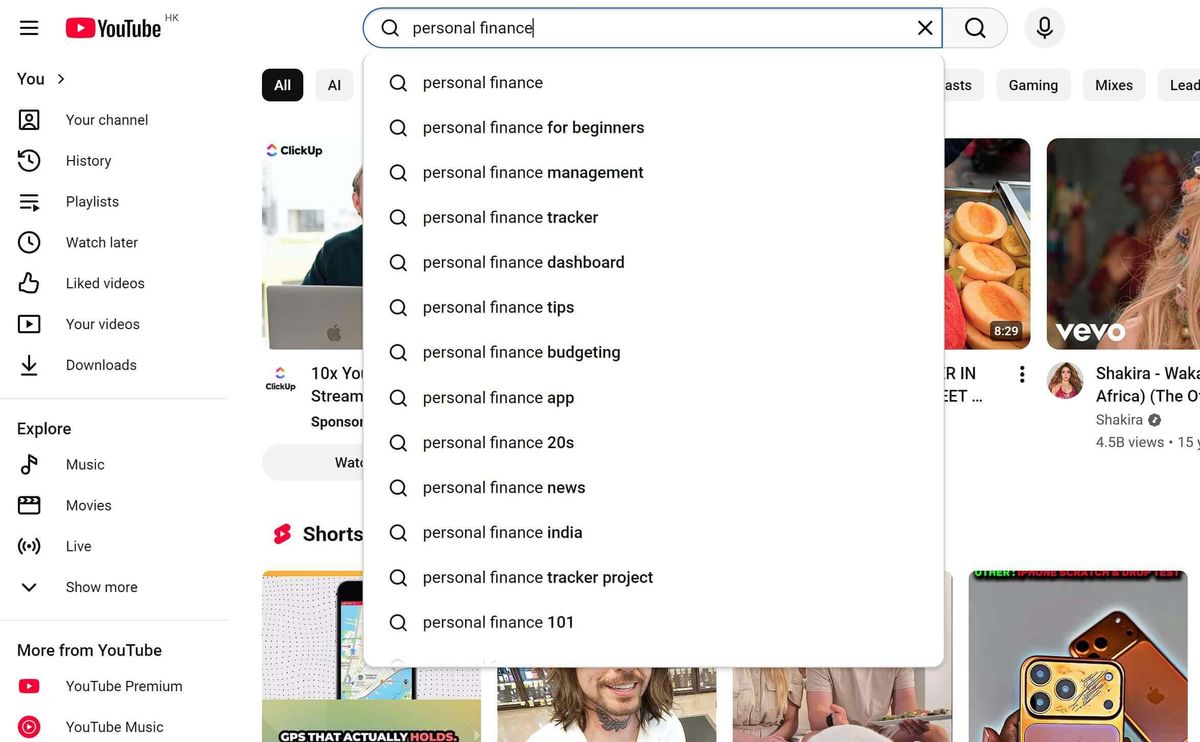
Steps 3. Note every autocomplete suggestion that appears. These are real queries with real search volume.
Steps 4. Add a letter after your topic (e.g., "personal finance a," "personal finance b") to surface more specific variants.
Steps 5. For each promising suggestion, search it and look at the top 10 results. Note: How many views do the top videos have? How old are they? Are there channels with fewer than 10,000 subscribers ranking well?
Steps 6. Repeat with question prefixes: "how to [topic]," "best [topic] for," "why [topic]."
What to look for:
- Suggestions with multiple autocomplete variants = strong audience demand
- Top results from small channels (under 50K subscribers) = lower competition
- Recent upload dates in top results = the algorithm is actively promoting this niche
Best for: Marketers validating a niche before committing to a creator partnership or brand channel investment. Takes 20–30 minutes per niche and costs nothing.
💡 Pro tip: Search the same terms in Google (not YouTube) and check if YouTube videos appear in the Google SERP. If they do, the niche has dual-platform discoverability — your content can rank on both YouTube and Google Search simultaneously.
Method 2: Analyze Competitor Channels for Content Gaps
Your competitors' YouTube channels are a roadmap of what's working — and a blueprint of what they're missing.
Competitor channel analysis is one of the highest-leverage niche research methods for marketers because it reveals proven demand (what's already getting views) and untapped opportunity (what no one is covering well).
Step 1. Find 3–5 active competitor channels in your niche.
Step 2. Sort each channel by “Most Popular.”
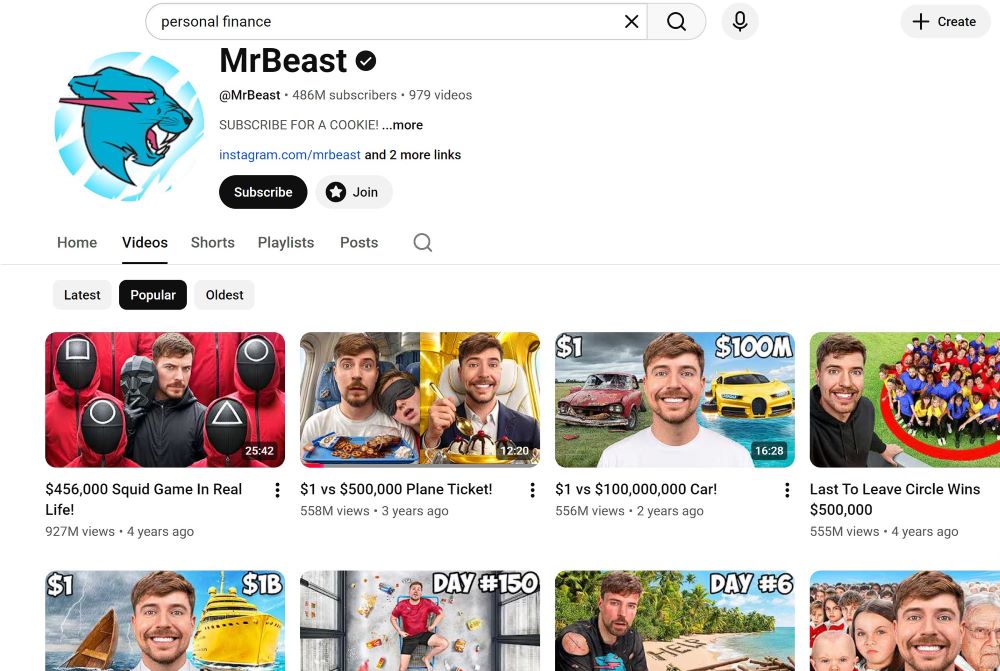
Step 3. Note the top 10 videos (title, views, date, topic).
Step 4. Identify patterns in topics and formats that consistently perform well.
Step 5. Switch to “Latest” and compare recent performance with older videos.
Step 6. List what topics competitors cover and identify what’s missing.
Step 7. Read top comments to find unanswered questions and audience pain points.
What to look for:
- Topics with high views but few competing videos = underserved demand
- Comment sections full of unanswered questions = content gap your brand can fill
- Competitor channels that haven't uploaded in 3+ months = abandoned niche with existing audience
Best for: E-commerce marketers identifying content gaps for product category channels; digital marketers building a content differentiation strategy for a brand's YouTube presence.
⚠️ Warning: Don't just copy what's working for competitors. The goal is to find what they're not doing well — that's where you can win. Copying their top content puts you in direct competition with an established channel that already owns that topic.
Method 3: Use Google Trends in YouTube Search Mode
Google Trends is the most underused niche research tool in a marketer's stack — especially when filtered to YouTube Search data.
Most marketers use Google Trends for web search data. But switching the data source to "YouTube Search" reveals a completely different picture: what people are actively searching for on YouTube specifically, with trend lines showing whether interest is growing, stable, or declining.
Step 1. Go to Google Trends and enter a broad niche topic.
Step 2. Change the data source from "Web Search" to "YouTube Search" using the dropdown below the search bar.
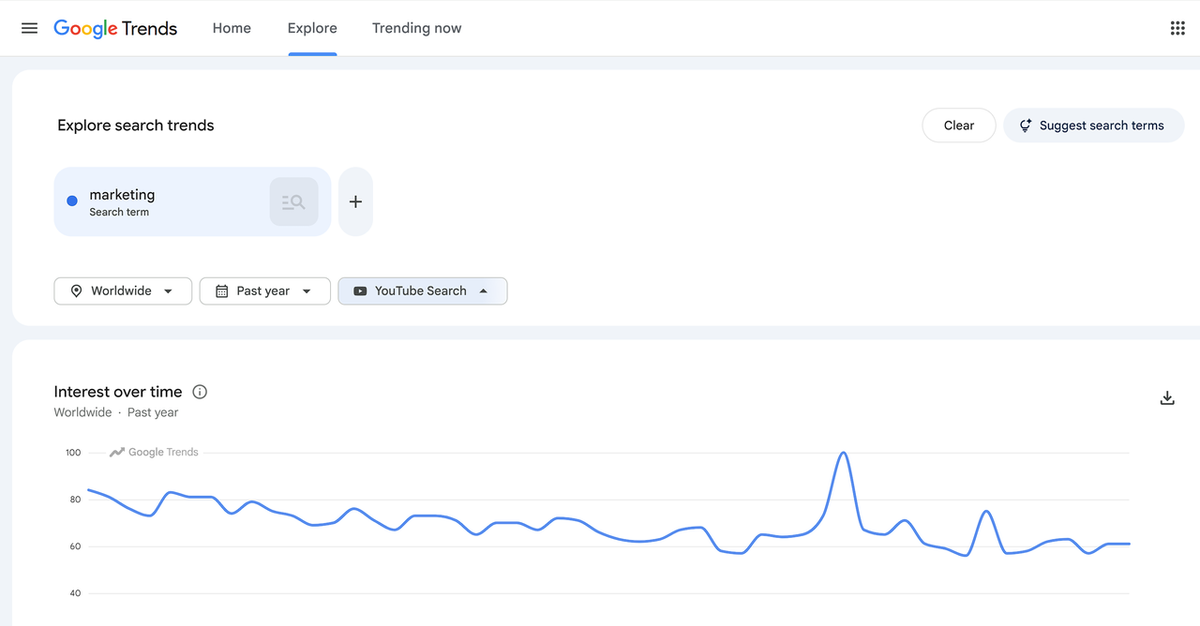
Step 3. Set the time range to "Past 5 years" to see long-term trend direction.
Step 4. Look at the "Interest over time" graph. Is the trend rising, stable, or declining?
Step 5. Scroll to "Related queries" and switch from "Top" to "Rising" — these are the fastest-growing search terms in your niche right now.
Step 6. Compare 2–3 niche candidates side by side using the "+ Compare" function to see which has stronger and more consistent demand.
Step 7. Check the "Interest by region" map to identify geographic concentrations — useful for geo-targeted campaigns or regional influencer selection.
What to look for:
- Rising trend line over 2+ years = evergreen niche with growing demand
- Seasonal spikes with a rising baseline = niche with predictable traffic peaks you can plan content around
- "Breakout" tags in Rising queries = emerging sub-niches before they become saturated
Best for: Marketers evaluating whether a niche has long-term viability before investing in a brand channel or 12-month influencer partnership.
Method 4: Mine YouTube Comments for Niche Pain Points
The most honest niche research data on YouTube isn't in analytics dashboards — it's in the comments section.
YouTube comments are where viewers tell creators exactly what they want more of, what they're confused about, and what problems they still haven't solved. For marketers, this is unfiltered audience intelligence that no survey can replicate.
Steps:
- Find the top 5–10 videos in a potential niche (use Method 1 or 2 to identify them).
- Open each video and sort comments by "Top Comments."
- Read the top 20–30 comments on each video. Look for:
- Questions the video didn't answer ("But what about...?")
- Requests for follow-up content ("Can you do a video on...?")
- Expressions of frustration ("I've tried everything and still can't...")
- Specific use cases the creator didn't address ("This is great, but I need this for [specific scenario]")
- Build a running list of recurring themes. Any theme that appears across multiple videos in multiple channels is a validated niche opportunity.
- Pay attention to the vocabulary people use. The exact phrases in comments are the search terms your audience uses — and the language your content should mirror.
What to look for:
- Questions that appear in 3+ comment sections = high-demand sub-niche
- Specific audience segments mentioned repeatedly (e.g., "as a freelancer," "for my Shopify store") = niche-within-a-niche opportunity
- Complaints about existing content quality = your differentiation angle
Best for: Marketers building audience personas for influencer briefs; e-commerce brands identifying content angles that address real customer objections.
Method 5: Validate Niche Monetization Potential with CPM Data
Not all niches are created equal when it comes to revenue — and for marketers, CPM data is a critical input for influencer ROI calculations.
CPM (cost per 1,000 impressions) determines how profitable a niche is. Higher CPM = higher advertiser demand = higher revenue potential.
Step 1. Research average CPM ranges for your target niche. High-CPM niches (typically $10–$50+ CPM) include:
- Personal finance and investing
- Digital marketing and SaaS tools
- Legal and business content
- Real estate
- Health and wellness (specific sub-niches)
Step 2. Cross-reference CPM data with audience size. A niche with $30 CPM and 100,000 monthly views generates significantly more ad revenue than a niche with $3 CPM and 500,000 monthly views.
Step 3. Evaluate monetization layers beyond AdSense: affiliate marketing potential, sponsorship rates, digital product opportunities, and membership revenue. High-CPM niches often have strong affiliate ecosystems (financial products, software tools).
Step 4. For influencer partnerships: use CPM benchmarks to calculate whether a creator's asking rate represents fair value. A creator in a $20 CPM niche charging $2,000 per sponsored video with 50,000 average views is priced at market rate.
Step 5. Check Social Blade for estimated earnings ranges on specific channels to validate CPM assumptions.
What to look for:
- CPM × views = sustainable revenue
- Strong affiliate/commercial ecosystem
- Clear alignment with your product category
Best for: E-commerce marketers calculating influencer partnership ROI; digital marketers building business cases for brand YouTube channel investment.
📌 Note: CPM fluctuates by season (Q4 is typically 30–50% higher than Q1), geography (US/UK/AU audiences command premium CPMs), and content type. Always use annual averages rather than peak-season data for planning.
Method 6: Use Keyword Research Tools to Quantify Niche Demand
Gut instinct is a starting point. Keyword data is how you confirm it.
Keyword research tools built for YouTube give you search volume estimates, competition scores, and related keyword clusters — the quantitative layer that turns a niche hypothesis into a validated opportunity.
Steps:
- Choose a YouTube-specific keyword research tool. The most widely used options:
- vidIQ: Keyword research, competition scores, trending topics, and daily niche ideas. Free tier available.
- TubeBuddy: Keyword Explorer with search volume estimates, competition analysis, and "Weighted Score" that balances demand vs. competition.
- Semrush: Tracks YouTube video rankings in Google Search — essential if your niche targets Google SERP placement alongside YouTube.
- Enter your niche topic into the keyword tool and review:
- Search volume: How many people search this term monthly on YouTube?
- Competition score: How many established channels are targeting this keyword?
- Related keywords: What sub-topics and variants cluster around your main niche?
- Look for keywords with a "Goldilocks" profile: search volume high enough to be worth targeting (500+ monthly searches), competition low enough to be winnable (avoid keywords dominated by channels with 1M+ subscribers).
- Build a keyword cluster map: Group related keywords into content pillars. Each pillar represents a sub-niche your channel (or creator partner) can own systematically.
- Check the "Trending" section of vidIQ or TubeBuddy weekly to catch emerging niche opportunities before they peak.
What to look for:
- Keywords with rising search volume + low competition = first-mover niche opportunity
- Keyword clusters with 10+ related terms = niche with enough content depth to sustain a channel long-term
- Keywords where top-ranking videos have low view counts = the algorithm hasn't crowned a winner yet
Best for: Marketers building a systematic content strategy for a brand channel; agencies evaluating niche viability for creator clients.
✅ Recommended: Start with vidIQ's free tier for initial niche validation, then upgrade to TubeBuddy's paid plan for deeper keyword scoring once you've narrowed to 2–3 niche candidates.
Method 7: Apply the Passion × Demand × Competition Framework
The most sustainable YouTube niches sit at the intersection of three forces — and for marketers, this framework applies to both brand channels and influencer selection.
No keyword tool can tell you whether a creator will still be making videos in 18 months. No CPM chart can predict whether a brand channel will produce consistent content. The Passion × Demand × Competition framework adds the human variable that data alone misses.
Step 1. Map Passion (or Brand Fit):
- For brand channels: What topics does your brand have genuine expertise and authority in? What can you talk about for 100+ videos without running out of substance?
- For influencer selection: Does the creator's authentic interest align with your product category? Forced enthusiasm is visible to audiences — and it kills conversion.
Step 2. Validate Demand:
- Use Methods 1–3 above to confirm that real audiences are actively searching for content in this niche.
- Demand threshold: At least 1,000 monthly YouTube searches for the core niche keyword, with multiple related keywords showing consistent volume.
Step 3. Assess Competition:
- Count the number of active channels (uploaded in the last 90 days) with 100,000+ subscribers in this niche.
- If there are fewer than 5 dominant channels: low competition, high opportunity.
- If there are 5–15 dominant channels: moderate competition, winnable with strong differentiation.
- If there are 15+ dominant channels: high competition — only enter if you have a clear, defensible angle.
- Score each niche candidate on all three dimensions (1–10 scale) and multiply the scores. The highest composite score is your best niche candidate.
- Stress-test with the "100 video" question: Can you (or your creator partner) produce 100 videos in this niche without repeating topics or losing quality? If not, the niche is too narrow.
Best for: Marketers making long-term channel investment decisions; influencer marketing managers evaluating creator-brand fit for 6–12 month partnerships.
YouTube Niche Research: Method Comparison
Method | Time Required | Cost | Best For | Difficulty |
YouTube Search Bar | 20–30 min | Free | Quick validation, first-pass research |
How Smart Marketers Turn YouTube Intelligence Into Scalable Campaigns
Manual niche research works — but it doesn’t scale. By the time you analyze a few channels, the market has already moved.
AllyHub is an AI agent that automatically discovers and tracks YouTube niche opportunities. Instead of manually checking videos, comments, and competitors, it continuously surfaces what’s new, what’s growing, and what your competitors just did.
How it works:
Step 1. Define your niche or target keywords.
Step 2. AllyHub maps competitors, content, and audience signals.
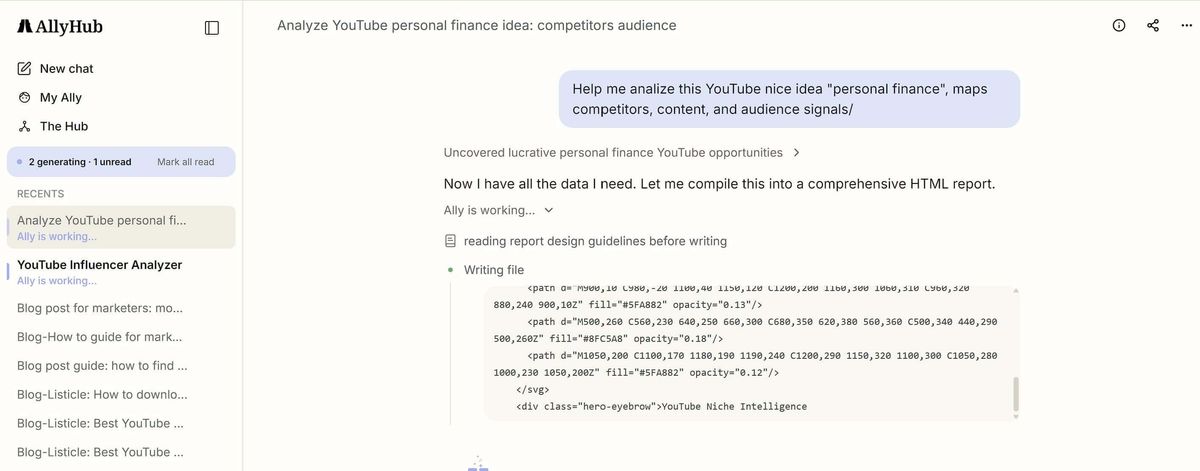
Step 3. It tracks changes over time (new topics, trends, gaps).
Step 4. You get updated insights without redoing the research.
Frequently Asked Questions
How do I find a YouTube niche idea if I'm starting from scratch?
Start with the YouTube search bar (Method 1) and Google Trends in YouTube Search mode (Method 3). These two free tools give you a demand-validated starting point without requiring any prior knowledge of the space. Enter broad topics related to your brand or audience, follow the autocomplete suggestions, and look for sub-topics with consistent search volume and manageable competition. From there, apply the Passion × Demand × Competition framework (Method 7) to score your top candidates.
How to find YouTube niche ideas that are low competition?
Use TubeBuddy's Keyword Explorer or vidIQ's keyword research features to filter for keywords with high search volume and low competition scores. In parallel, run competitor channel analysis (Method 2) and look for niches where the top-ranking channels have fewer than 50,000 subscribers — this signals that no dominant player has claimed the space yet. Rising queries in Google Trends are another reliable signal for emerging low-competition niches.
What YouTube niches have the highest CPM?
The highest-CPM YouTube niches consistently include personal finance and investing ($15–$50+ CPM), digital marketing and SaaS tools ($10–$30 CPM), legal and business content ($10–$25 CPM), real estate ($8–$20 CPM), and health and wellness sub-niches like mental health and medical information ($8–$15 CPM). CPM varies by audience geography — US, UK, and Australian audiences command significantly higher CPMs than global averages.
Should I choose an evergreen niche or a trending niche?
For long-term brand channel investment, evergreen niches are lower risk — they generate consistent traffic without requiring constant trend-chasing. For influencer campaigns with a defined campaign window, trending niches can deliver faster reach and higher engagement. The optimal strategy is an evergreen niche with trending sub-topics: a stable content foundation that allows for timely content spikes around emerging trends within the niche.
How many videos does a niche need to support?
A viable YouTube niche should support at least 100 distinct video topics without significant repetition. Use the "100 video test": brainstorm 100 video titles in your niche candidate. If you run out of ideas before 50, the niche is too narrow. If you easily reach 100+, the niche has enough depth for a sustainable channel. This test also reveals whether a creator partner has the content depth to maintain quality over a long-term partnership.
Can I use AI tools to find YouTube niche ideas faster?
Yes — and for marketing teams managing multiple campaigns or channels, AI tools are increasingly essential. Tools like vidIQ use AI to surface daily niche ideas and trending topics. AI agent platforms like AllyHub can automate deeper research tasks: extracting and analyzing comment data across hundreds of videos, tracking competitor channel activity, and generating structured niche intelligence reports.
How do I know if a YouTube niche is too saturated?
A niche is likely too saturated if: (1) the top 10 search results are all from channels with 500,000+ subscribers, (2) the most recent top-performing videos are 2+ years old (meaning new content isn't breaking through), and (3) keyword competition scores in vidIQ or TubeBuddy are consistently above 70/100. Saturation isn't always a dealbreaker — if you have a clear differentiation angle (unique format, underserved audience segment, or superior production quality), you can still compete.
What's Next
Finding the right YouTube niche is the foundation — but it's only the beginning. Once you've validated a niche, the next steps are to build a content calendar, identify creator partners whose audiences match your target segment, and set up a system to track niche trends over time so you're never caught flat-footed by a competitor's move.
The marketers who win on YouTube aren't the ones who found the best niche once. They're the ones who built a repeatable research process that keeps their intelligence current.
If you're managing YouTube strategy at scale — multiple channels, multiple creator partnerships, or ongoing competitive monitoring — AllyHub can automate the research layer so your team focuses on strategy, not spreadsheets.