Choosing a YouTube niche isn’t about what’s popular — it’s about what actually makes money. Some niches earn 5–10x more per 1,000 views. Pick wrong, and monetization is hard. Pick right, and even a small channel can outperform larger ones.
Most guides miss this: high CPM doesn’t equal high income, and ads are rarely the main revenue source. The most profitable niches combine strong buyer intent, multiple monetization paths, and high advertiser demand.
This guide shows the most profitable niches, which ones are beginner-friendly in 2026, and how to choose one you can sustain and monetize.
Key Takeaways
- Highest-CPM niches: Personal finance, B2B software, legal services, and digital marketing consistently deliver CPMs of $15–$65 — 5–10x higher than entertainment or gaming.
- CPM ≠ your earnings: Creators receive RPM (Revenue Per Mille), which is roughly 45–55% of CPM after YouTube's cut — factor this into any revenue projection.
- Ad revenue is rarely the biggest income stream: Sponsorships, affiliate marketing, and digital products often outpace AdSense for established channels in high-value niches.
- Most profitable YouTube niches for beginners: AI & automation, digital marketing, and personal finance offer the best combination of high CPM, growing search demand, and lower competition than legacy niches.
- Geography multiplies earnings: Audiences from the US, UK, Canada, and Australia generate 5–15x higher CPMs than developing-market audiences — niche selection and audience targeting work together.
What Actually Makes a YouTube Niche Profitable?
Before diving into the list, it's worth understanding the mechanics. "Profitable niche" is often used loosely — but for marketers, it needs a precise definition.
A YouTube niche is profitable when it delivers high RPM (Revenue Per Mille — what you actually earn per 1,000 views), strong sponsorship rates, and multiple monetization layers beyond AdSense.
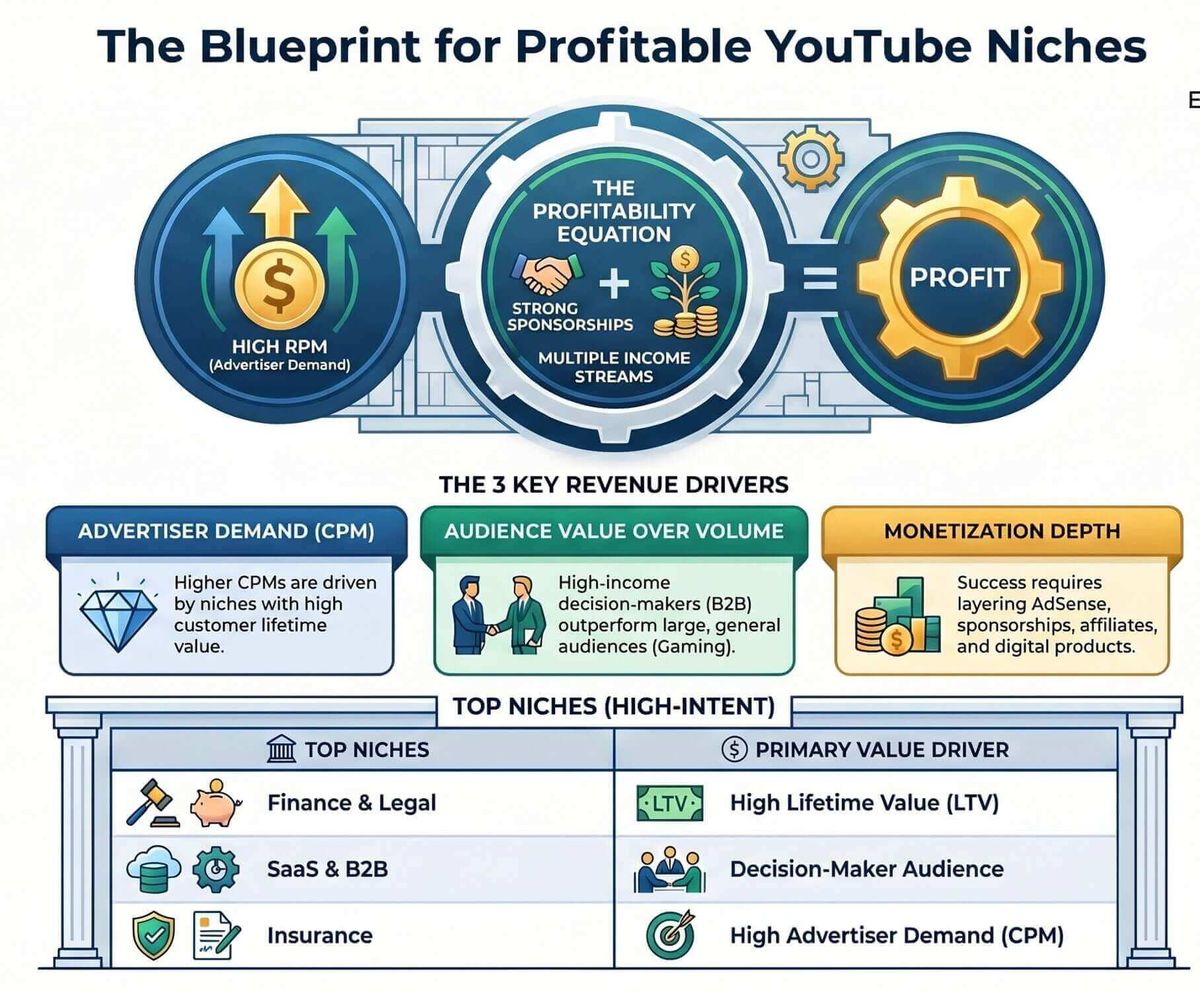
Three factors drive this:
- Advertiser demand (CPM): High-CPM niches (finance, SaaS, legal) attract advertisers willing to pay more because each customer is highly valuable.
- Audience value: Viewing count is not the target. Viewers with buying power or decision authority lead to higher sponsorship deals, often more important than audience size.
- Monetization depth: The best niches don’t rely on ads alone. They support sponsorships, affiliates, products, and services — increasing total revenue potential.
📌 Note: CPM figures in this article represent advertiser-side rates. Your actual RPM will be approximately 45–55% of CPM after YouTube's revenue share and accounting for ad blockers and non-monetized views.
Most Profitable YouTube Niches: CPM Comparison Table
Niche | CPM Range | Sponsorship Potential | Affiliate Potential | Competition Level | Best For |
Personal Finance & Investing | $15–$65 | ⭐⭐⭐⭐⭐ |
The 7 Most Profitable YouTube Niches
Niche 1: Personal Finance & Investing
CPM range: $15–$65 | Monetization ceiling: Very High
Personal finance is the undisputed king of YouTube CPM. Advertisers in financial services — credit cards, investment platforms, insurance, tax software — pay premium rates because their customer lifetime value is enormous. A single converted viewer for a wealth management firm can be worth $10,000+ in fees.
Why it's profitable for marketers:
- Affiliate programs in this space pay some of the highest commissions online (credit card referrals, brokerage sign-ups, tax software)
- Sponsorship rates are 3–5x higher than lifestyle niches at equivalent subscriber counts
- Evergreen content (budgeting basics, investing 101) compounds in views over years
Sub-niches with strong CPM:
- Retirement planning and 401(k) optimization
- Real estate investing for beginners
- Crypto and DeFi (volatile but high CPM when markets are active)
- Tax strategies and deductions
- Side hustles and passive income
Best for: Marketers with a finance background, financial advisors building a personal brand, or affiliate marketers targeting high-commission financial products.
💡 Pro tip: The "personal finance for [specific demographic]" angle (Gen Z, freelancers, small business owners) cuts through competition while maintaining high CPM — advertisers still pay premium rates for targeted financial audiences.
Niche 2: B2B Software & SaaS
CPM range: $15–$45 | Monetization ceiling: Very High
B2B software tutorials are a marketer's dream niche. The audience is professionals with purchasing authority. The advertisers are software companies with massive acquisition budgets. And the content — tool comparisons, workflow tutorials, integration guides — is inherently useful and evergreen.
Why it's profitable for marketers:
- SaaS affiliate programs pay recurring commissions (often 20–30% of monthly subscription)
- Sponsorship rates are among the highest on YouTube — software companies pay $30–$50+ per 1,000 views for dedicated integrations
- Content naturally positions you as an expert, opening consulting and agency revenue streams
Sub-niches with strong CPM:
- CRM software tutorials (HubSpot, Salesforce, Pipedrive)
- Project management tools (Notion, Asana, Monday)
- Marketing automation platforms
- AI tools for business (the fastest-growing sub-niche in 2026)
- Cloud infrastructure and DevOps (higher technical barrier, but CPMs reach $25–$45)
Best for: Digital marketers, marketing ops professionals, or agency owners who already use these tools daily and can create genuinely expert content.
Niche 3: AI & Automation
CPM range: $12–$35 | Monetization ceiling: High (and growing)
AI and automation content is the fastest-growing high-CPM niche on YouTube right now. Search demand is surging, competition is still relatively low compared to legacy niches, and the audience — professionals trying to automate their workflows — has strong purchasing intent.
Why it's profitable for marketers:
- AI tool companies are aggressively spending on creator partnerships and affiliate programs
- The audience skews toward tech-forward professionals and business owners — high sponsorship value
- Content has a natural "show don't tell" format that performs well on YouTube
Sub-niches with strong CPM:
- AI tools for marketers (content generation, SEO automation, ad creative)
- No-code automation (Zapier, Make, n8n workflows)
- AI agents and autonomous workflows
- Prompt engineering and AI productivity
- AI for e-commerce (product descriptions, customer service automation)
Best for: Digital marketers and e-commerce marketers who are already using AI tools in their workflow — your real-world experience is the differentiator in a niche full of surface-level content.
💡 Pro tip: "AI tools for [specific job role]" videos (e.g., "AI tools for e-commerce marketers") outperform generic AI content because they match high-intent search queries and attract sponsorships from tools targeting that specific audience.
Niche 4: Digital Marketing & Make Money Online
CPM range: $12–$40 | Monetization ceiling: High
Digital marketing content sits at the intersection of high advertiser demand and a highly monetizable audience. Viewers are actively trying to grow businesses or build income streams — they're buyers, not just browsers.
Why it's profitable for marketers:
- You're already the expert — content creation is an extension of your existing knowledge
- Affiliate programs for marketing tools (SEO software, email platforms, ad tools) pay strong commissions
- The "make money online" adjacent content unlocks course and coaching revenue at scale
Sub-niches with strong CPM:
- SEO tutorials and keyword research
- Paid advertising (Google Ads, Meta Ads, TikTok Ads)
- Email marketing and list building
- Influencer marketing strategy
- E-commerce marketing (Shopify, Amazon, DTC brands)
Best for: Marketing professionals who want to build a personal brand while monetizing their expertise through courses, consulting, and affiliate income.
Niche 5: Legal Services & Law
CPM range: $10–$45 | Monetization ceiling: High
Legal content has one of the highest CPMs on YouTube because law firms pay substantial fees per lead — a single client can be worth tens of thousands of dollars. The content doesn't require you to be a lawyer (though it helps), but it does require careful framing around "educational, not legal advice."
Why it's profitable for marketers:
- Extremely high CPM driven by law firm advertising budgets
- Low creator competition relative to CPM potential
- Strong affiliate opportunities in legal tech (contract software, LLC formation services)
Sub-niches with strong CPM:
- Business law for entrepreneurs (contracts, LLCs, IP)
- Immigration law explainers
- Real estate law and landlord/tenant rights
- Employment law and workplace rights
- Legal tech and document automation
Best for: Marketers working with legal clients, or those with a legal background looking to build a content-driven lead generation channel.
Niche 6: Health, Fitness & Wellness
CPM range: $10–$30 | Monetization ceiling: Medium-High
Health and fitness is a massive, evergreen niche with strong CPM and exceptional affiliate and product monetization potential. The challenge is competition — it's one of the most crowded niches on YouTube. The solution is specificity.
Why it's profitable for marketers:
- Supplement and fitness product affiliate programs pay strong commissions
- Brand sponsorships are abundant — fitness brands, nutrition companies, and wellness apps actively seek creator partnerships
- Content scales well: workout videos, nutrition guides, and product reviews all perform
Sub-niches with lower competition and strong CPM:
- Fitness for specific demographics (over 40, postpartum, desk workers)
- Longevity and biohacking (high-income audience, premium CPM)
- Mental health and stress management for professionals
- Nutrition for performance (athletes, executives)
Best for: Marketers with a health or wellness background, or those representing health brands looking to build organic reach.
Niche 7: Tech Reviews & IT Education
CPM range: $10–$30 | Monetization ceiling: Medium-High
Tech reviews and IT education attract a tech-savvy, high-income audience that advertisers pay premium rates to reach. The niche is broad enough to sustain years of content but specific enough to build genuine authority.
Why it's profitable for marketers:
- Tech affiliate programs (Amazon Associates for hardware, software affiliate programs) generate consistent passive income
- Sponsorship rates are strong — tech brands actively seek YouTube placements
- Tutorial content (Excel, Notion, coding basics) is highly evergreen and compounds in search traffic
Sub-niches with strong CPM:
- Cybersecurity and privacy tools
- Productivity software tutorials
- Home lab and self-hosting
- Tech for small business owners
- Gadget comparisons and reviews
Best for: Marketers with a tech background, IT professionals building a personal brand, or agencies serving tech clients.
How to Pick the Most Profitable YouTube Niche for Beginners
Knowing which niches pay the most is only half the equation. The other half is picking the right one for you — because a high-CPM niche you can't sustain content in is worth nothing.
Here's a 5-step framework for choosing the most profitable YouTube niche as a beginner:
Step 1: Map Your Existing Expertise
- List every professional skill, tool, or domain you have genuine expertise in.
- Cross-reference that list against the high-CPM niches above.
- Identify the overlap — that's your starting point.
The best YouTube channels are built on real expertise, not researched expertise. Viewers can tell the difference, and so can the algorithm (watch time and engagement are higher when the creator actually knows what they're talking about).
Step 2: Validate Search Demand
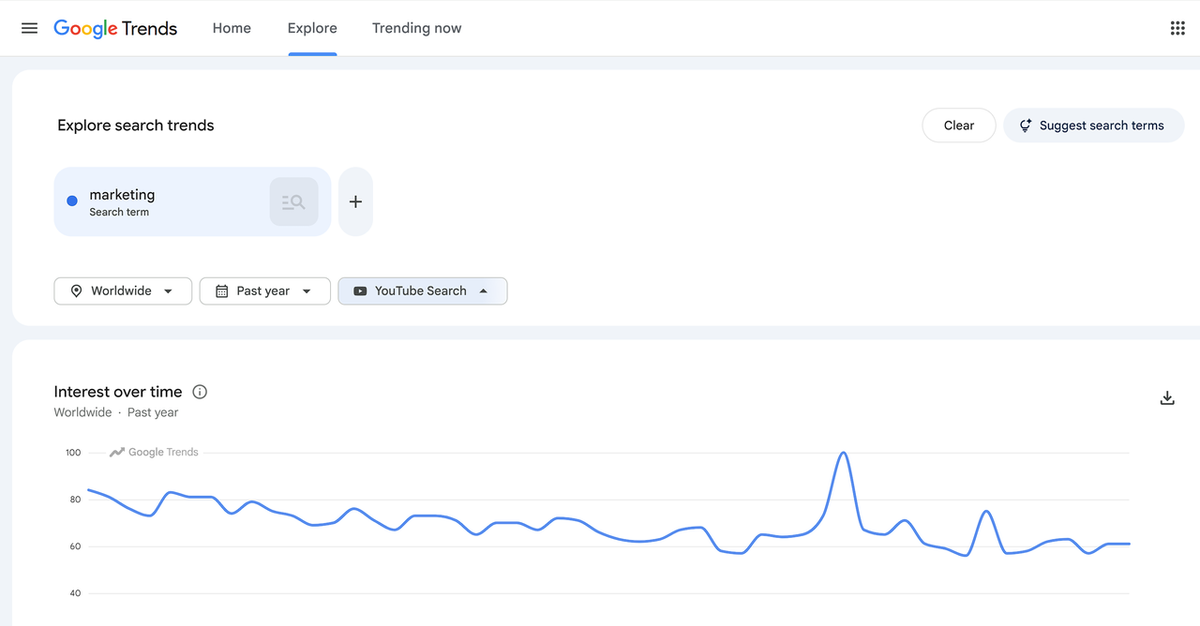
- Open Google Trends and search your niche topic.
- Check the 5-year trend — is it growing, stable, or declining?
- Use YouTube's search bar autocomplete to see what specific questions people are asking within your niche.
- Look for consistent search volume, not just viral spikes.
⚠️ Warning: Trending niches (e.g., a specific AI tool that's hot right now) can generate fast early growth but may plateau quickly. Balance trend-based content with evergreen topics that will drive search traffic for years.
Step 3: Niche Down to a Specific Sub-Niche
Broad niches are hard to break into. Specific sub-niches are not.
Instead of "personal finance," try "personal finance for freelancers." Instead of "digital marketing," try "Google Ads for e-commerce brands." The more specific your niche, the easier it is to rank, the more targeted your audience, and — counterintuitively — the higher your CPM, because advertisers pay more to reach precisely defined audiences.
Best for: Beginners who want faster growth and clearer positioning.
Step 4: Assess the Monetization Stack
Before committing to a niche, map out every revenue stream available:
- AdSense CPM — use the ranges in this article as a baseline
- Affiliate programs — search "[niche] affiliate program" to see what's available and what commissions look like
- Sponsorship potential — look at channels in your niche with 10k–100k subscribers and check if they have sponsors
- Digital products — could you sell a course, template, or guide to this audience?
- Services — could this channel generate consulting or agency leads?
The most profitable YouTube niches for beginners are those with at least 3 viable monetization streams from day one.
Step 5: Test Before You Commit
- Brainstorm 30 video ideas in your chosen niche — if you struggle to reach 30, the niche may be too narrow, or you may not have enough expertise.
- Publish 5–10 videos before concluding performance.
- Track watch time and click-through rate (CTR) — these are the leading indicators of channel health, not subscriber count.
💡 Pro tip: Use YouTube Studio's Search Analytics to see which keywords are driving impressions to your early videos. This tells you what the algorithm thinks your channel is about — and where to double down.
How Marketers Actually Monetize High-CPM Niches
For marketers, AdSense is rarely the primary revenue driver — and it shouldn't be. Here's how the most profitable YouTube channels in high-CPM niches actually make money:
Brand Sponsorships
In finance, B2B software, and digital marketing niches, sponsorship rates range from $20–$50 per 1,000 views for dedicated integrations. A channel with 50,000 views per video can earn $1,000–$2,500 per sponsored video — often more than AdSense generates in a month.
Affiliate Marketing
High-CPM niches have correspondingly high-commission affiliate programs. Financial products, SaaS tools, and legal tech platforms pay $50–$500+ per conversion. A single well-placed affiliate link in a high-ranking video can generate passive income for years.
Digital Products and Courses
Channels in digital marketing, finance, and AI niches naturally position the creator as an expert. That authority converts into course sales, templates, and digital downloads — often at 80–90% margins.
Lead Generation for Services
For marketers running agencies or consulting practices, a YouTube channel in a relevant niche is one of the highest-ROI lead generation channels available. A single video that ranks for a high-intent keyword can generate qualified leads indefinitely.
How Smart Marketers Research and Execute at Scale
Choosing a niche is the easy part. The real challenge is execution — consistently finding winning topics, understanding competitors, and knowing what your audience cares about.
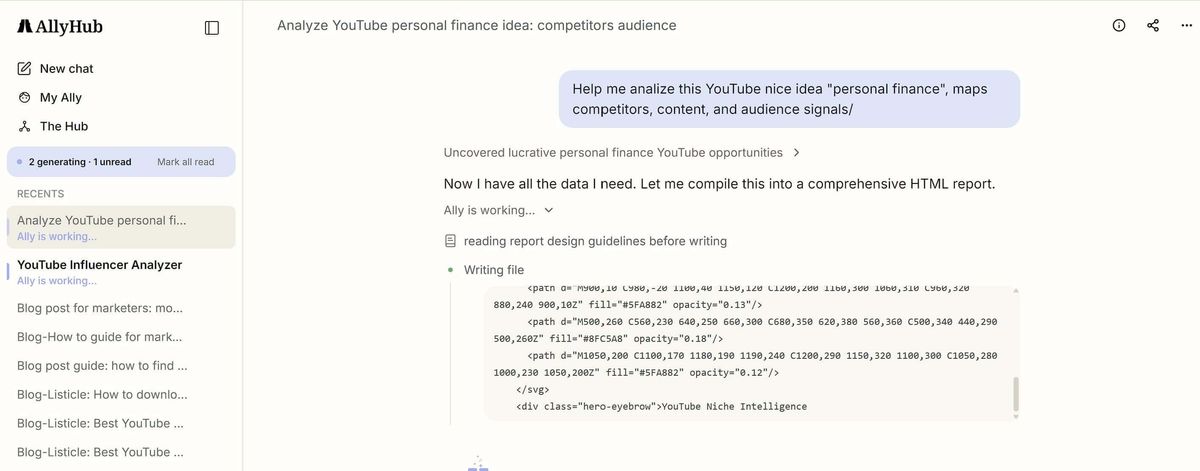
Most of this work is manual and time-consuming — reviewing competitor channels, identifying high-performing videos, reading comments for insights, and tracking keywords and trends.
AI tools can speed this up, but they don’t fully automate strategy. Tools like AllyHub help streamline parts of the process by:
- Aggregating competitor video playlists, views, topics, engagement, and more.
- Summarizing comment patterns and common audience questions
- Assisting with topic ideation based on existing content signals
- Turning research into structured outlines or drafts
Instead of replacing research, the value is reducing repetitive work and organizing insights faster.
👉 For marketers managing multiple channels, this can significantly improve efficiency — but results still depend on how well you interpret and apply the data.
Frequently Asked Questions
What is the most profitable YouTube niche in 2026?
Personal finance and investing consistently hold the top position for CPM, with rates ranging from $15 to $65 depending on the specific sub-niche and audience geography. B2B software and SaaS are a close second, particularly for creators targeting business decision-makers. For beginners, AI and automation offer the best combination of high CPM, growing demand, and relatively lower competition.
What is the difference between CPM and RPM on YouTube?
CPM (Cost Per Mille) is what advertisers pay per 1,000 ad impressions. RPM (Revenue Per Mille) is what you actually receive per 1,000 video views — after YouTube takes its 45% revenue share and accounting for non-monetized views and ad blockers. Your RPM is typically 45–55% of the CPM for your niche. Always use RPM, not CPM, when projecting your actual earnings.
How much can a beginner YouTuber earn per 1,000 views?
It depends heavily on niche and audience geography. In high-CPM niches (personal finance, B2B software), beginners can expect $8–$25 RPM once monetized. In lower-CPM niches (gaming, entertainment), RPM typically falls between $1–$5. Geography matters significantly — US, UK, Canadian, and Australian audiences generate 5–15x higher RPM than developing-market audiences.
What are the minimum requirements to monetize a YouTube channel?
To access full ad revenue sharing through the YouTube Partner Program (YPP), you need 1,000 subscribers and either 4,000 valid public watch hours in the past 12 months or 10 million public YouTube Shorts views in 90 days. An earlier entry point at 500 subscribers (with 3,000 watch hours or 3 million Shorts views) unlocks fan funding features like Super Thanks and channel memberships.
Are YouTube Shorts a good way for beginners to earn money in profitable niches?
Shorts are excellent for channel discovery and subscriber growth, but their RPM is significantly lower than long-form content — approximately 95% lower according to vidIQ's monetization research. The best strategy for profitable niches is to use Shorts for audience building and long-form videos (8–20 minutes) for monetization. Long-form content in high-CPM niches is where the real earnings happen.
Does my audience's country affect my YouTube earnings?
Yes, significantly. Audiences from the US, UK, Canada, and Australia generate 5–15x higher CPMs than audiences in developing markets. This is because advertisers in these countries pay more to reach their local consumers. If you're targeting a global audience, consider creating content that specifically appeals to English-speaking, high-income-country viewers — or explicitly targeting those markets in your YouTube settings.
Can I make money on YouTube without relying on ads?
Absolutely — and for most successful channels in profitable niches, AdSense is not the primary income source. Brand sponsorships, affiliate marketing, digital product sales, and consulting/service leads often generate more revenue than AdSense, especially in B2B software, digital marketing, and personal finance niches. Building multiple monetization streams from the start is the most resilient approach.
How do I research which YouTube niche is right for me without spending weeks on manual analysis?
The traditional approach — manually browsing competitor channels, reading comments, tracking video performance — is time-consuming and hard to scale. AI-powered tools like AllyHub can automate competitor channel analysis, comment sentiment extraction, and keyword research, compressing weeks of manual research into hours. This is particularly valuable for marketers managing multiple channels or advising clients on YouTube strategy.
What's Next: Turning Niche Selection Into Channel Strategy
Choosing the right niche is just the start. High-revenue channels tend to:
- Stay consistent — regular uploads win with the algorithm
- Go narrow — dominate a sub-niche instead of covering everything
- Prioritize research — spot gaps, unmet demand, and weak competition
- Diversify early — ads alone aren’t enough; add sponsors, affiliates, products
Most teams underinvest in research because it doesn’t scale manually. AllyHub help automate competitor analysis, comment mining, and content briefs — making your workflow faster and more effective over time.