You've narrowed your AI agent shortlist to two names — AllyHub and Manus — and you want to know which one fits your current workflow. Both AllyHub and Manus can operate a browser. The biggest difference is where the work happens: AllyHub focuses on turning repeated browser workflows into reusable Services that compound over time. Manus focuses on broader autonomous execution across cloud tasks, browser operation, mobile access, team workflows, and creative outputs.
This article compares AllyHub and Manus across 8 dimensions, including execution model, repeat-workflow reuse, pricing structure, background execution, security, team readiness, and real-world fit.
Key Takeaways
- Quick answer: AllyHub is stronger when your main goal is to turn recurring research, scraping, and content workflows into reusable assets. Manus is stronger when you want a broader AI agent platform that can run cloud tasks, support mobile access, and fit more naturally into team/enterprise workflows.
- Pricing: Both Manus and AllyHub use a credit-based subscription model, but economics diverge when workflows repeat. AllyHub is designed to compound through reusable Services; Manus is stronger when you need cloud-based async capacity and team-scale execution.
- Key difference: AllyHub is built around repeatable browser workflows and reusable Services. Manus is a hybrid agent platform: it can run cloud tasks in the background and can also operate your local browser through Manus Browser Operator.
- For knowledge workers: If you run the same workflow 5+ times, AllyHub's compounding "Service" model usually wins. If you fire 15 scraping jobs at 2 a.m. and want them done by morning, Manus wins.
- Bottom line: Neither dominates. They optimize for opposite things. Pick based on whether your work is recurring (AllyHub) or asynchronous + high-concurrency (Manus).
AllyHub vs Manus: Quick Verdict
AllyHub is better for knowledge workers who run the same research, scraping, or content workflow weekly, because its self-evolving "Service" cards make each subsequent run cheaper and faster.
Manus is easier to take through enterprise vendor review today because it publicly lists SOC 2 and ISO certifications, while AllyHub should be positioned more carefully for solo operators, consultants, and small teams until its enterprise roadmap is shipped.
For example: If you're an individual analyst or consultant running 1–3 recurring workflows, pick AllyHub. If you're an ops lead at a 50+ person org running >5 simultaneous jobs at odd hours, pick Manus.
What Is AllyHub?
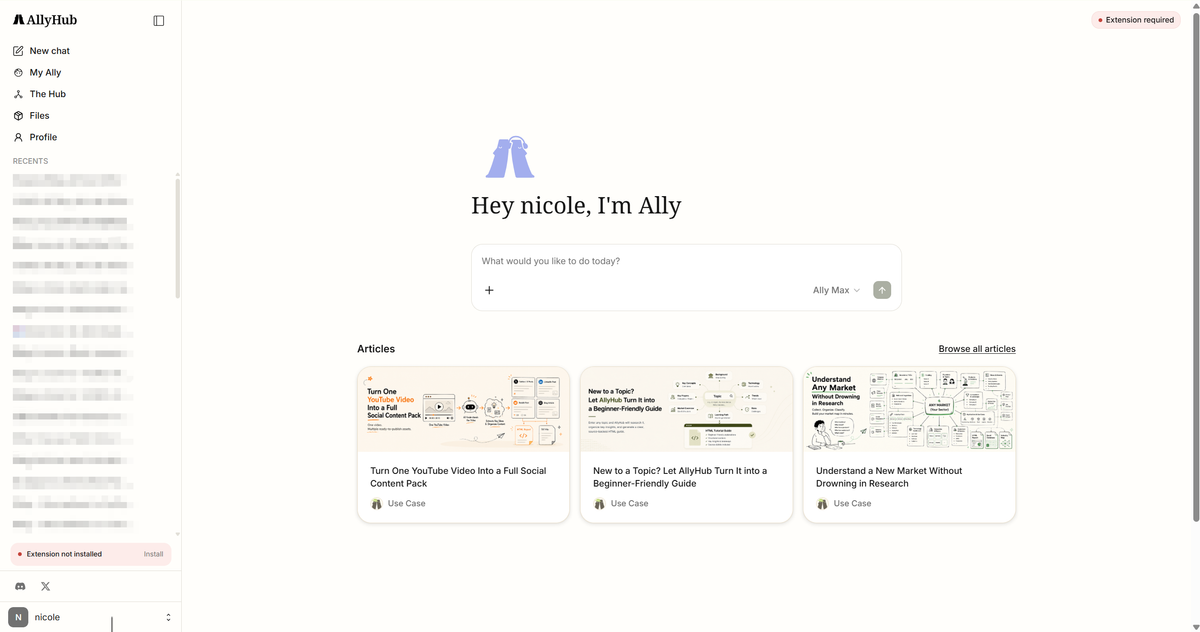
AllyHub is a browser-native AI copilot built for knowledge workers, founders, and professional teams. It ships as a Chrome extension and operates your real browser session — clicking, scrolling, filling, scraping, and drafting using your existing cookies and login state. Its core philosophy is ROTI (Return on Token Investment): every completed workflow can be saved as a one-click reusable Service that gets faster and cheaper on each subsequent run. The Hub is a public marketplace of 50+ pre-built Services that any user can install or publish.
What Is Manus?
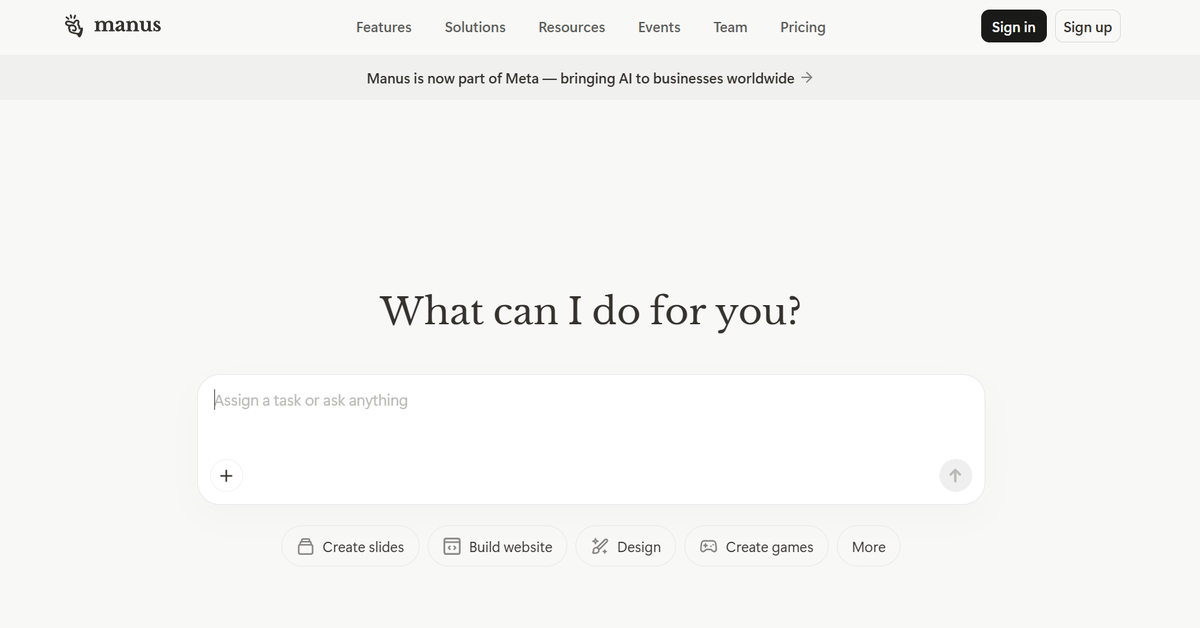
Manus is a cloud-native AI agent platform that executes tasks in a sandboxed Linux VM. You fire a task, the VM spins up, runs the workflow, and pushes a notification when it's done — even if you've closed the tab. With Manus Browser Operator, it can also connect to your desktop browser through an extension, use your local IP and active browser context, and operate pages you are already logged into.
Its enterprise-grade infrastructure is equipped with SSO, native iOS + Android apps, scheduled/recurring jobs, and SOC 2 T1+T2 plus ISO 27001:2022 certifications. It also ships a Web App Builder, a creative suite (slides/images/music), and Manus Collab for real-time multi-user sessions.
AllyHub vs Manus: Feature-by-Feature Breakdown
Feature | AllyHub | Manus | Winner |
Execution model | Browser-Native Workflow System | Hybrid Agent Platform | Tie — opposite strengths |
Starting paid price |
Where the Difference AllyHub vs. Manus Actually Matters
The table above tells you what — this section tells you why. These are the four dimensions where the architectural difference between AllyHub and Manus actually matters.
1. Execution Model
This is the most consequential difference, and it drives most of the trade-offs below.
Manus typically runs tasks in a cloud sandbox, but it also supports local browser operation through Manus Browser Operator. You fire a task, the VM spins up, runs the workflow, and pushes a notification when it's done — even if you've closed the tab. The upside is true asynchrony: long jobs run unattended. In cloud mode, Manus does not naturally inherit your everyday browser cookies, extensions, or logged-in tabs. But with Browser Operator, it can work inside your current browser session.
AllyHub is a Chrome extension that operates your own browser session. It clicks, scrolls, and fills using the cookies and login state you already have. That means it can reach behind logins (your CRM dashboard, your logged-in competitor pricing pages) without re-authenticating, and it inherits your real local IP — which is materially less likely to trigger anti-bot defenses on sites that are sensitive to datacenter IPs. The trade-off is that your browser has to stay online for the duration of the task.
Who wins where:
- Logged-in browser workflows → Both can support them
- Sites that require local IP or logged-in sessions → Both can work
2. ROTI: The Compounding Layer
This is where AllyHub genuinely differentiates, and it's the core of the ROTI thesis: completion is the baseline; intelligence is how the work improves while it's being done.
When AllyHub finishes a workflow, it can save the entire execution, as a Service — a one-click reusable asset. Subsequent runs of that Service reuse the page maps, login steps, and extraction patterns from prior runs. The Hub is a public marketplace of 50+ pre-built Services that any user can install or publish.
Who wins where:
- One-off novel tasks → Tie
- The same workflow run weekly/monthly → AllyHub, which improves effective cost-per-output over time, but the exact gain depends on the workflow
- Multi-agent orchestration inside one task → Manus, cloud VM supports more complex agent topologies
3. Security, Compliance & Team Readiness
This is AllyHub's weakest dimension in 2026, and we're calling it out plainly.
Capability | AllyHub | Manus |
SOC 2 | ❌ Not certified | ✅ T1 + T2 |
ISO 27001 / 27701 | ❌ | ✅ 2022 / 2019 |
If you're evaluating for an enterprise or regulated-industry buyer, Manus has a clearer security posture today because it publicly lists SOC 2 and ISO certifications. AllyHub's local-browser model has practical workflow advantages, such as using your existing browser session and local environment.
For solo operators and small teams, this matters less. For 50+ employee orgs or anyone handling PII/PHI, it's a deal-breaker until AllyHub ships its enterprise roadmap.
Who wins where:
- Solo / small team → Tie (security certifications rarely gate buying)
- Enterprise / regulated industry → Manus, the safer choice today because it has public compliance documentation.
- Logged-in browser context and local-session execution → AllyHub
4. Ecosystem & Creative Output
Capability | AllyHub | Manus |
Public API | ⏳ Roadmap | ✅ |
MCP support | ⏳ Roadmap | — |
AllyHub's marketplace (The Hub) is its ecosystem standout — a place to publish, share, and install reusable Services. Manus's ecosystem standout is its Web App Builder and creative suite (slide decks, images, music), which AllyHub does not match. For knowledge workers whose deliverable is research or analysis docs, AllyHub's research depth and Service reuse usually win; for teams whose deliverable is presentations or internal tools, Manus's creative stack wins.
AllyHub vs Manus: Pricing Compared
Both Manus and AllyHub use a credit-based subscription model. The more you pay, the more monthly credits you receive. Both also offer annual billing discounts and free access for users who want to try the product before subscribing.
The main difference is how their plans are structured. Manus is better suited to users who want a broader AI workspace for research, slide creation, website deployment, and scheduled tasks. It also offers higher concurrency and a dedicated team plan. AllyHub has a lower starting price and a simpler structure, with its main execution modes included across all paid tiers. Its pricing is more focused on browser automation and repeatable browser workflows.
Pricing factor | Manus | AllyHub |
Free access | Free plan available | Free access available |
Entry-level paid price | Starts at $20/month | Starts at $15.99/month with annual billing |
AllyHub vs Manus: Performance, Background Tasks & Mobile Access
Here’s how AllyHub and Manus compare when it comes to speed, background tasks, and mobile use.
Capability | AllyHub | Manus |
Cold-start speed | Fast—runs in your open browser | Slower—requires a cloud environment to start |
Repeat-run speed | Improves as reusable Skills and workflow assets accumulate | Generally consistent across runs |
Manus is stronger for users who want to launch tasks from a phone, let them run in the background, and receive a notification when they finish. AllyHub is better suited to browser-based workflows that depend on existing logins, local browser sessions, and repeated processes that can be turned into reusable assets.
When to Choose AllyHub
Choose AllyHub if you:
- Run the same research / scraping / content management / workflow weekly or monthly
- Need to operate behind logins (CRM dashboards, paid competitor tools, your logged-in account on a target site)
- Are a solo operator, consultant, or small team without enterprise procurement constraints
- Want repeated workflows to build on previous execution instead of starting from scratch
- Care more about effective cost-per-run over a 3-month horizon than about headline concurrency limits
- Are mostly scraping public sites with light anti-bot defenses (where your local IP is sufficient)
When to Choose Manus
Choose Manus if you:
- Prioritze cloud-based background execution, scheduled tasks, mobile access, and a procurement-friendly security posture
- Have a team that needs SSO, shared templates, and concurrent runs (>3 at once)
- Are selling into an enterprise that requires SOC 2 / ISO 27001 vendor certifications
- Need cloud-based execution for larger, unattended data collection workflows
- Want mobile push notifications and on-the-go task delegation
- Need scheduled / recurring jobs natively
- Build internal tools or deliverable decks where the creative suite matters
Frequently Asked Questions when Comparing AllyHub and Manus
Is AllyHub better than Manus?
For knowledge workers who repeat the same workflows weekly, AllyHub's self-evolution model usually produces lower effective cost per run. For one-off novel tasks, async background execution, and team/enterprise scenarios, Manus is a stronger pick. Both are suitable for different situations.
Which is better for repeated research workflows?
AllyHub is the better fit for repeated research workflows. If you do the same kind of market research, competitor tracking, content research, or data collection every week, AllyHub is more aligned with that use case because the workflow can build on what it has already learned instead of starting from zero every time.
Can AllyHub run tasks in the background?
Not in the same way Manus can. AllyHub is mainly browser-native, so tasks usually depend on your active browser session. That makes it strong for logged-in browser workflows and reusable Services, but it is not the best choice if you need fully cloud-based, fire-and-forget background execution.
Which is better for enterprise teams?
Manus is stronger for enterprise teams today. It has a broader team and compliance story, including public security certifications, cloud-based execution, scheduled tasks, and a more mature setup for larger organizations.