Best Amazon Price History Tracker: 5 Tools to Turn Price History Into Competitive Intelligence
Compare the 5 best Amazon price history trackers in 2026. See which tools marketers use to check pricing history on Amazon, monitor competitors, and automate pricing intelligence.
Sophie
Jun 26, 2026 · 11 min read
Copy link
You're launching a new product on Amazon. You've done your keyword research and sourced your wholesale supplier. But there's one question that keeps you up at night: What price should I set? How are competitors pricing similar products?
Set it too high, and your listing bleeds conversion rate. Set it too low, and you leave margin on the table — or worse, trigger a race to the bottom with competitors you didn't even know were watching.
That's where an Amazon price history tracker comes in. For shoppers, these tools are about saving a few bucks. But for marketers, they are a window into competitor behavior, market dynamics, and the pricing patterns that determine whether a product launch scales or stalls.
In this guide, I'll walk through the 5 best Amazon price history trackers in 2026 — analyzed entirely through the lens of a marketer whose job depends on getting pricing strategy right.
Key Takeaways
Keepa is the marketer's gold standard: With 10+ years of price history, sales rank data, and Buy Box tracking across 11 marketplaces, it's the most comprehensive tool for competitive pricing analysis.
CamelCamelCamel is the best free option: Zero-cost price history charts and email alerts — ideal for marketers who need basic competitor monitoring without a budget line item.
Honey Droplist covers multi-retailer pricing: If your competitive set spans beyond Amazon (Walmart, Target, Best Buy), Honey's cross-retailer tracking fills a gap the Amazon-only tools miss.
No single tracker does everything: Many advanced users combine multiple tools.
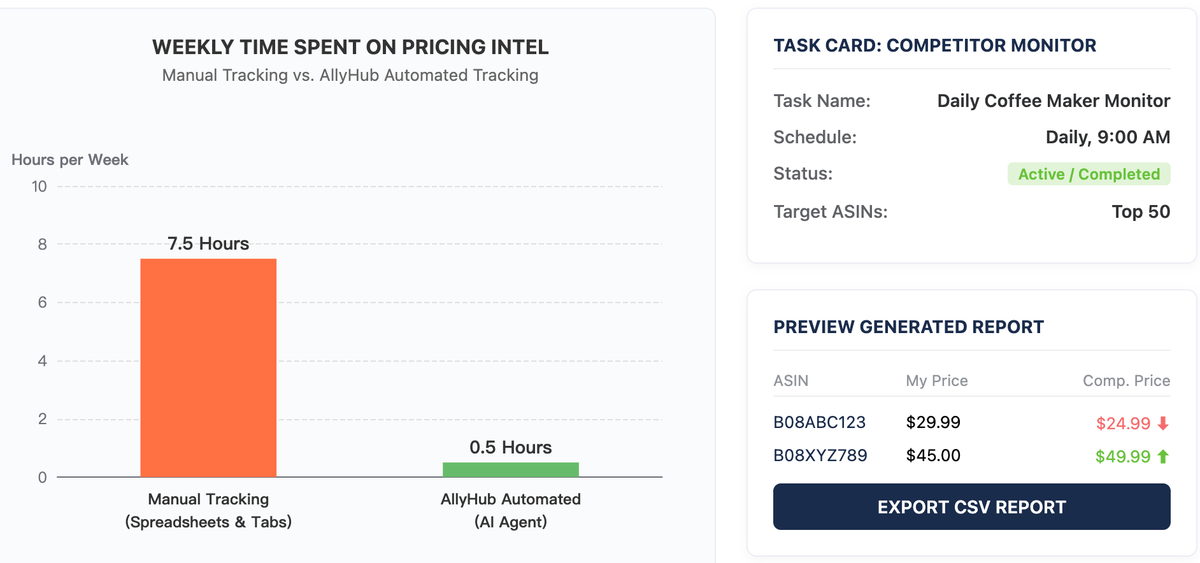
The automation agent: AllyHub takes the manual work out of price tracking. It runs daily competitor price and BSR monitoring, delivering finished CSV reports so you never have to check dashboards manually.
Why Marketers Need an Amazon Price History Tracker
When most people search for "best Amazon price history tracker," they're trying to avoid overpaying for a coffee maker. But if you're a marketer — whether you manage a brand's Amazon channel, run an agency, or operate your own ecommerce business — the stakes are orders of magnitude higher.
Related Insights
Want to know what your Amazon Sales Rank actually means for your business? Learn how BSR works in plain English, how to spot a good rank, and 5 practical ways to boost your sales speed.
VictoriaJun 29, 2026
Amazon Marketing
Confused by Amazon BSR? Learn what Amazon Sales Rank means, how the algorithm calculates it hourly, what counts as a good rank by category, and 5 proven strategies to climb the rankings.
VictoriaJun 29, 2026
Amazon Marketing
Ever clicked a 5-star item only to find reviews praising a bath towel? Discover the truth behind Amazon Review Hijacking, the 3 schemes sellers use, and how to spot manipulated listings.
VictoriaJun 29, 2026
Amazon Marketing
Here's what price history data actually unlocks for marketers:
1. Competitive Pricing Intelligence
Understanding where competitors set their prices — and how those prices shift over time — is the foundation of any pricing strategy. A price history tracker shows you whether a competitor runs predictable discount cycles, how they price during Prime Day vs. off-season, and whether they're gradually raising or lowering their baseline.
Example: A brand manager notices that three top competitors all drop prices by 12–18% during the first week of every month. That's not a coincidence — it's a pattern you can plan around.
2. MAP Compliance Monitoring
If you sell through resellers or distributors, minimum advertised price (MAP) violations can erode your brand value and channel relationships. A price history tracker with alerting lets you catch violations within hours rather than weeks.
3. Promotional Calendar Optimization
When you check pricing history on Amazon for a product category over 12–24 months, seasonal patterns emerge. You'll see exactly when competitors run their deepest promotions — data that directly informs your own promotional calendar and budget allocation.
4. New Product Launch Pricing
Launching a new product without historical pricing data is flying blind. Price history tools let you analyze the category's pricing landscape over time: what's the floor, what's the ceiling, and where does the sweet spot sit for your target positioning.
5. Buy Box Strategy
The Buy Box drives the vast majority of Amazon sales. Price history data — combined with sales rank tracking — reveals the relationship between pricing decisions and Buy Box ownership in your category.
How Amazon Price History Trackers Work
Amazon does not publish a clean, public pricing API. Therefore, trackers rely on a mix of data collection methods:
Method
How It Works
Data Freshness
Browser Extension
Records prices as users browse product pages
Near real-time, but limited to actively viewed products
Data aggregated from the tracker's active user base
Variable; dense for top sellers, sparse for niche items
Enterprise API
Dedicated infrastructure with structured JSON/CSV delivery
Real-time or strictly scheduled
Most consumer-grade trackers (Keepa, CamelCamelCamel) use a combination of server-side polling and extension data. Enterprise solutions (Bright Data, Apify, AllyHub) offer more structured, on-demand data collection.
The 5 Best Amazon Price History Trackers in 2026
1. Keepa — Best Overall for Marketers
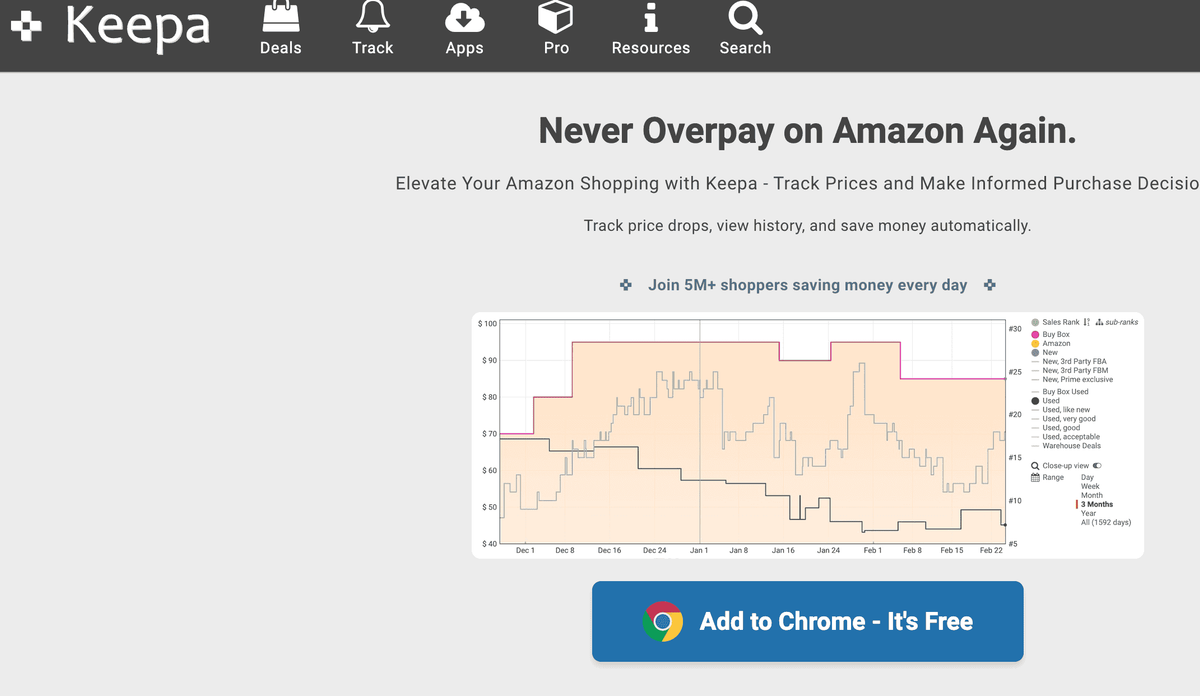
Keepa is the most comprehensive Amazon price tracker available. It tracks over 5 billion products across 11 Amazon marketplaces, with price history dating back to 2011 in many cases. For marketers, Keepa's value goes far beyond price charts.
Key features relevant to marketers:
Historical price charts for Amazon, third-party new, used, and warehouse deals — all on one graph
Sales rank (BSR) history — critical for estimating competitor sales velocity
Buy Box ownership history — see who's winning and losing the Buy Box over time
Comprehensive API access for custom integrations and bulk data exports.
Pricing: Free tier available with basic data; full features start at ~$20/month.
Best for: Marketers who need deep competitive analysis, product research, and data-driven pricing decisions. If you only use one price tracker, this is the one.
Pro tip: Use Keepa's "Product Viewer" to compare up to 10 ASINs side-by-side on a single chart. This is invaluable for competitive benchmarking across your category.
2. CamelCamelCamel — Best Free Option
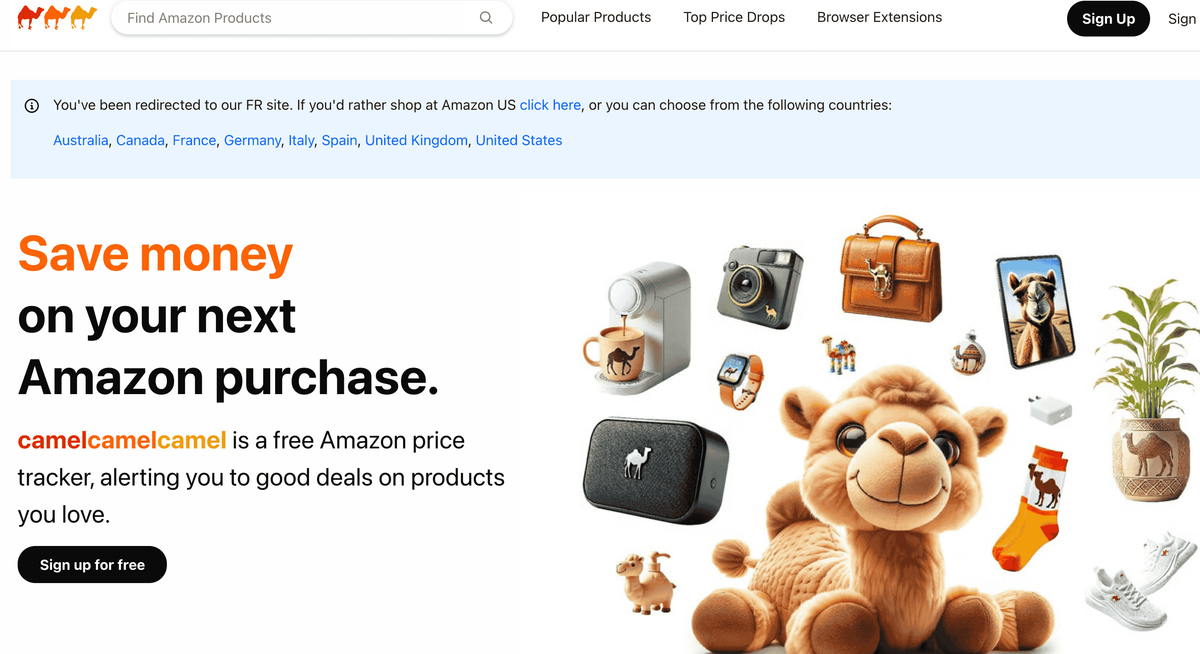
CamelCamelCamel (often called "CCC" or "The Camelizer" for its browser extension) is the most well-known free Amazon price tracker. It's been around since 2008 and has built a loyal following among both shoppers and marketers.
Key features:
Clean, simple price history charts for Amazon and third-party new/used prices
Customizable price drop alerts with percentage and dollar thresholds
A lightweight browser extension that embeds charts directly onto Amazon listings.
Pricing: Completely free.
Limitations for marketers: No sales rank data, no Buy Box tracking, no API, limited to a handful of Amazon marketplaces (US, UK, Canada, and a few European countries). The data updates less frequently than Keepa, and there's no mobile app.
Best for: Marketers who need basic competitor price monitoring without a budget, or as a supplementary tool alongside Keepa. It's also great for quick "check pricing history Amazon" lookups when you don't need deep analytics.
3. Honey Droplist — Best for Multi-Retailer Tracking
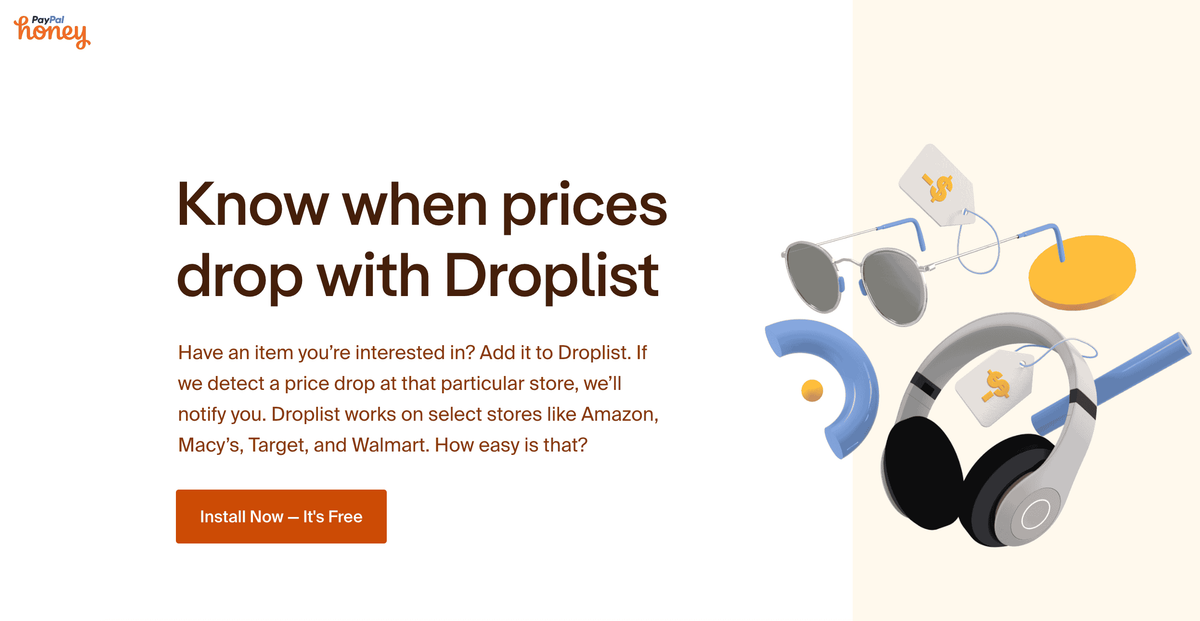
Honey (owned by PayPal) is best known for coupon-finding, but its Droplist feature is a solid price tracker that works across 30,000+ online retailers — not just Amazon.
Key features:
Price tracking across multiple retailers simultaneously (Amazon, Walmart, Target, Best Buy, and more)
Price drop alerts via email
Basic price history charts
Honey Gold cashback rewards on eligible purchases
Pricing: Free.
Limitations for marketers: Amazon-specific data is less detailed than Keepa or CCC. No sales rank, no Buy Box tracking, and the price history charts are basic. This is not a tool for deep Amazon competitive intelligence.
Best for: Marketers whose competitive landscape spans beyond Amazon — for example, a brand that sells on Amazon, Walmart.com, and its own DTC site and needs to monitor pricing across all channels.
4. Price History App — Clean Multi-Platform Tracker
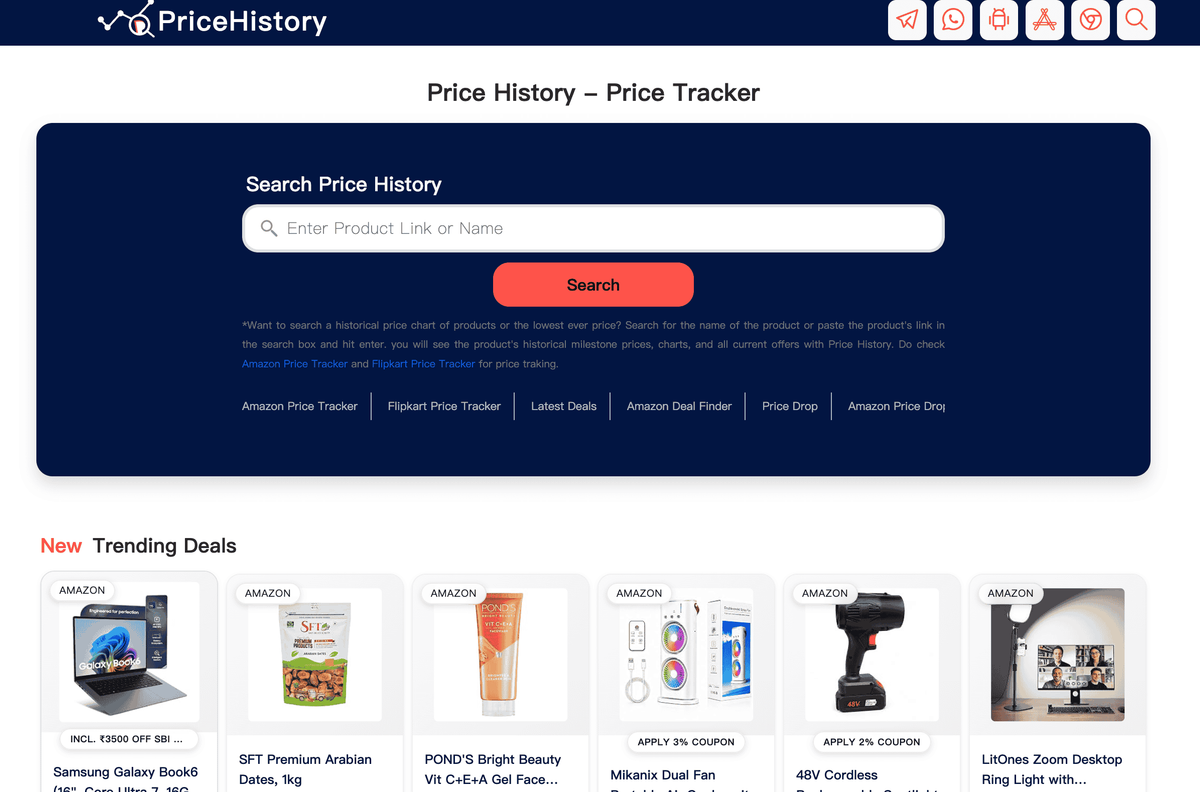
Price History (pricehistory.app) is a newer entrant that's gained traction for its clean interface and multi-platform coverage. It supports Amazon, Flipkart, and several other marketplaces.
Key features:
Clean, mobile-friendly price history charts
Price drop alerts
Supports multiple regional Amazon sites
Browser extension available
Pricing: Free with premium features available.
Limitations for marketers: Relatively shallow historical data compared to Keepa. No sales rank, Buy Box, or inventory tracking. Limited API capabilities.
Best for: Marketers who want a lightweight, easy-to-use tracker for quick price checks, especially those operating in markets beyond the US.
5. Bright Data / Enterprise Scraping Tools
For large-scale, programmatic price tracking, enterprise data platforms like Bright Data, Apify, and similar services offer Amazon price scraping via API. These are not "trackers" in the traditional sense — they're data infrastructure.
Key features:
Real-time or scheduled data collection at scale
Structured data delivery (JSON, CSV, database)
Coverage across all Amazon marketplaces
No rate limiting or blocking issues (enterprise-grade proxy networks)
Pricing: Usage-based, typically starting at hundreds of dollars per month.
Best for: Enterprise marketing teams, agencies managing dozens of brands, or businesses building proprietary pricing intelligence dashboards.
Comparison Table: Amazon Price History Trackers at a Glance
Tool
Price
Best For
Sales Rank
Buy Box Data
Multi-Marketplace
API Access
Keepa
Free / $20/mo
Deep competitive analysis
✅
✅
11 marketplaces
✅
CamelCamelCamel
Free
Basic price monitoring
❌
❌
Limited
❌
Honey Droplist
Free
Multi-retailer tracking
❌
❌
Amazon + 30K stores
❌
Price History App
Free / Premium
Quick cross-platform checks
❌
❌
Multiple regions
❌
Bright Data / Enterprise
$100s+/mo
Large-scale API data
Via configuration
Via configuration
All marketplaces
✅
How to Choose the Right Amazon Price Tracker for Your Marketing Stack
The right tool depends on what you're actually trying to accomplish. Here's a decision framework based on common marketer scenarios:
Your Scenario
Recommended Setup
Why
I manage 1–3 brands on Amazon and need competitive intel
Keepa (paid) + CamelCamelCamel (free backup)
Keepa covers deep analysis; CCC serves as a quick-check fallback
I run an agency with 10+ brand clients
Keepa API + AllyHub automated monitoring
Keepa API for ad-hoc deep dives; AllyHub for automated daily competitor reports across all clients
I sell on Amazon, Walmart, and my DTC site
Keepa + Honey Droplist
Keepa for Amazon depth; Honey for cross-retailer pricing visibility
I need to check pricing history on Amazon occasionally
CamelCamelCamel or Price History App
Free, simple, gets the job done without subscription overhead
I'm building a custom pricing intelligence dashboard
Bright Data / Enterprise API + Keepa API
Programmatic data collection with structured output for your internal tools
Note: Most experienced marketers run at least two tools in parallel. No single tracker captures everything perfectly — and having a second data source helps validate your findings.
How to Automate Competitive Price Tracking for Marketers
If you are looking for the best amazon price history tracker, tools like Keepa will show you past data, but they won't do the actual research for you. AllyHub will do.
Unlike traditional trackers that only visualize pricing history, AllyHub acts as a browser-native AI copilot. It can execute competitor monitoring workflows, collect pricing and BSR data, generate structured reports, and package recurring research into reusable workflows.
There is no complex setup. You simply select the competitor price monitor tool, input your product category and target competitors, and let the AI do the actual browsing and extraction.
What AllyHub delivers automatically:
Daily Price Comparison Tables: See exactly where you stand against the category.
Automated Price Change Alerts: Get notified the moment a competitor shifts strategy.
Ready-to-Use CSV Exports: Clean, structured data delivered directly to you.
The AI That Compounds:
Unlike standard automation tools that start from scratch every time, AllyHub builds on what it learns. Every completed task builds Skills and Memory. The second time you run your weekly price monitoring workflow, the AI executes it faster and smarter—maximizing your Return on Token Investment (ROTI).
Don't just track price history. Package your recurring competitive research into one-click workflow assets with AllyHub, and keep your time for the pricing decisions that truly matter.
FAQ
Is there a completely free Amazon price tracker that's good enough for marketers?
CamelCamelCamel is free and excellent for basic history checks and alerts. However, it lacks BSR and Buy Box data. For professional marketing decisions, upgrading to Keepa's paid tier is highly recommended.
How accurate are Amazon price history trackers?
Accuracy depends on polling frequency. Keepa updates high-volume products every 15–60 minutes. While flash sales lasting only a few minutes might be missed, macro-level pricing trends are highly accurate. Always cross-reference critical data.
Can I check pricing history on Amazon for products in other countries?
Yes. Keepa supports 11 international Amazon domains, making it the best choice for global brand managers. Always verify a tool's regional support before integrating it into your workflow.
What's the difference between a price tracker and a price intelligence tool?
A tracker visualizes historical data (what happened). An AI agent like AllyHub executes the ongoing monitoring for you (extracting data daily, formatting reports, and alerting you to shifts) without manual intervention.
How can I track competitor prices on Amazon without checking manually every day?
This is exactly where automation tools shine. Rather than manually opening each competitor's product page daily, use a tool like AllyHub's Competitor Price Monitor — it browses Amazon for you on a schedule, collects current prices and BSR data, and delivers a structured report. This is the difference between "having a price tracker" and "having a price tracking system."
Do Amazon price trackers violate Amazon's terms of service?
Most consumer-facing price trackers rely on publicly visible pricing data. Compliance considerations vary by collection method, scale, and jurisdiction.