Amazon apparel is one of the hardest categories for marketers because every conversion problem shows up at once: fit, returns, image trust, reviews, PPC costs, and private-label brands competition.
Return rates can be much higher in apparel than in many other ecommerce categories, especially when sizing, fabric expectations, or product imagery are unclear. Generic apparel keywords like “women’s summer dress” or “yoga pants” can become expensive quickly, especially during seasonal peaks.
That is why apparel is difficult to scale profitably on Amazon. This guide reviewed the 4 best Amazon clothing brands. You can learn why brands that do win are worth studying closely. They may build strong visibility, high review counts, and defensible positions inside competitive apparel niches. Let's dive in.
Why the Best Amazon Apparel Brands Worth Studying
Before we break down each brand, let's be honest about what apparel marketers are up against:
Challenge | What It Means for Marketers | What Winners Do Differently |
Return rates (20–30%) | Every return erases profit — shipping, restocking, potential damage | Obsess over sizing accuracy, use AI fit tools, build sizing into A+ Content |
Brutal PPC costs | Generic keywords like "summer dress" are auctioned to death |
The four brands below each solve a different part of this stack.
Quick Comparison of Best Amazon Clothing Brands
Brand | Category | Why marketers should study it |
CRZ Yoga | Activewear | Affordable alternative positioning and review trust |
PrettyGarden | Dresses | Color/variant depth and review consolidation |
How We Selected These Brands for Analysis
We chose brands that represent different winning strategies, not just the highest revenue. Each brand in this playbook demonstrates a distinct marketing approach that apparel sellers — and e-commerce marketers generally — can adapt:
- Positioning strategy (CRZ Yoga): Winning through "dupe" positioning and review trust
- Variant & listing strategy (PrettyGarden): Winning through color/variant depth and review volume
- Social-friendly product strategy (ANRABESS): Winning with matching sets that are easy to show in short-form video and influencer content.
- Data-driven private label strategy (Amazon Essentials): Winning through marketplace data, pricing power, and scale
Case Study 1: CRZ Yoga — The Power of Affordable Alternative Positioning
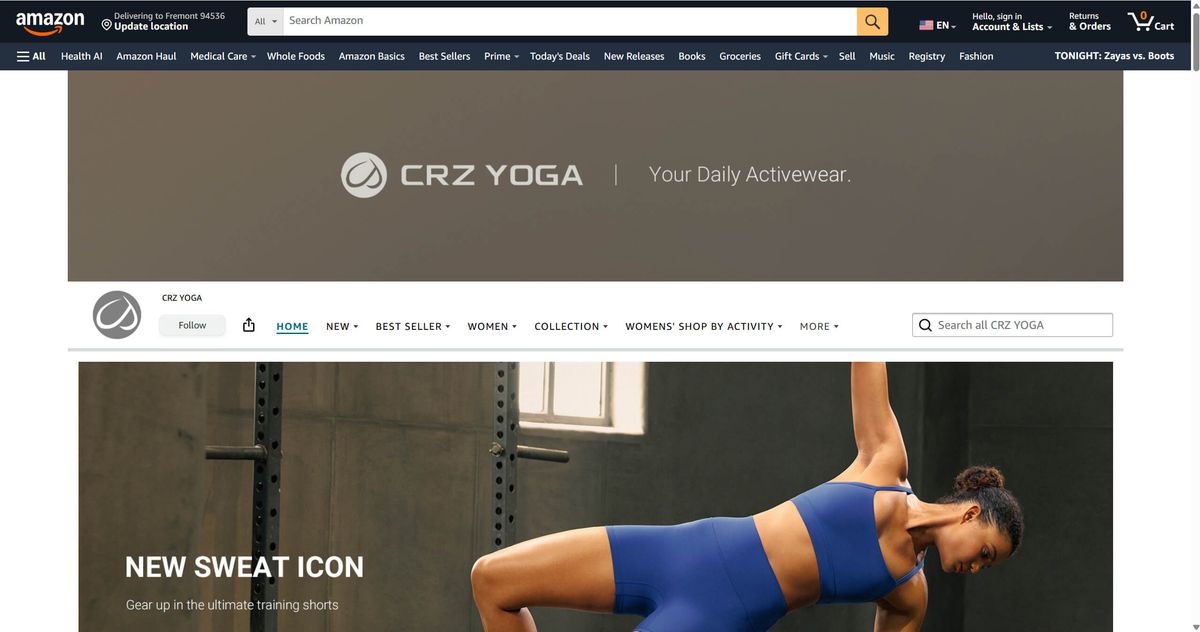
CRZ Yoga didn't try to invent a new activewear category. They did something smarter: they positioned themselves as the affordable version of a brand people already loved and trusted. Shoppers and reviewers often compare CRZ Yoga’s Butterluxe and Naked Feeling collections with premium activewear lines. The comparison matters because shoppers already understand the reference point: soft fabric, light compression, and everyday yoga-to-lounge use.
What Marketers Should Study
1. The "dupe" positioning is a conversion shortcut.
When a customer searches for "Lululemon alternative" or "Align dupe" on Amazon, CRZ Yoga benefits from that intent because shoppers already know what kind of product experience they are looking for. They don't need to explain what Butterluxe fabric feels like — customers already have a reference point. This dramatically shortens the consideration window.
Takeaway: If you can position your product against a known premium reference point, you borrow some of the shopper’s existing understanding of the premium category without spending a decade building it.
2. Amazon reviews play a major role in shopper trust.
CRZ Yoga is not Amazon-exclusive, but Amazon has become one of the most important discovery and review environments for the brand. Every Amazon sale creates the opportunity for platform-native reviews, photos, and Q&A to accumulate, and every review builds trust for the next shopper.
Takeaway: If you're building an Amazon-first apparel brand, every unit sold builds your review moat. Lean into it.
3. Coupons and limited-time deals drive initial velocity.
CRZ Yoga frequently uses visible Amazon deal mechanics such as coupons or limited-time discounts. A visible coupon can improve click-through and conversion, which may support early sales velocity and ranking signals.
Takeaway: A well-timed coupon during the early launch period is a ranking investment, not a margin sacrifice.
Case Study 2: PrettyGarden — The Color/Variant Strategy
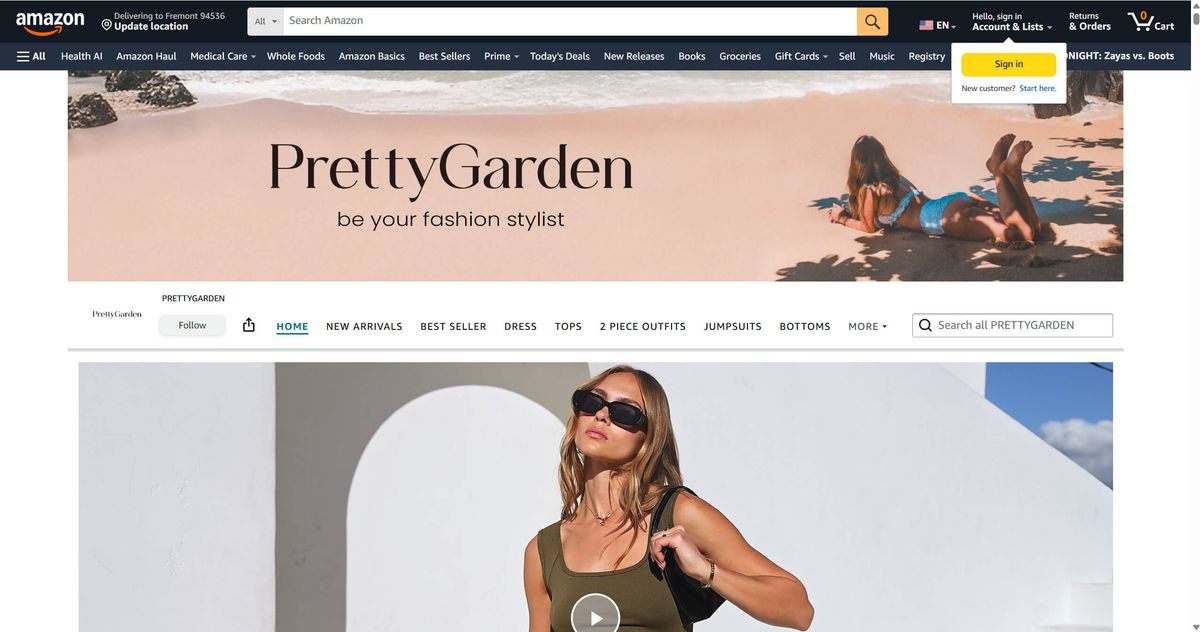
PrettyGarden often turns a single winning dress silhouette into a deep variant strategy, sometimes with dozens of colors or prints. Their mock neck satin dress alone has over 30 color variants, each with its own product image, each giving the listing more chances to match color-, occasion-, and style-specific shopper intent.
This is not an accident. It's a deliberate listing strategy that multiplies organic reach.
What Marketers Should Study
1. Color variants can expand long-tail relevance.
Every color variant on an Amazon listing creates a new discoverable path. "Green satin midi dress" and "floral mock neck dress" and "burgundy wedding guest dress" are all different searches — and PrettyGarden's 30-color strategy means one listing captures all of them.
Takeaway: In apparel, color diversity isn't just about customer preference — it's an organic search expansion strategy.
2. Review consolidation can strengthen social proof.
Amazon's algorithm weights review count, which is a visible trust signal for shoppers. A well-structured parent ASIN with legitimate variants and concentrated reviews can have a stronger conversion advantage than fragmented listings.
Takeaway: This is the "review consolidation" advantage: more variants → more sales → more reviews → higher ranking → even more sales.
3. The "frequently bought together" flywheel.
Once shoppers find PrettyGarden through a floral dress, Amazon's recommendation engine surfaces their other dresses. The brand's massive SKU count becomes a cross-sell machine — every purchase feeds the "Customers who bought this also bought" algorithm.
Takeaway: Product line depth isn't just about offering choice. On Amazon, it's a traffic retention mechanism.
Case Study 3: ANRABESS — Why Matching Sets Are Built for Social Commerce
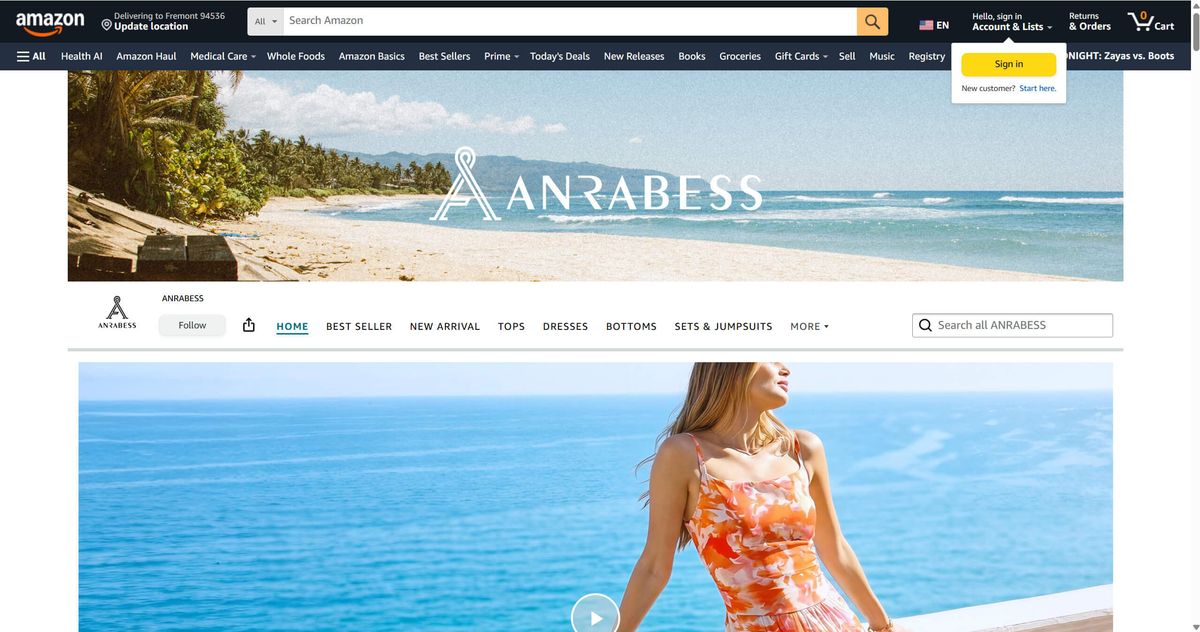
ANRABESS is especially strong in social-friendly apparel formats such as matching sets, lounge sets, and vacation-ready outfits. Knit co-ords with a sweater and skirt. Lounge sets in coordinated colors. Vacation two-pieces that photograph as a complete outfit. The product format is inherently social-media-friendly — one photo shows a complete look, one purchase delivers a complete outfit, and one try-on video can communicate the full outfit faster than a static product image.
What Marketers Should Study
1. The product format itself is the marketing.
A matching set is naturally easier to show in TikTok and Instagram content. Why? Because a complete outfit looks better in a 15-second video than a single garment. The viewer sees the "after" transformation immediately. The product format lowers the content burden: creators can show a complete outfit in one shot.
Takeaway: Design products with content creation in mind. Ask: "Would this look good in a 15-second haul video?" If the answer is no, rethink the product or rethink the content strategy.
2. External traffic feeds Amazon's organic algorithm.
When TikTok influencers link to ANRABESS sets and those links drive sales on Amazon, the algorithm notices. Strong off-Amazon traffic that converts can support sales velocity, which may improve the listing’s overall performance. This creates a virtuous cycle: TikTok drives sales → Amazon boosts organic rank → organic shoppers find the brand → sales increase further → more TikTok creators feature the brand.
Takeaway: Don't treat Amazon PPC and external traffic as separate channels. External traffic that converts to Amazon improves your organic ranking on Amazon. The two are linked.
3. Micro-influencers are often a better starting point.
For brands using an ANRABESS-style social-commerce playbook, micro-influencers are often a practical starting point. These creators have higher engagement rates than macro-influencers, cost less per collaboration, and generate content that feels like a friend's recommendation rather than a paid ad.
Takeaway: In many apparel campaigns, several authentic micro-influencer try-on posts can be more useful than one polished macro-influencer ad, especially when the goal is content volume and product education.
Case Study 4: Amazon Essentials — What Amazon's Own Data-Driven Machine Teaches
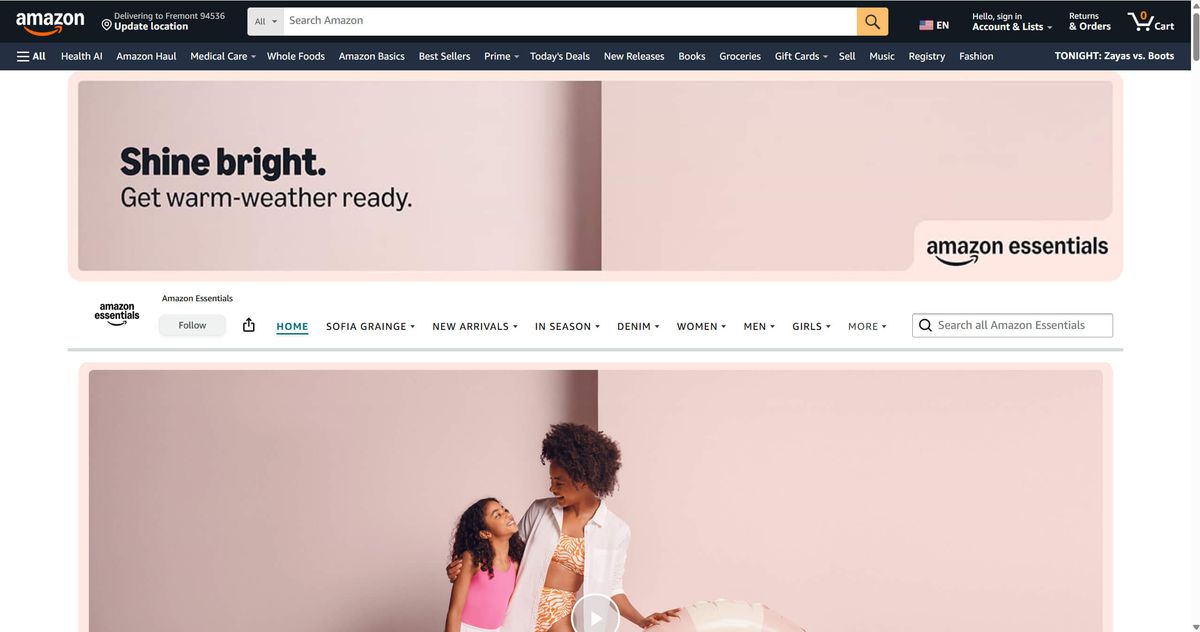
Amazon Essentials is Amazon's private label basics brand — t-shirts, leggings, underwear, casual dresses, puffer vests. It's built on a data advantage no third-party seller can match: Amazon operates with broader marketplace visibility than individual sellers, which can inform where private-label basics are likely to work.
What Marketers Should Study
1. Amazon Essentials doesn't compete on brand. It competes on placement and price.
Amazon Essentials can benefit from strong marketplace visibility, competitive pricing, Prime eligibility, and broad relevance in basic apparel searches. Combined with aggressive pricing (often priced aggressively against comparable basics.), Essentials captures the "I just need a basic X" shopper who doesn't care about brand name.
Takeaway: It is difficult to beat Amazon Essentials on generic basics where price, Prime delivery, and broad search relevance matter most.
2. Amazon Essentials reveals Amazon's own strategy — which reveals the gaps.
From a marketer’s perspective, Amazon Essentials tends to be most threatening in categories where the product is basic, price-sensitive, easy to compare, and weakly differentiated. It enters categories where:
- Search volume is high and growing
- Existing brands have weak differentiation (low brand loyalty)
- Manufacturing costs are low relative to retail price
- Return rates are manageable
This tells you exactly which categories to avoid competing on price.
Takeaway: Monitor Amazon Essentials category expansion. It's Amazon's own market research, can be treated as a useful competitive signal.
3. Multi-packs are an underrated pricing strategy.
Amazon Essentials uses multi-pack pricing aggressively — two-pack t-shirts, three-pack underwear, five-pack socks. This increases average order value, reduces per-unit fulfillment costs, and makes comparison shopping harder (is the competitor's $12 single tee better than Essentials' two-pack for $18? Harder to compare).
Takeaway: Multi-pack variants are a margin-protection strategy disguised as a customer-value feature. If your product works in multi-packs, test the format — it changes the comparison dynamic entirely.
The Apparel Marketer's Checklist
Here's a prioritized checklist drawn directly from these case studies. Each item is actionable.
Listing & Conversion Optimization
- Use comparison positioning carefully. Use shopper-recognized category cues instead of unsupported competitor claims.
- Add color variants strategically. Each new color on a parent ASIN is a free keyword opportunity. Prioritize colors with their own search volume. (PrettyGarden)
- Test multi-pack variants. If your product can be sold in multiples, test 2-pack and 3-pack options. It changes the price comparison dynamic and increases AOV. (Amazon Essentials)
- Invest in video and lifestyle imagery. In apparel, images do more selling than text. A strong apparel listing should ideally include video, lifestyle images of different body types, fabric close-ups, and clear size/fit visuals.
Traffic & External Acquisition
- Build a TikTok influencer program before you need it. Start with micro-influencers, track Amazon Attribution or storefront performance where possible, and scale based on content quality and conversion signals. (ANRABESS)
- Treat external traffic as an organic ranking lever. Social traffic that converts to Amazon can support sales velocity and may help listing performance. Your TikTok strategy is also your SEO strategy.
- If you run limited releases, make the inventory rules clear. Scarcity only works when customers trust it.
Review & Trust Building
- Get more reviews. Early reviews are one of the most important trust signals for new apparel ASINs.
- Analyze competitor 3-star reviews systematically. These reviews contain the most actionable product feedback — they liked the product enough to engage but found a specific flaw. That flaw is your product improvement roadmap.
How to Automate Apparel Competitor Research
Manually conduct the competitor research outlined above — analyzing review sentiment across thousands of reviews, monitoring pricing changes across competitor ASINs — takes hours of manual browser work.
AllyHub is an AI copilot built to automate your work. It can operates your browser directly — extract competitor review data, track pricing and listing changes over time, and turn the findings into structured competitive reports.
For Amazon apparel sellers and marketers specifically, AllyHub can:
- Extract and analyze competitor reviews at scale — collect and summarize review samples across competitor ASINs.
- Track pricing, variant, and listing changes across your competitive set over time — so your team can spot competitive changes earlier and decide whether they matter.
- Compile structured competitive intelligence reports — brand comparison tables, review sentiment summaries, pricing trend analysis — that your team can act on, not just read.
- Save repeat research workflows as one-click reusable assets. Your monthly competitive audit becomes easier to repeat because the workflow, prompts, sources, and report structure do not need to be rebuilt from scratch every time. That's AllyHub's compounding model — every research session makes the next one faster.
Try AllyHub for free: install the Chrome extension and run your first Amazon competitor research workflow immediately. No configuration, no setup.
Frequently Asked Questions
What makes an Amazon clothing brand successful from a marketing perspective?
Successful Amazon clothing brands typically master three things: (1) a clear positioning strategy, (2) a traffic strategy that doesn't depend entirely on Amazon PPC and (3) obsessive attention to sizing accuracy and return reduction.
How important is TikTok for Amazon clothing brands?
Increasingly important for many fashion brands, especially those with products that work well in try-on videos, hauls, and creator-led recommendations.
What is the best PPC strategy for Amazon apparel?
Apparel PPC requires a different approach than most categories. Generic keywords are often highly competitive. A practical strategy is to use automatic campaigns to discover long-tail, size-specific, color-specific, and occasion-specific terms, then move proven queries into manual campaigns.
How do I build an influencer program for an Amazon clothing brand?
Start with micro-influencers (10K–50K followers) rather than macro-influencers. Send product, ask for authentic try-on content with an Amazon storefront link, and track which creators drive the most attributable sales.