Going viral on Twitter (X) is not about having a huge following or finding one magic posting time. The real challenge is getting a post seen beyond your existing audience and giving people a reason to stop, read, reply, repost, or share it.
This guide breaks down 7 practical ways to increase your chances of going viral on Twitter, including how to write stronger hooks, use replies and trends, structure threads, study winning formats, and turn your analytics into better posts.
Key Takeaways
- Hook fast.
- Create conversation, not just impressions.
- Use trends as context, not a content strategy.
- Turn winning posts into repeatable formats.
- Optimize for consistency, not one-off virality.
What Actually Makes a Tweet Go Viral on X in 2026
You don't need a huge following to reach people beyond your audience. X recommends posts to users who don't follow the author, using signals such as engagement, user interests, content relevance, and relationships between users and posts. In practice, virality is less about how many followers you start with and more about whether a post earns attention and meaningful interaction from the right audience.
Two platform mechanics are also worth knowing in 2026:
- Premium can affect visibility: X says Premium subscribers receive prioritized replies, and its recommendation systems consider whether a reply comes from a Premium subscriber. Independent research has also reported higher reach for Premium accounts, although the size of that effect varies by dataset.
- External links can underperform: X's current public recommendation documentation does not state a blanket penalty for external links, but large-scale third-party data shows that posts containing links tend to generate less engagement than native posts. If driving traffic is the goal, test putting the link in a reply and compare the results with your own account data.
How to Go Viral on Twitter (X): 7 Strategies
These strategies focus on the factors you can control: earning attention, encouraging meaningful engagement, joining relevant conversations, and learning from what already works. Use them together as a repeatable process rather than relying on a single viral trick.
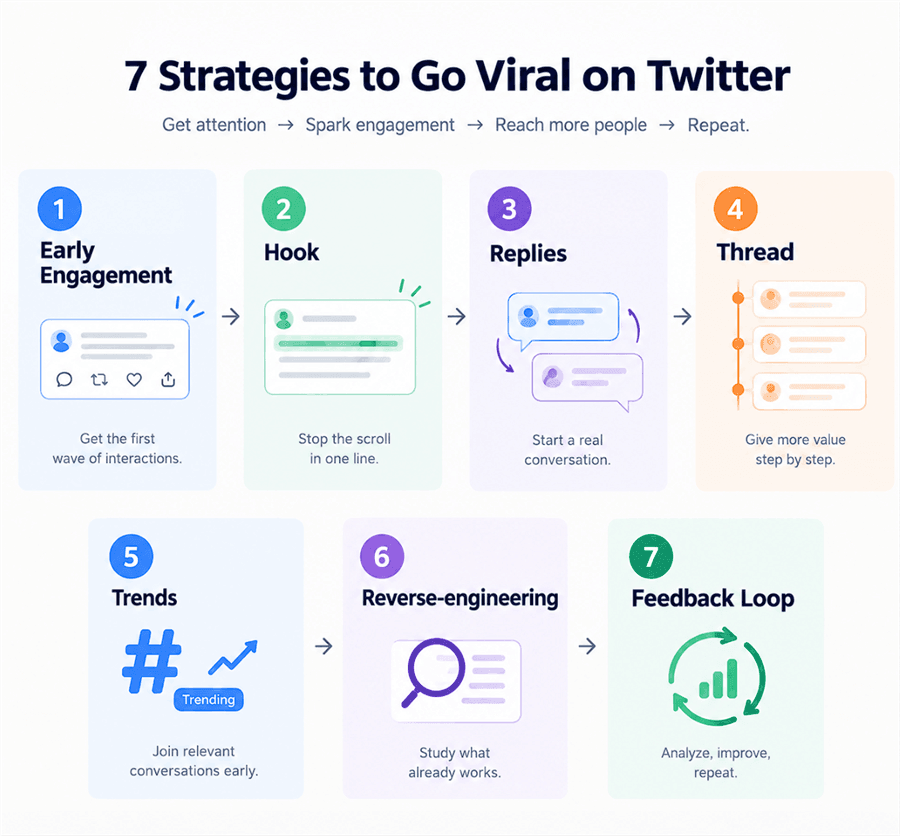
Strategy 1. Build Early Engagement
Early engagement can help a post gain momentum, but there is no fixed 30-minute rule. X's recommendation systems use many signals, including likes, replies, reposts, clicks, and other interactions, to decide what content is relevant to each user.
To build early engagement, you can:
Step 1: Post when your audience is active. Use your analytics as a starting point, then test different time slots and compare replies, reposts, and profile visits.
Step 2: Stay available after publishing. Reply to early comments with useful information, follow-up questions, or a different perspective.
Step 3: Don't delete a slow post too quickly. A post can gain traction later through a reply, repost, or renewed conversation.
Strategy 2. Write a Hook That Stops the Scroll
The opening needs to give people a reason to keep reading. The strongest hooks usually lead with a specific result, surprising fact, clear opinion, or curiosity gap rather than a long setup.
A simple rule: put the interesting part first. Cut phrases such as “I think,” “In my opinion,” or “Unpopular opinion,” and make the main claim clear enough to understand at a glance.
Then give readers a reason to continue. You can use:
- A specific result: “We tested 100 tweets. Three formats generated most of the engagement.”
- A clear claim: “You don't need more followers to get more reach on X.”
- A curiosity gap: “We changed one thing in our X strategy. The results surprised us.”
The hook earns the initial attention; the rest of the post has to deliver on it.
Strategy 3. Give People a Reason to Reply
Replies are an important engagement signal on X, but that doesn't mean you should chase them at all costs. What matters is whether your post sparks genuine conversation, rather than collecting low-effort comments just to inflate engagement.
Give people something worth responding to: a clear position, a question that invites a real answer, or a claim they can push back on.
Try three approaches:
- Take a clear position. A specific opinion gives people something to agree with, challenge, or build on.
- Ask a question that adds value. When a question genuinely fits the post, ask for an experience, judgment, or recommendation instead of a simple yes/no answer.
- Keep the conversation going. Respond to useful replies with additional context or a follow-up question. You can also join relevant conversations yourself, especially on posts with an audience already interested in your topic.
Avoid manufactured controversy. A strong opinion can start a useful discussion; misleading or inflammatory claims can damage credibility and may also run into X's recommendation and safety rules.
Strategy 4. Turn a Strong Idea Into a Thread
Threads are useful when an idea needs more space than a single post. They work particularly well for tutorials, frameworks, case studies, and step-by-step explanations.
Step 1: Make the first post useful on its own. State the main idea and give readers a reason to continue.
Step 2: Give each post one clear point. Remove repetition and unnecessary setup.
Step 3: Build toward a payoff. Examples, evidence, or a practical takeaway give readers a reason to keep going.
Step 4: End with the key takeaway. If the thread contains a particularly useful point, make it easy to quote or share.
Don't turn every idea into a thread. If the point fits naturally into one strong post, keep it short.

Strategy 5. Join Relevant Trends Early
Trending topics can create discovery opportunities, but relevance matters more than simply adding a popular hashtag. The goal is to contribute while a conversation is developing, not to attach your account to every viral topic.
Use this quick filter before joining a trend:
Is it relevant? Does the topic connect naturally to your niche or audience?
Is there still room to contribute? Look for an angle that hasn't already been repeated hundreds of times.
Can you add something useful? Bring your own analysis, experience, data, explanation, or counterpoint.
If the answer is no, skip it. A random viral topic may generate impressions without attracting people who care about what you normally post.
One more rule: don't rely on hashtags to explain the trend. Make the connection clear in the actual post.
Strategy 6. Reverse-Engineer Winning Posts
Don't copy viral tweets. Study the pattern that made them work, then rebuild it for your own audience.
Start with 20–50 accounts in your niche, including both established creators and accounts closer to your own size. Review their strongest posts from the past few months and flag posts that clearly outperform their normal engagement.
For each one, record:
- Hook: What makes you stop scrolling?
- Structure: How does the post deliver its idea?
- Topic: What subject or pain point does it address?
- Format: Single post, thread, question, list, example, or story?
- Engagement trigger: What gives people a reason to reply, repost, or save it?
Then turn the patterns into your own templates. Common structures include:
- Bold claim → explanation
- Result → how it happened
- Problem → solution
- Framework → examples
- Opinion → evidence
The important part is to rebuild the idea with your own experience, data, or point of view. Copy the structure, not the wording.
Strategy 7. Turn Viral Posts Into a Feedback Loop
Next, knowing why a viral post worked is more valuable.
Step 1: Review the post after 24–48 hours. Compare impressions, replies, reposts, profile visits, and follows with your normal results.
Step 2: Look across your best-performing posts. After enough posts, identify recurring topics, formats, hooks, and angles.
Step 3: Test the pattern again. Reuse the underlying idea or format with a different example, update, or perspective.
Step 4: Convert attention into a next step. Follow up with related content and make sure your profile clearly explains what you offer.
Which Strategy Should You Start With?
Start with the part of your workflow that needs the most improvement. The seven strategies work best as a loop, but they don't all need to be used at once.
Strategy | Effort | Main goal | Watch out for |
1. Early Engagement | Low | Build initial momentum | Don't manufacture engagement |
How to Turn X Virality Into Consistent Growth

Besides creating a Twitter post that goes viral, building the research-to-content loop is a long-term strategy — knowing what's winning in your niche, what your own data says, and closing the gap every week. And AllyHub is an AI-powered workspace that helps you automate the research & publishing:
- Radars — Creator Watch tracks the X (and TikTok) creators you specify and flags their viral hits, positioning, and success patterns — turning Strategy 6's manual study list into a scheduled scan you review instead of building.
- Radars — News & Trends monitors keywords, news sources, and the X accounts you choose, surfacing rising topics before they peak — Strategy 5 on autopilot.
- Social connects to your own X account and analyzes your post performance — follower and engagement metrics plus AI briefs on your winning content patterns, content gaps, and next-topic suggestions, which is Strategy 7 without the spreadsheet.
- Profiles and Studio lock your positioning and brand voice into long-form drafting, so the content matches the analysis.
Honest caveat: AllyHub's Social and Radar modules currently cover TikTok and X (more platforms on the roadmap), and it won't write a viral tweet for you — nothing will. It handles the monitoring and analysis that most creators skip because it takes hours. It runs on a Free plan with daily credits, with Pro at $15.99/month (annual billing is 20% less).
FAQs on How to Go Viral on Twitter
Can you go viral on Twitter without followers?
Yes. X can recommend posts to people who don't follow the account, so a large following isn't required. A strong hook, relevant topic, and meaningful engagement can help a post reach beyond its existing audience.
How often should you post on X to grow?
There is no universal posting frequency. Focus on publishing useful content consistently and use your analytics to identify which topics, formats, and posting patterns perform best.
Does X Premium help posts go viral?
Premium can affect how some content and replies are displayed, but it is not a substitute for strong content. Virality still depends on how people respond to the post and how relevant it is to the audience.
Can AI tools help you go viral on Twitter?
AI tools can help with research, trend monitoring, competitor analysis, and finding patterns in your own content. They can make the process more systematic, but no tool can guarantee a viral post.