You open the composer. The cursor blinks. Nothing comes.
That's not a creativity problem — it's a supply problem. If you're stuck on what to tweet, the fastest fix is a list of prompts you can adapt right now. The lasting fix is a system that tells you what to post next week, next month, and next quarter.
This is both. Below you'll find 40+ tweet ideas grouped by what you want the post to do, plus a four-source loop for generating ideas in your own niche — whether you're a solo creator, a faceless account, a UGC creator filling a portfolio, or a brand selling on Shopify.
Key Takeaways: Tweet Ideas and the System Behind Them
- "What to tweet" really means "give me something I can post today." Start with the idea bank below — 40+ prompts grouped by what you want the post to do.
- Ideas run out; a source doesn't. Four places will keep you supplied: your own best posts, live trends in your niche, the sources you already consume, and a running idea bank.
- Replies are what move an account in 2026. Questions, strong first lines, and clear opinions beat announcements every time.
- One good idea can fill a week. Break it into five angles before you move on to the next one.
Why You Run Out of Things to Tweet (and Why Idea Lists Don't Fix It)
Generic advice fails for two reasons.
First, it isn't about your niche. "Share a tip" sounds like an idea until you try to apply it to hand-poured candles, on-page SEO, or a new skincare launch — and then you're stuck again. The prompt was never the hard part; the relevance was.
Second, your own track record is invisible to you. You've already posted things that earned replies. You just never went back and looked at which ones, so you're rebuilding from zero every morning.
And there's a quieter blocker: fear. Rewriting a post four times and deleting it before it goes out costs you more reach than any mediocre post ever would. Consistency beats polish, and an idea supply is what makes consistency possible.
What to Post on Twitter in 2026?
Three mechanics matter more than any tactic.
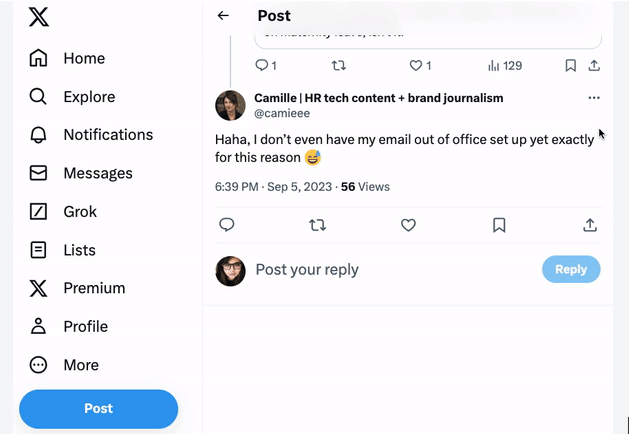
Replies are the prize. X's recommendation algorithm weights real engagement signals (replies, reposts, likes, and how long people linger) rather than raw impressions. A post that starts a conversation travels further than one that just announces something.
The first line is the whole post. On a feed, people don't read — they scan. Your opening line has to earn the second line, so lead with the tension, the number, or the claim.
Format variety keeps you visible. Accounts that post only one kind of thing get tuned out. A sensible default is a mix weighted toward value, with a regular dose of personality and a light touch of promotion.
One small, honest data point before the list: I scanned 79 recent posts surfaced by X's Top search across creator and e-commerce topics in September 2026. Of the 55 with at least 20 likes, roughly 3 in 10 were packaged as a list or a step-by-step breakdown — and the single most-saved post was a step-by-step workflow with more saves than likes. The breakdown format is the default. Which is exactly why your angle matters more than your structure.
4 Places to Find Tweet Ideas in Your Niche (So You Never Run Out)
This is the part that stops the problem from coming back.
Place 1. Mine your own best posts.
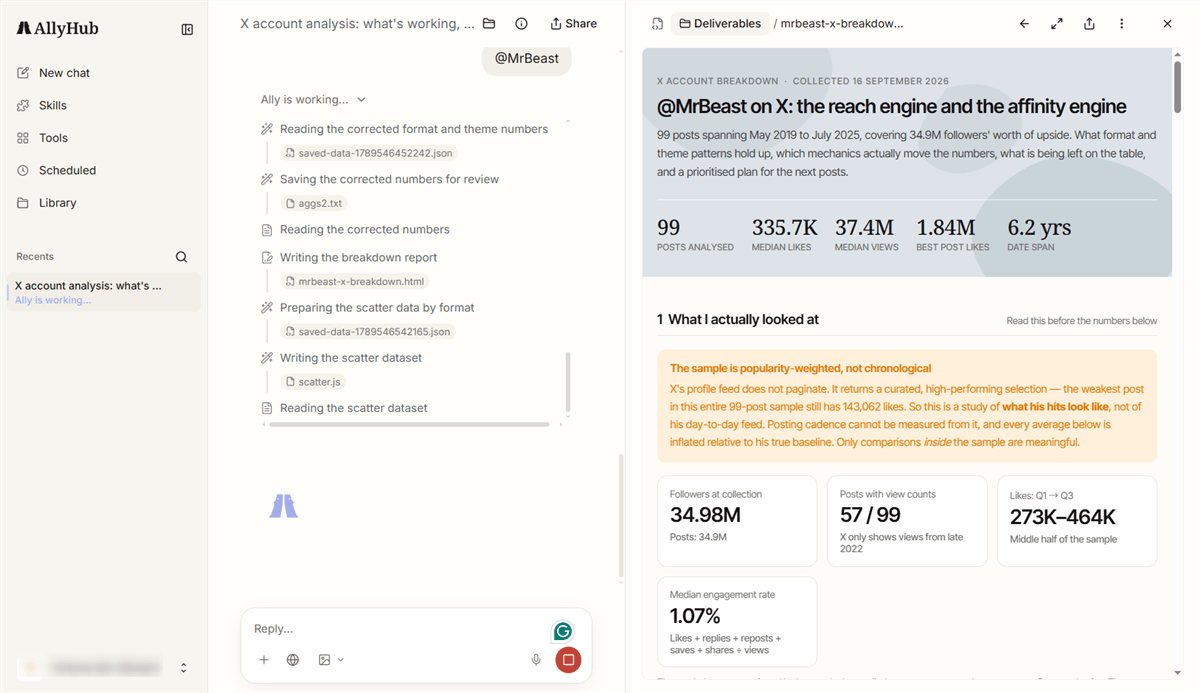
Sort your account by replies, not likes. The posts that started conversations are a private idea mine — the pattern that worked once will work again, in a new shape. If you'd rather not do it by hand, AllyHub's Social pulls your X performance data and turns it into a topic list.
Place 2. Track trends and creators in your niche.
You don't need to invent trends; you need to catch them early and add your angle. Watch two or three news sources and three creators who are one step ahead of you. AllyHub's Radars run that watch for you — News & Trends for what's heating up, Creator Watch for what competitors are posting that works.
Place 3. Turn what you already consume into posts.
Newsletters, podcasts, support tickets, customer DMs, the replies under a competitor's post — everything you read for work is raw material. The fix is one line of commentary, not a summary.
Place 4. Keep a running idea bank.
Capture the idea the moment it arrives, in whatever you'll actually reopen. A note app, a spreadsheet, a saved thread — the tool doesn't matter; the habit does. Aim for ten ideas banked for every one you post.
40+ Tweet Ideas by Goal (Twitter Post Ideas That Get Replies)
Grouped by what you want the post to do. Adapt, don't copy.
Tweet Ideas That Get Replies (10)
- Ask a question your audience has an opinion about, not one with a right answer.
- Post an unpopular opinion you can defend.
- Offer a this-or-that choice with no middle ground.
- Fill in the blank: "The most underrated ___ in [niche] is ___."
- Ask for recommendations — tools, creators, suppliers, books.
- Share a mistake and ask who else has made it.
- Poll two options, then argue for one in the replies.
- Ask what people are working on this week.
- Post a result and ask how they'd have gotten it.
- Ask what everyone gets wrong about your niche.
Tweet Ideas That Build Authority (10)
- Bust a myth your niche repeats.
- Explain one thing you learned the hard way.
- Break a big process into five steps.
- Share a tool you actually use, and why.
- Show a before-and-after from a real project.
- Define a term everyone uses but nobody defines.
- Explain why a common piece of advice fails.
- Show your workflow, screenshots and all.
- Compare two approaches and pick a winner.
- Give a number-backed answer to a question you get often.
Tweet Ideas That Show Personality (10)
- Behind the scenes of a normal working day.
- A small win you'd normally keep to yourself.
- Something you're testing that might flop.
- A strong take on something small and specific.
- What you changed your mind about this year.
- A photo with context, not a caption.
- The unglamorous part of your job.
- A tool or habit you're quietly obsessed with.
- A prediction about your niche.
- Something that made you laugh this week.
Tweet Ideas That Promote Without Sounding Like an Ad (10)
- A customer's result, told plainly.
- How you built one feature and why.
- A free resource you made that solves one problem.
- A change you shipped because people asked.
- A behind-the-scenes look at how a product gets made.
- An honest limitation, and who shouldn't buy.
- A quick answer to a question your product raises.
- A comparison of how people solved this before you existed.
- An announcement framed around the user, not the product.
- A "we're hiring" or "we're opening this up" post.
Twitter Post Examples That Land — and Why They Work
You don't need famous posts. You need the patterns.
The workflow teardown. "TikTok + a tool + a workflow = a content machine," followed by arrows listing each part. It works because the promise is concrete and the structure is scannable. Use it when you have a real system, not a theory.
The impossible number. "This AI creator makes more than most real influencers." One claim, then the evidence, then the takeaway. It works because the first line refuses to be scrolled past. Use it when the number is true and you can show your work.
The direct answer. Open by knocking down the obvious answer, then give the real one: "The best-performing strategy isn't the one everyone recommends. It's answering questions head-on." This works because it's quotable, and quotable posts get screenshotted and saved.
Notice what the three have in common: a specific promise, a clear structure, and no throat-clearing. That's the whole recipe.
Tools That Help You Never Run Out of Tweet Ideas
AllyHub is an AI workspace built for exactly this loop: Social reads your own X and TikTok performance and tells you which posts worked and what to post next; Radars watch news, trends, and rival creators in your niche; Profiles keeps your voice consistent; and Studio turns a strong idea into long-form content. It's free to start, with Pro at $15.99/month.
To be straight about scope: AllyHub doesn't publish or schedule your posts — it handles the ideation, research, and creation layer around your schedule. If you just want a random prompt generator, there are free ones and they're fine for a bad day. If you want to stop having bad days, you need your own data and your own niche in the loop.
What to Tweet on X: FAQs
How often should you tweet on X?
Post often enough to stay active without turning content creation into a second job. For many solo creators, one useful post a day plus a few genuine replies is a manageable starting point. The right cadence depends on how much useful content you can consistently produce.
What should I tweet if I'm brand new with no followers?
Start with useful, specific content, not audience-building announcements. Answer questions people in your niche are already asking, share lessons from your work, or explain something you know well. Thoughtful replies to relevant conversations can also help you get discovered before your own posts have much reach.
Should I use hashtags on X in 2026?
Use them selectively. One or two relevant hashtags can make sense when you're joining an active conversation or using an established topic tag. Adding hashtags to every post is unlikely to solve a reach problem.
Is it OK to recycle or repost your own tweets?
Yes. Revisit strong ideas after a reasonable gap, but refresh the hook, example, or angle rather than reposting the exact same copy. Your audience changes over time, and most followers won't see every post the first time.
How do I find out which of my tweets performed best?
Start with the metrics that match your goal. Replies and bookmarks can indicate deeper engagement, while likes, reposts, clicks, and impressions help you understand different aspects of performance. Compare several posts rather than judging a winner from a single metric.
Should I delete a tweet that flopped?
Usually, there's no need to delete a post simply because it underperformed. Check whether the problem was the topic, hook, timing, format, or distribution, then use that information to improve the next post. Delete or hide a post when there's a specific reason to do so, rather than treating low engagement as one.