The real bottleneck in market research isn’t analyzing data—it’s extracting it. Scaling lead lists, tracking competitor prices, or pulling e-commerce reviews manually is impossible, yet most professional scrapers demand coding skills or constantly break under complex CAPTCHAs, Cloudflare walls, and messy data formatting. Marketers don't need a development degree; they just need clean, structured data delivered without the technical headache.
To help marketers collect public web data more efficiently, we curated the 10 best web scraping tools for 2026. We focused on no-code usability, workflow automation, scheduling, export options, and reliability on dynamic websites. Whether you are a solo growth hacker or an enterprise marketing team, you will find the perfect tool here to automate your competitive intelligence.
Key Takeaways
- Best Overall: Browse AI – Top choice for most marketers.
- Zero code, built-in monitoring, and effortless automation.
- Best for Enterprise: Bright Data – Unmatched infrastructure for heavy, large-scale competitive intelligence.
- Best Free Option: Apify – Generous free tier with $5 monthly credits and hundreds of ready-to-use scrapers.
- Best for Lead Gen: Clay – Combines smart data extraction with outbound sales automation.
- Best for AI Workflows: AllyHub – An AI browser agent that transforms complex research into repeatable, automated workflows.
Why Web Scraping Matters for Marketers
Web scraping used to be a developer's job. In 2026, it's a marketer's competitive advantage.
The data you need to make better decisions — competitor pricing, customer sentiment, trending topics, ad copy, product listings — is all publicly available on the web. The problem is collecting it at scale, consistently, without spending hours doing it manually. That's where web automation tools come in.
Scraping tools for market research let you monitor competitor product pages, track pricing changes in real time, and pull customer reviews across platforms to understand what buyers actually care about. For community-driven insights, you can also extract Reddit data to surface unfiltered buyer sentiment straight from niche forums. Scraping tools for competitive intelligence go further — helping you track competitor ad copy, job postings (a signal of strategic direction), content publishing cadence, and even backlink profiles.
For e-commerce marketers, this means knowing when a competitor drops prices before your customers notice. For digital marketers, it means building content strategies based on real data, not guesswork.
How We Selected These Tools
We evaluated over 20 web scraping tools based on the following criteria:
- No-code usability: Can a marketer use this without engineering support?
- Marketing-specific use cases: Does it support the workflows marketers actually run — price monitoring, review scraping, lead generation, competitor tracking?
- Scheduling and monitoring: Can it run automatically and alert you to changes?
- Integration depth: Does it connect to the tools marketers already use (Google Sheets, CRMs, Zapier, Make)?
- Pricing transparency: Is the pricing model predictable and fair for non-enterprise teams?
- Reliability: Does it handle JavaScript-heavy sites, CAPTCHAs, and anti-bot measures?
Only tools that meaningfully serve marketing use cases — not just developer workflows — made this list.
Best Web Scraping Tools - Quick Comparison Table
Tool | Best For | Pricing (monthly billing) | No-Code | Free Plan |
Browse AI | Monitoring & tracking | From $48/mo | ✅ Yes |
10 Best Web Scraping Tools for Marketers in 2026
Browse AI — Best for Monitoring & Competitive Tracking
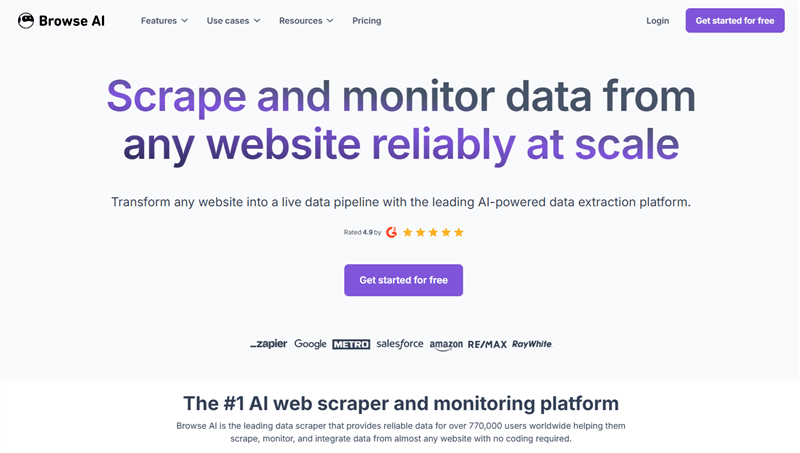
Browse AI is a no-code web automation platform built around two core actions: extracting data and monitoring websites for changes. For marketers who need to track competitor pricing, product listings, or news feeds on a schedule, it's one of the most practical tools available.
You train a "robot" by clicking through a website in your browser — no code, no configuration files. The robot then runs on a schedule and alerts you when something changes. It integrates with over 7,000 apps via Zapier and Make, so your scraped data can flow directly into Google Sheets, Airtable, Slack, or your CRM.
Key features:
- Point-and-click robot training — no coding required
- Scheduled monitoring with change detection alerts
- 7,000+ app integrations, including Google Sheets and Airtable
- Handles CAPTCHAs and adapts to website layout changes
- Pre-built robots for common marketing tasks (LinkedIn, Amazon, job boards)
Pricing: Free plan available (limited credits). Personal at $48/month, Professional at $87/month, Premium starting at $500/month, with yearly billing typically lower.
Best for: Marketers who need to monitor competitor pages, track pricing changes, or aggregate content from multiple sources — without writing a single line of code.
Limitations: Costs can escalate quickly if you're monitoring many pages simultaneously. Not ideal for very large-scale data collection (think millions of records).
AllyHub — Best for End-to-End Browser Automation and Research Workflows
Most web scraping tools give you data. AllyHub gives you outcomes.
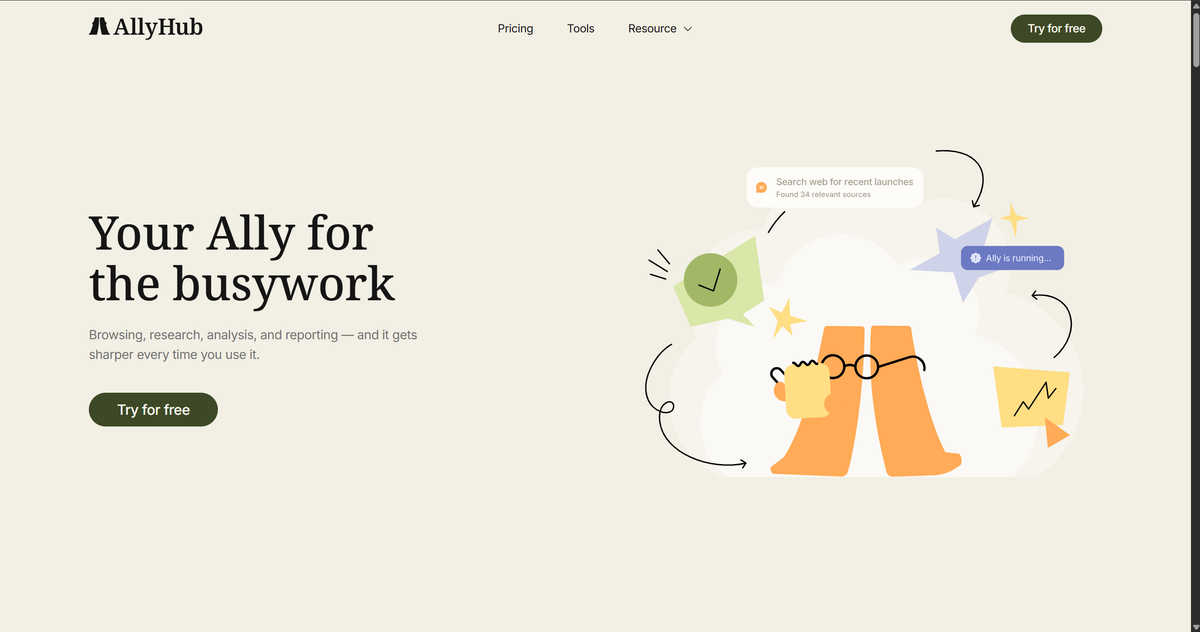
AllyHub is a browser-native AI copilot that can operate web pages directly — clicking, scrolling, extracting visible data, filling forms, and organizing findings into a structured output. For marketers, that means it can help with repeatable research workflows such as competitor monitoring, review analysis, lead research, and content research.
What makes AllyHub different for marketers is its compounding intelligence model. Every research task you run builds reusable Skills and Service assets. The second time you run a competitor analysis, AllyHub already knows your preferences, your format requirements, and the sites you care about — so it runs faster and produces better output without you re-explaining anything.
Key features:
- Operates your browser directly — clicks, scrolls, extracts, and fills forms
- Builds reusable Skills and Service assets from every completed task
- One-click Service cards for recurring research workflows (competitor monitoring, automate product review analysis, lead research)
- Browser extension format — install and start immediately, no server setup
- Combines data extraction with content generation, reporting, and workflow automation in a single tool
Pricing: Free to start. $19.99/month for getting started, $49.99/month for professional use, with yearly billing typically lower.
Best for: Digital and e-commerce marketers who run recurring research workflows — competitive monitoring, market research, review analysis, content research — and want those workflows to get faster and smarter over time, not just execute once.
Limitations: AllyHub is a broader AI copilot, not a dedicated high-volume scraping API. For raw data collection at a million-record scale, a dedicated scraping infrastructure tool like Bright Data is more appropriate.
💡 Pro tip: AllyHub's real advantage isn't the first run — it's the tenth. Package your most-repeated research workflows as Service cards and trigger them with one click. Your competitor monitoring routine, which took 2 hours manually, can become a 5-minute task.
Octoparse — Best No-Code Scraper with Templates
Octoparse is one of the most established no-code web scraping tools on the market, and it shows. The visual point-and-click interface makes it accessible to marketers with zero technical background, and its library of 600+ pre-built templates covers most common marketing data sources — Amazon, LinkedIn, Google Maps, Yelp, and more.
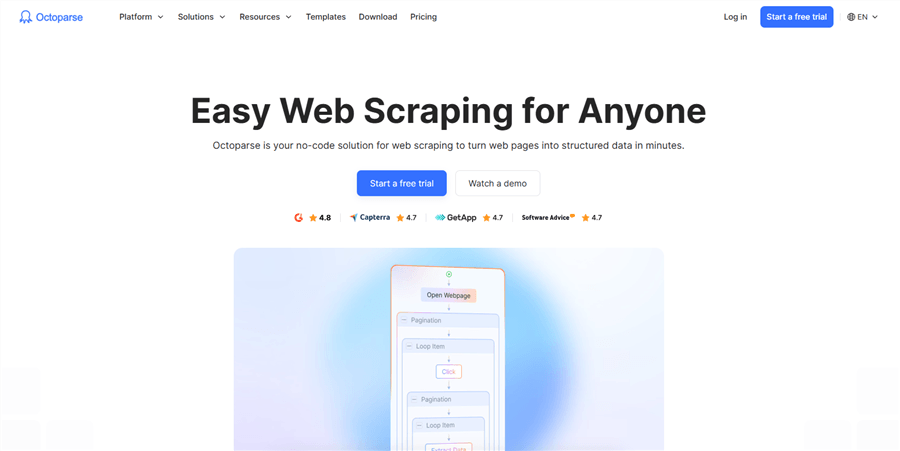
For e-commerce marketers, Octoparse is particularly strong for pulling competitor product listings, pricing data, and customer reviews at scale. If you need to automate Amazon pricing research specifically, that workflow pairs well with Octoparse's scheduled scraping. Data exports to Excel, Google Sheets, CSV, and JSON, making it easy to feed into your existing reporting workflows.
Key features:
- Visual drag-and-drop scraping builder
- 600+ pre-built templates for popular websites
- Cloud-based execution with scheduled scraping
- IP rotation and CAPTCHA solving built in
- Export to Excel, Google Sheets, CSV, JSON
Pricing: Free plan (10 tasks, up to 50,000 rows/month, local execution only). Standard at $83/month, Professional at $249–$299/month. Enterprise pricing available. Yearly billing typically lower.
Best for: E-commerce marketers who need to scrape product data, pricing, and reviews from major retail platforms without developer support.
Limitations: Can struggle with highly dynamic or JavaScript-heavy websites. Advanced features have a learning curve, and API access is limited on lower tiers.
💡 Pro tip: Octoparse's template library is a shortcut most marketers overlook. Before building a custom scraper, check if a template already exists for your target site — it usually does.
Apify — Best for Scalable Scraping with a Marketplace
Apify is a cloud-based web scraping and automation platform built around "Actors" — modular, reusable scrapers that can be run on demand or on a schedule. What makes Apify stand out is its marketplace: thousands of pre-built Actors created by the community, covering everything from Google SERP scraping to Instagram data extraction to Amazon product monitoring.
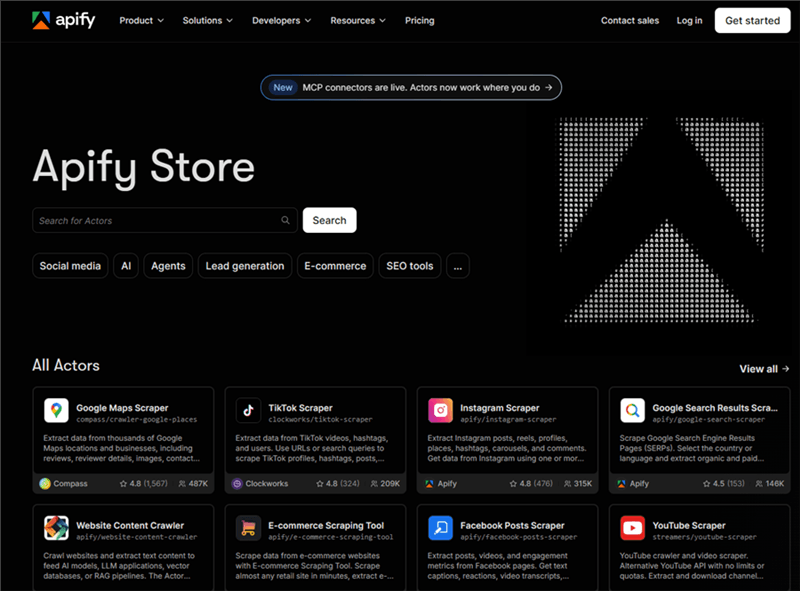
For marketers who need more flexibility than a template-based tool but don't want to build everything from scratch, Apify hits a useful middle ground. Non-technical users can run ready-made Actors without writing code; technical users can build custom ones.
Key features:
- Marketplace of 1,000+ pre-built Actors for common data sources
- Cloud execution with scheduling and API access
- Integrates with Google Sheets, Zapier, Make, and more
- JavaScript rendering and proxy management built in
- Supports large-scale data collection with pay-as-you-go credits
Pricing: Free plan with $5 in monthly platform credits. Starter at $29/month, Scale at $199/month, Business at $999/month. Some Actors charge additional per-result fees. Yearly billing typically lower.
Best for: Marketers who need a wide variety of data sources covered and want the flexibility to scale up without switching tools.
Limitations: Pricing can be unpredictable — some Actors charge per result on top of platform credits. Scheduling and metadata customization have some limitations on lower tiers.
Bright Data — Best for Enterprise-Scale Competitive Intelligence
Bright Data is the heavy artillery of web scraping. With over 400 million residential IPs, 660+ pre-built scrapers, and a suite of enterprise-grade tools, it's built for organizations that need data at a scale that would break most other platforms.
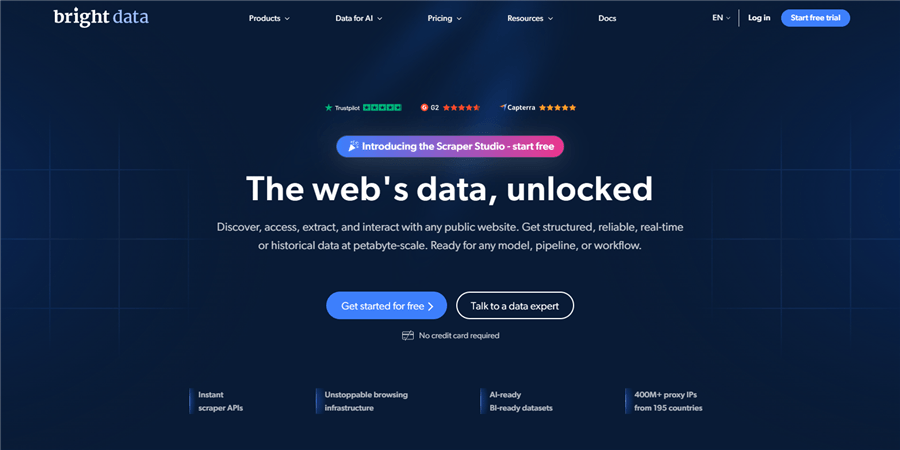
For marketing teams running large-scale competitive intelligence programs — tracking thousands of competitor SKUs, monitoring ad copy across markets, or building comprehensive market research datasets — Bright Data is the most capable option available. It handles anti-bot measures that would stop other tools cold.
Key features:
- 400M+ residential IPs for reliable, undetected scraping
- 660+ pre-built scrapers for major platforms
- Web Scraper API, SERP API, and Web Unblocker
- Automatic proxy selection and CAPTCHA solving
- Data delivery in multiple formats; integrates with major data pipelines
Pricing: Usage-based. Web Scraper API from $1.50 per 1,000 records. Residential proxies from ~$6–$8.40/GB. Pre-built datasets from $250 per 100,000 records. Free trial available.
Best for: Enterprise marketing teams and agencies running large-scale competitive intelligence, price monitoring, or market research programs that require maximum reliability and scale.
Limitations: Complex and expensive for smaller teams. Often requires engineering resources to process raw data into actionable insights. Not a no-code solution for most use cases.
Clay — Best for Lead Generation and GTM Automation
Clay is less a traditional scraper and more a data workflow builder that happens to include powerful scraping capabilities. It combines AI-powered web research (via its "Claygent" AI agent) with data from 150+ providers and outbound automation — making it the tool of choice for growth marketers and sales-led teams.
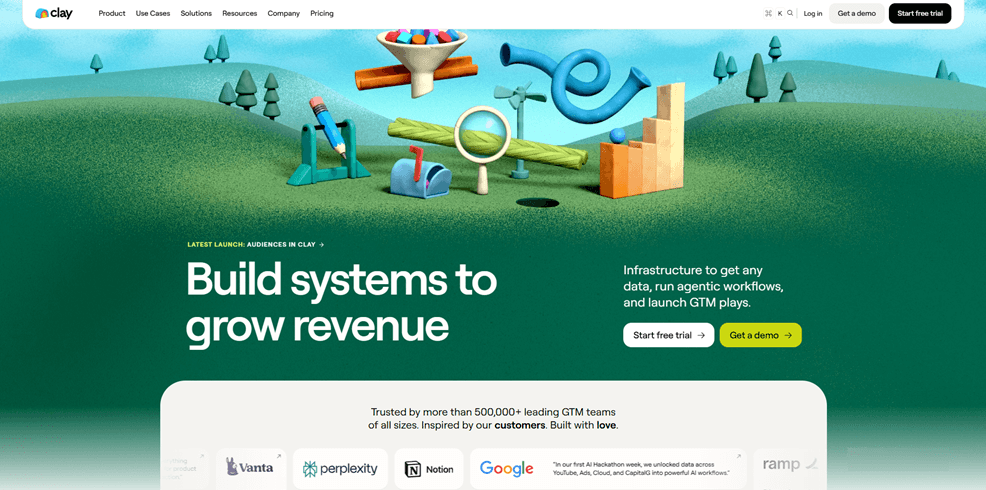
Where other tools give you raw data, Clay helps you turn that data into action. You can build workflows that scrape company websites, enrich leads with firmographic data, score prospects, and push them directly into your CRM or outbound sequences — all without writing code.
Key features:
- AI-powered scraping via Claygent (natural language data extraction)
- 150+ data provider integrations for enrichment
- Chrome extension for manual research workflows
- CRM integrations and outbound automation
- Pre-built templates for common GTM workflows
Pricing: Free plan (100 Data Credits/month). Launch at $185/month (2,500 credits), Growth at $495/month (6,000 credits). Enterprise contracts from ~$30K/year.
Best for: Growth marketers, demand gen teams, and sales-led marketing teams who need to build and enrich prospect lists at scale and connect that data directly to outbound workflows.
Limitations: Steep learning curve for complex multi-step workflows. Credit costs can be unpredictable depending on data sources used. Expensive for teams that only need basic scraping.
⚠️ Warning: Clay's credit system can get expensive fast if you're enriching large lists with multiple data providers per record. Map out your workflow and estimate credit consumption before committing to a plan.
Phantombuster — Best for Social Media Data Extraction
Phantombuster specializes in extracting data from social platforms — LinkedIn, Instagram, Facebook, Twitter/X, and more. Its 150+ pre-built "Phantoms" cover specific extraction tasks on each platform, from pulling LinkedIn company followers to scraping Instagram hashtag posts to extracting Facebook group members.
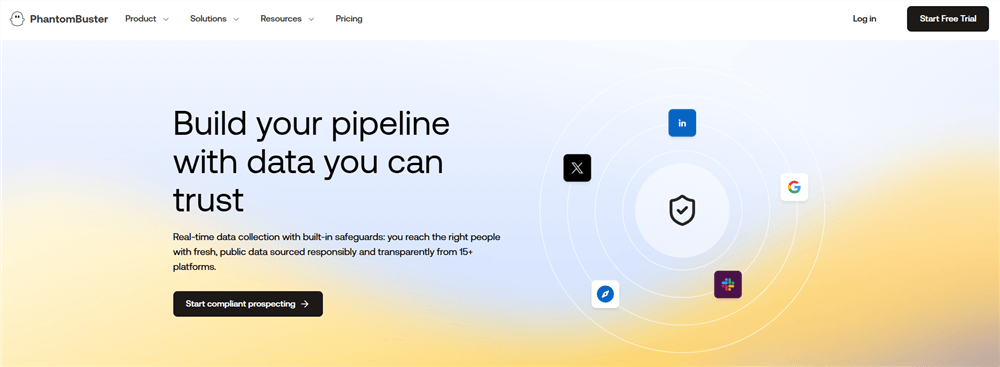
For marketers who need social data for audience research, influencer identification, or competitive social intelligence, Phantombuster is the most purpose-built option available. Its LinkedIn Phantom suite is especially popular for teams that need to extract LinkedIn profiles at scale for prospecting or audience research.
Key features:
- 150+ pre-built Phantoms for major social platforms
- Cloud-based execution — runs without keeping your browser open
- Supports lead list building, profile data extraction, and outreach automation
- Unlimited users and exports on all paid plans
- AI and email credits are included on paid tiers
Pricing: Free tier. Starter at $69/month, Grow at $159/month, Scale at $439/month. Yearly billing typically lower.
Best for: Social media marketers, influencer marketing teams, and demand gen marketers who need structured data from LinkedIn, Instagram, or other social platforms for audience research or lead generation.
Limitations: LinkedIn automation carries a real risk of account restrictions — Phantombuster uses session cookies, which violates LinkedIn's Terms of Service. Automations can break when platforms update their interfaces. Credits don't roll over.
⚠️ Warning: Use LinkedIn Phantoms carefully. Running high-volume automation on LinkedIn can trigger account restrictions. Keep volumes conservative and use a secondary account for testing.
ScrapingBee — Best Managed API for Developer-Assisted Teams
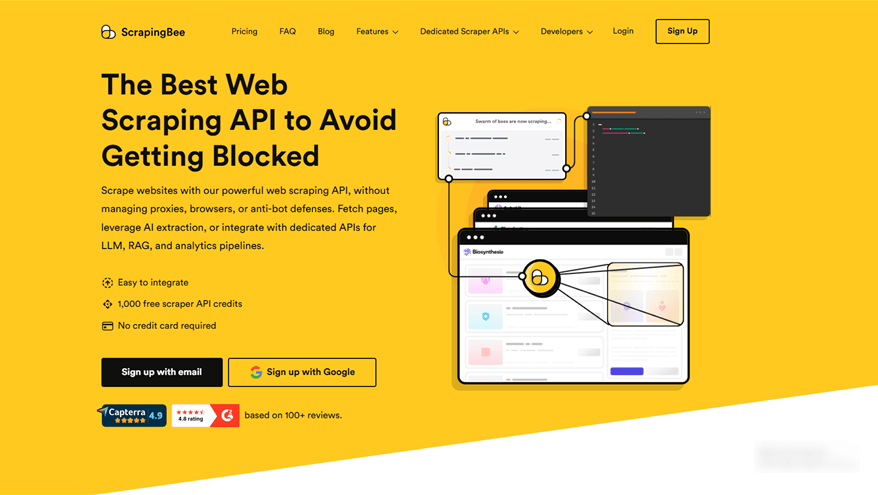
ScrapingBee is a managed scraping API that handles the hard parts of web scraping — headless browsers, proxy rotation, JavaScript rendering, and anti-bot bypass — through a single API call. It's developer-first, but marketing teams with a technical resource on hand will find it one of the most reliable options for scraping JavaScript-heavy sites.
Its AI Web Scraping API is particularly useful for marketers: you describe what data you want in plain language, and ScrapingBee extracts it — no XPath or CSS selectors required.
Key features:
- Handles JavaScript rendering, proxy rotation, and anti-bot bypass automatically
- AI Web Scraping API for natural language data extraction
- Dedicated Google SERP API parameters to extract SERP data at scale
- HTML to PDF conversion
- Make.com integration for no-code automation
Pricing: Credit-based. Discovery at $49/month (250,000 credits), up to Enterprise at $599/month (8,000,000 credits).
Best for: Marketing teams with a developer or technical marketer who need reliable, scalable scraping of JavaScript-heavy e-commerce or SaaS sites for price monitoring or competitive research.
Limitations: No native no-code UI — requires API calls or Make.com integration. Credits don't roll over. Some benchmarks show below-average success rates on heavily protected sites.
Firecrawl — Best for AI-Ready Data Extraction
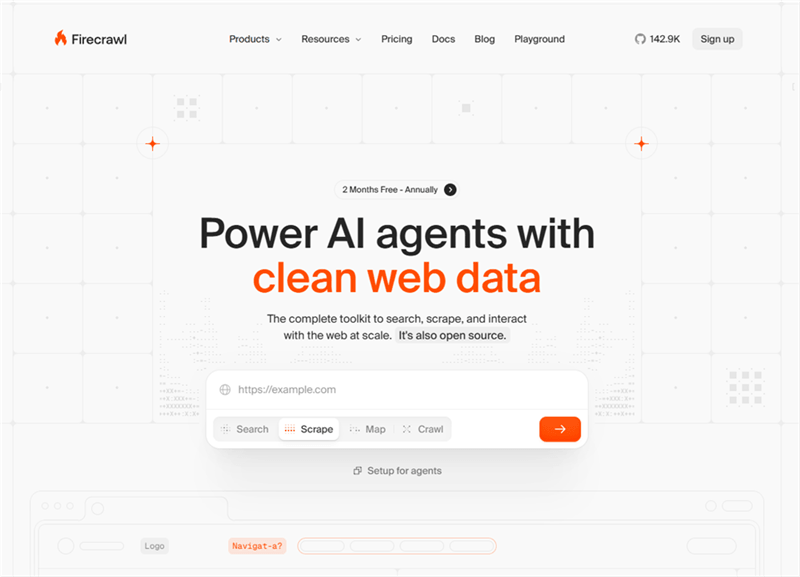
Firecrawl is purpose-built for the AI era. It converts web content into clean, structured Markdown or JSON — the format that LLMs and AI workflows actually need. If you're building AI-powered marketing tools, feeding data into RAG pipelines, or using AI agents for research, Firecrawl produces the cleanest output of any tool on this list.
For marketers who are integrating AI into their research and content workflows, Firecrawl is the bridge between the open web and your AI stack.
Key features:
- Converts web content to LLM-ready Markdown or JSON
- Handles dynamic content, JavaScript rendering, and complex interactions
- Smart wait technology and built-in proxy management
- Comprehensive API with real-time monitoring
- Supports media parsing and structured data extraction
Pricing: Credit-based. Free plan (1,000 credits/month). Hobby at $16/month (5,000 credits). Enterprise pricing available. Credits don't roll over on standard plans.
Best for: Marketers building AI-powered research workflows, content generation pipelines, or competitive intelligence tools that feed into LLMs or AI agents.
Limitations: API-first — not a no-code tool for non-technical marketers. No built-in scheduling or pre-built platform scrapers. Stealth mode costs extra credits.
Diffbot — Best for Structured Web Knowledge Extraction
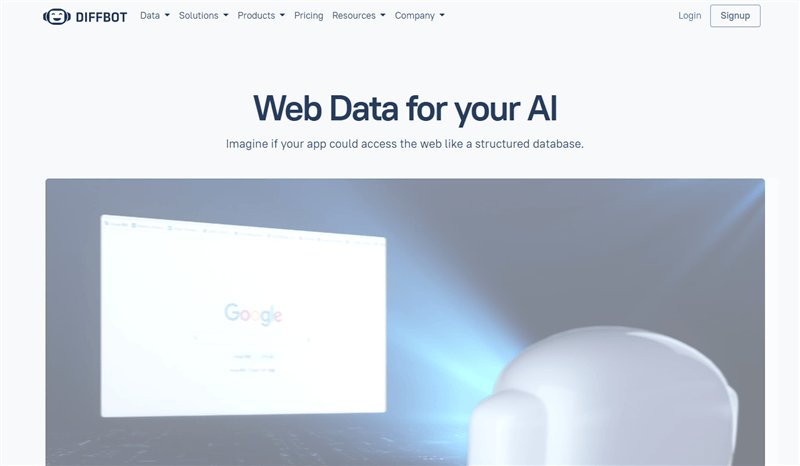
Diffbot uses machine learning to automatically identify and extract structured data from any web page — without requiring you to configure selectors or templates. It builds a continuously updated knowledge graph from the web, covering companies, people, products, articles, and more.
For marketers who need clean, structured data from a wide variety of sources without the setup overhead, Diffbot's automatic extraction is genuinely impressive.
Key features:
- Automatic structured data extraction using ML (no selectors needed)
- Continuously updated knowledge graph covering companies, people, and products
- Natural Language Processing API for entity and sentiment extraction
- Supports bulk crawling and real-time extraction
- Enterprise-grade reliability and data quality
Pricing: Free plan available ($0/mo for 10,000 credits). Paid plans start at $299/mo (Startup) with 250,000 credits, $899/mo (Plus) with 1,000,000 credits, and custom Enterprise pricing for large-scale operations.
Best for: Marketing teams and agencies that need high-quality structured data from diverse web sources for market research, competitive intelligence, or data enrichment — and have the budget for an enterprise solution.
Limitations: Expensive — not suitable for small teams or individual marketers. Primarily developer-oriented. Less flexible for highly customized extraction tasks.
How to Choose the Right Web Scraping Tool for Your Needs
With ten solid options on this list, the right choice depends on your specific situation. Here's a decision framework:
If you're a solo marketer or a small team with no developer:
Start with Browse AI or Octoparse. Both are genuinely no-code, have free plans, and cover the most common marketing use cases out of the box.
If you need to monitor competitors on an ongoing basis:
Browse AI is purpose-built for this. Set up monitoring robots once and get alerted to changes automatically.
If you're focused on lead generation and outbound:
Clay is the strongest option — it combines scraping with data enrichment and outbound automation in a single workflow.
If you need social media data:
Phantombuster is the most purpose-built option, but use it carefully on LinkedIn.
If you have a developer on your team:
ScrapingBee or Apify give you more flexibility and reliability for complex scraping tasks.
If you're building AI-powered marketing workflows:
Firecrawl produces the cleanest AI-ready output. AllyHub goes further by combining extraction with end-to-end task execution.
If you're running enterprise-scale competitive intelligence:
Bright Data or Diffbot are the only tools built for that level of scale and reliability.
FAQ: Best Web Scraping Tools for Marketers
What is the best web scraping tool for marketers with no coding experience?
Browse AI and Octoparse. Both feature intuitive point-and-click visual builders. Browse AI excels at ongoing change monitoring, while Octoparse is best for one-time bulk extraction using its library of pre-built templates.
Is web scraping legal for marketing purposes?
Yes, for publicly available data. Scraping public pricing, reviews, and listings is legally defensible. However, you must respect privacy regulations (GDPR/CCPA) by avoiding personal data, and never bypassing authentication or paywalls to access private areas.
How can marketers use web scraping for competitive intelligence?
By automating data collection across three main pillars: tracking real-time competitor pricing/promotions, monitoring new product launches or catalog changes, and pulling competitor ad copy, landing pages, and cross-platform customer reviews.
What are the best free web scraping tools for marketers?
Apify offers the most flexible free tier ($5 monthly credits with marketplace access). Octoparse allows up to 50,000 rows/month locally. Browse AI, Clay, and AllyHub also provide free starter tiers or credits.
How do scraping tools for market research differ from general scraping tools?
Marketing scrapers prioritize no-code usability, pre-built templates for popular sites (Amazon, LinkedIn), automated scheduling, and native connections to marketing stacks (Google Sheets, CRMs, Zapier). Developer tools offer raw APIs that require coding to manage.
Can web scraping tools replace manual market research?
They fully replace manual data collection, saving hundreds of hours on gathering raw inputs like pricing or product listings. However, human strategic interpretation is still required to turn those automated data points into actual marketing decisions.
What should I look for in a web scraping tool for e-commerce marketing?
Prioritize tools that seamlessly support major retail platforms (Amazon, Shopify), offer automated price tracking, reliably extract product variants and customer reviews, and can easily bypass anti-bot security on dynamic, JavaScript-heavy pages.