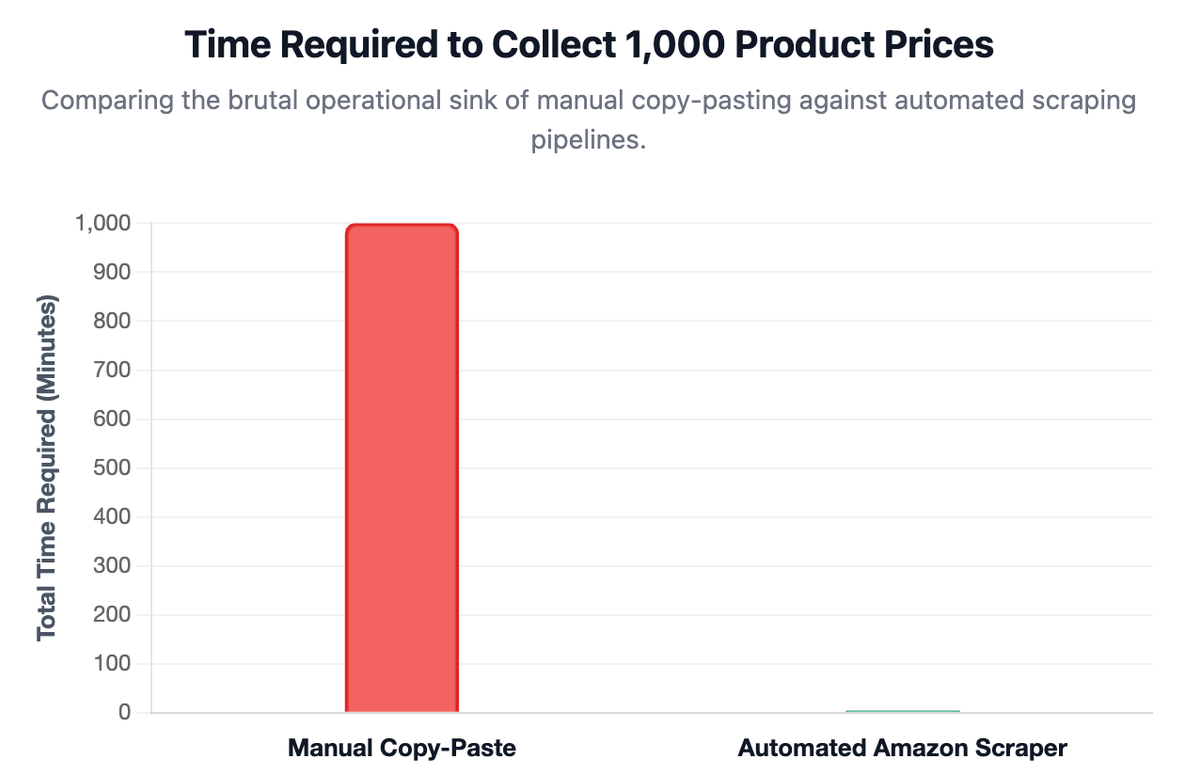
E-commerce operations move too fast for manual data collection. When competing brands are tracking price fluctuations daily, mining thousands of customer reviews, and identifying emerging category trends before they surface on mainstream dashboards, they are relying on automation.
To build a truly reactive product or marketing strategy, you need an Amazon scraper—a specialized data extraction engine that systematically pulls product data, pricing structures, review text, and search visibility metrics directly into clean, structured files.
Whether you are a developer tasked with engineering a custom database pipeline or an e-commerce growth manager trying to scale market intelligence, finding the right balance between raw API scraping and no-code software configurations determines how fast you can convert marketplace signals into actual revenue. This guide details the 8 best Amazon scrapers available in 2026, breaking down their infrastructure, performance capabilities, and real-world costs.
Key Takeaways
- Best overall Amazon scraper: Bright Data leads for enterprise-scale Amazon data extraction with deep product data, though it requires technical setup.
- Best for non-technical marketers: ScrapingBee and offer no-code Amazon scraper software that works without writing a single line of code.
- Fastest Amazon scraper API: Decodo delivers ~4.1-second median response times at budget-friendly pricing — ideal for real-time price monitoring.
- Critical caveat for marketers: Amazon scraping alone won't give you competitive intelligence — raw data still needs analysis, and most marketing teams lack the bandwidth to process it manually.
- Smart alternative: Instead of managing scrapers, proxies, and data pipelines yourself, platforms like AllyHub automate the entire Amazon research workflow — from data extraction to ready-to-use competitive reports — without any technical setup.
What Is an Amazon Scraper — and Why Should Marketers Care?
An Amazon scraper is software that automatically collects publicly available data from Amazon product pages, search results, and review sections — then structures it into usable formats like CSV, JSON, or Excel spreadsheets.
For marketers, this isn't a "nice to have." It's the difference between guessing and knowing:
- Competitor price monitoring: Track how competitors adjust prices daily, not monthly
- Customer voice research: Mine thousands of reviews in minutes instead of hours
- Market trend detection: Spot rising product categories before they saturate
- Product positioning intelligence: Understand what features and benefits your competitors emphasize
Note: Amazon aggressively blocks automated data collection. Any Amazon scraper software worth using must handle IP rotation, CAPTCHA solving, and browser fingerprinting — all invisible to you.
Amazon Scraper API vs. No-Code Amazon Scraper Software
Type | How It Works | Best For |
Amazon scraper API | You send a request (e.g., an ASIN) and get structured JSON back | Marketers with developers on their team; automated workflows |
No-code Amazon scraper | Browser extension or desktop app where you point-and-click to extract data | Solo marketers and small teams; one-off research projects |
How to Evaluate Amazon Scraper Software (Without a Technical Background)
Most Amazon scraper comparison articles throw around terms like "JavaScript rendering" and "rotating residential proxies." Here's what actually matters for marketers:
Evaluation Criteria | What It Means for You | Red Flag |
Success rate | Percentage of requests that actually return data (not blocked by Amazon) | Below 95% means you're paying for failed requests |
Response speed | How fast data comes back after you send a request | Above 15 seconds makes real-time monitoring impossible |
The 8 Best Amazon Scrapers Compared
Based on independent benchmarking by Bright Data and Scrape.do, and verified against real user experiences across Reddit, here's how the top Amazon data extraction tools stack up as of mid-2026.
1. Bright Data — Best for Enterprise-Scale Amazon Data Extraction
Bright Data operates one of the largest proxy networks globally, giving their Amazon scraper near-immunity to blocks. Their Web Scraper IDE lets you build custom extraction workflows, but the learning curve is real.
- Success Rate: Industry-leading
- Median Response Time: ~10.2 seconds
- Output Formats: Structured JSON, CSV, or direct webhook/database streaming
- Best for: Enterprise engineering frameworks and data teams requiring massive, multi-marketplace item scraping pipelines.
Pro tip: If you need product data across multiple Amazon marketplaces simultaneously, Bright Data's geo-targeting capabilities are unmatched. But expect to invest time in setup.
2. Oxylabs — Best for AI-Powered Amazon Data Parsing
Oxylabs combines a robust proxy infrastructure with AI-driven parsing that automatically identifies and structures Amazon data fields — even when Amazon changes its page layout. This "self-healing" capability is a significant time-saver.
- Success Rate: Exceptional
- Median Response Time: ~13.5 seconds
- Output Formats: Structured JSON featuring pre-parsed e-commerce fields
- Best for: Agile teams who want to completely skip the process of writing and updating custom web parsers.
3. Scrape.do — Best Overall Value for Amazon Scraper APIs
Scrape.do offers the strongest price-to-performance ratio among dedicated Amazon scraper APIs, with a 100% success rate and fast ~3-second median response times. It handles proxies, CAPTCHAs, and browser rendering automatically.
- Success Rate: Exceptional
- Median Response Time: ~3.0 seconds
- Output Formats: Structured JSON or raw HTML
- Best for: Projects that require reliable, no-nonsense API endpoints with an elite price-to-performance ratio.
4. Decodo — Best for Speed and Budget-Conscious Teams
Decodo (formerly Smartproxy) is a newer entrant that's made a name for itself on speed: ~4.1-second median response times at competitive pricing. It's purpose-built for Amazon scraping rather than a general-purpose tool adapted for it.
- Success Rate: High
- Median Response Time: ~4.1 seconds
- Output Formats: JSON and clean data arrays
- Best for: Real-time pricing monitors that rely on fast, high-frequency category snapshots.
5. ScraperAPI — Best General-Purpose Amazon Scraper API
ScraperAPI isn't Amazon-specific, but its massive proxy pool and straightforward API make it a reliable choice for Amazon data extraction — especially if you also scrape other platforms.
- Success Rate: High
- Output Formats: JSON, custom structured formats, or raw HTML
- Best for: Cross-platform inventory tracking and comprehensive multi-marketplace competitor audits.
6. ScrapingBee — Best for Beginners and Small Marketing Teams
ScrapingBee is fundamentally a developer-focused Web Scraping API that specializes in managing heavy JavaScript rendering and complex anti-bot walls. However, it stands out for lean operations because it integrates a powerful custom extraction rules engine.
By defining simple JSON parameters in your API request, ScrapingBee processes the raw HTML on its own servers and returns only the data points you asked for (like price or title). This unique feature significantly reduces the local code needed to clean and parse your data.
- Success Rate: High
- Output Formats: Formatted JSON or rendered HTML
- Best for: Technical teams and growth analysts who want an API pipeline without writing complex data-cleaning scripts.
Recommended: If you're a marketer testing Amazon data extraction for the first time, start with ScrapingBee's free tier. It lets you validate whether the data you need is actually extractable before committing to a paid plan.
7. ZenRows — Best for Amazon Search and Product Pages
ZenRows specializes in handling JavaScript-heavy pages — critical for Amazon search results, which load dynamically. Their anti-bot bypass is specifically tuned for e-commerce platforms.
- Success Rate: High
- Output Formats: Clean structural data arrays or HTML
- Best for: Teams attempting to catalog dynamic category layouts and deep search ranking indexes.
8. Apify — Best for Deep Amazon Data Extraction
Apify offers pre-built Amazon scrapers (called "Actors") maintained by the community. You can find specialized Actors for reviews, product details, best-seller lists, and even Amazon Advertising data.
- Success Rate: Variable (dependent on individual Actor upkeep)
- Output Formats: CSV, Excel sheets, or raw JSON
- Best for: Targeted extractions that require modular data parameters, such as downloading isolated blocks of customer review text.
Side-by-Side Comparison: Amazon Data Extractors at a Glance
Tool | Best For | Success Rate | Speed | Pricing Starts At | Technical Skill Needed |
Bright Data | Enterprise scale, deep data | Industry-leading | ~10.2s |
A Smarter Path: Automate the Entire Amazon Research Workflow with an AI Copilot
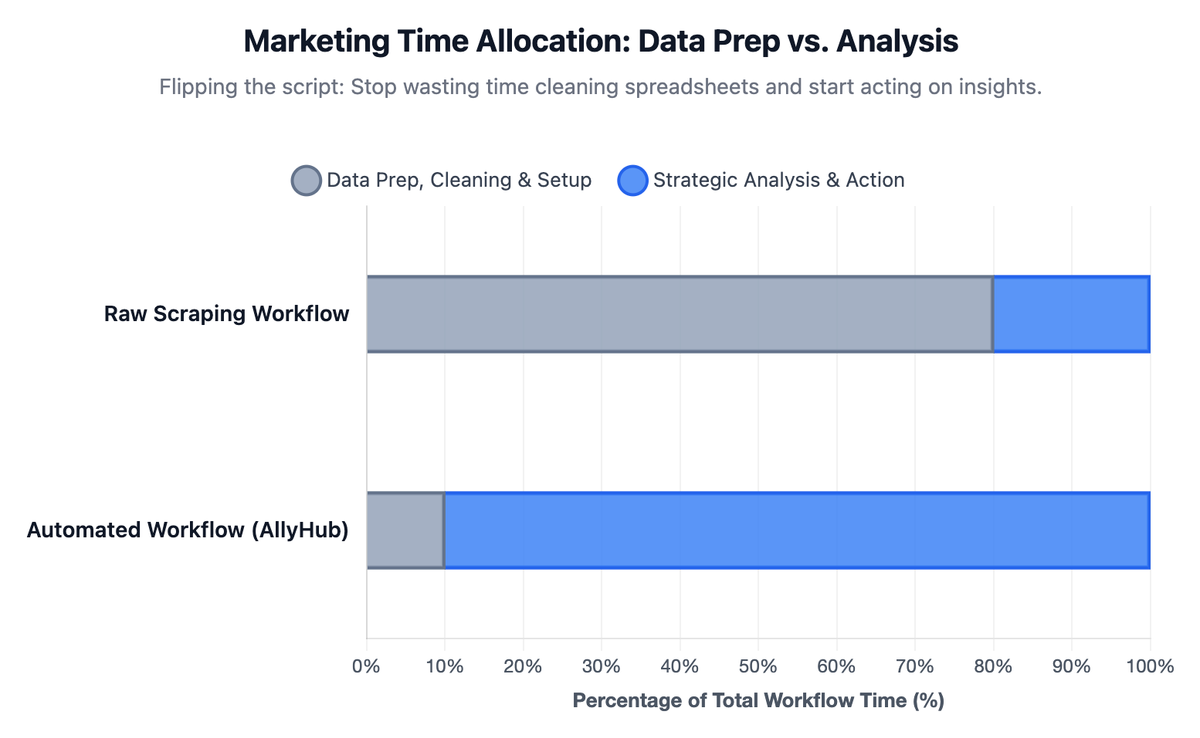
Instead of managing the scraper → data → analysis pipeline yourself, what if your AI could handle the extraction, clean the data, and generate the final strategic report?
Meet AllyHub, a browser-native AI autopilot. It doesn't just give you raw data; it operates your browser directly to complete the entire research workflow. You simply select a one-click Service card, fill in a few details (ASIN, competitor name), and AllyHub takes over.
For marketers specifically, this means:
- Competitor Price Monitor: Track competitor prices and BSR rankings daily across any number of ASINs — get a formatted comparison table and price-change alerts, not raw logs
- Amazon Review Mining: Discover the top buyer complaints and pain points for any product — receive a ranked pain-point report with sentiment analysis and keyword clouds, not a CSV of 10,000 reviews
- Product Research: Find high-potential product opportunities in any category — get scored recommendations with competition difficulty and demand trends, not raw search-result data
- Market Research Report: Understand any new market or category fast — get a complete report covering market size, key players, user pain points, and opportunity gaps
Pro tip: If your goal is *understanding the Amazon market*, not *operating a data pipeline*, skip the scraper setup entirely. Use a platform that delivers the finished analysis. You'll move from data to decision in minutes instead of days.
How to Choose the Right Amazon Scraper for Your Marketing Use Case
Tools are ranked above, but the "best" Amazon scraper depends entirely on what you're trying to accomplish. Here's how to match your marketing scenario to the right tool:
Your Marketing Scenario | Recommended Amazon Data Extractor | Why |
How to Automate Amazon Scraping and Research Workflow | AllyHub | Bypasses proxy setups and data pipelines entirely to deliver completed category summaries and competitor reports. |
Daily competitor price tracking across 50+ ASINs | Decodo or Scrape.do | Fast response times, high success rate, affordable at scale |
Common Marketing Use Cases for Amazon Data Extraction
Whether you use a scraper directly or a platform like AllyHub, here are the most common ways marketers leverage Amazon data:
Real-Time Competitor Price Monitoring
Track how competitors adjust prices in response to promotions, seasonality, and market shifts. Daily monitoring reveals pricing patterns you can exploit — like when a competitor consistently raises prices on weekends.
Customer Voice and Sentiment Analysis
Mine thousands of Amazon reviews to understand what customers love, hate, and wish existed. This is pure, unfiltered VOC (Voice of Customer) data that informs product positioning, ad copy, and content strategy.
Market Trend and Opportunity Detection
Analyze best-seller lists and new-release rankings across categories to spot rising trends before they become obvious. The earlier you identify a growing product category, the more room you have to position your brand.
Product Feature Benchmarking
Compare your product's listed features, images, and descriptions against competitors. Identify gaps in your own listing or opportunities to differentiate.
KOL and Partnership Discovery
Track which brands are gaining review velocity — high review growth signals a brand that's investing heavily in Amazon. These are potential partnership or acquisition targets.
Frequently Asked Questions
Is Amazon scraping legal?
Scraping publicly available data from Amazon sits in a gray area. Amazon's terms of service prohibit automated data collection, and they actively block scrapers. However, many businesses scrape responsibly for competitive research purposes. Always consult legal counsel for your specific use case and jurisdiction.
What's the best free Amazon scraper?
Open-source options like the Amazon Reviews Scraper on GitHub are free but require technical setup and break frequently as Amazon updates its anti-bot systems. Most free scrapers lack proxy rotation, meaning they'll get blocked within minutes. For reliable results, a paid Amazon scraper API with built-in proxy management is worth the investment.
Do I need to know Python to use an Amazon data extractor?
Not necessarily. No-code Amazon scraper software like ScrapingBee offer visual interfaces for data extraction. However, API-based tools typically require some scripting. If you're entirely non-technical, a managed platform like AllyHub handles everything end-to-end.
How do Amazon scrapers handle CAPTCHAs?
Professional Amazon scraper APIs use rotating residential proxies, browser fingerprint rotation, and automated CAPTCHA-solving services behind the scenes. You don't see or interact with any of this — requests either succeed or they don't. This is why success rate is the most important metric when comparing tools.
What Amazon data can I extract with a scraper?
Product titles, prices, ratings, review counts, BSR rankings, product dimensions, variants (size/color), bullet points, product descriptions, images URLs, seller information, and review text. The depth varies significantly by tool — Bright Data and Oxylabs offer the most comprehensive field extraction.
Can I scrape Amazon without getting blocked?
No scraper has a 0% block rate, but the best tools maintain 97–100% success rates through sophisticated proxy management. The key variables are IP quality (residential vs. datacenter), request frequency, and how well the scraper mimics human browsing behavior.
Is there a way to get Amazon competitive intelligence without managing a scraper?
Yes. Platforms like AllyHub provide pre-built service cards for Amazon competitor monitoring, review mining, and product research. You input what you need (product, category, competitors) and receive a finished analysis report — no scraper management, no data cleaning, no manual analysis required.