You're scrolling through an Amazon product page, scanning the images and bullet points, when a number catches your eye in the Product Details section: #1,245 in Home & Kitchen.
If you run Amazon campaigns, monitor competitors, or report on marketplace performance, that number matters. Amazon Best Sellers Rank, or BSR, is one of the fastest public signals marketers can use to understand whether a product is gaining or losing sales momentum.
This guide breaks down what Amazon BSR means, where to find it, how to interpret rank changes, and how marketers can use it for product research, competitor analysis, campaign tracking, and marketplace strategy.
Key Takeaways
- BSR measures sales, not quality: It reflects recent sales velocity—not reviews, ratings, or traffic.
- Lower = better: #1 means top seller; higher numbers mean lower sales.
- Context matters: The same rank can mean very different sales depending on the category.
- Updates frequently: Amazon refreshes Best Sellers Rank often, but exact timing can vary.
- Not search ranking: BSR is based on sales, while search rank depends on keywords and conversion.
What Does BSR Mean on Amazon?
BSR stands for Best Sellers Rank. It is Amazon's official, publicly visible metric that ranks products within a specific category based on how well they are selling.
Think of it as a real-time leaderboard. Every product in every category is constantly being compared against every other product in that same category. If your bamboo cutting board is in Home & Kitchen and it's selling faster than 5,000 other cutting boards this hour, its BSR goes down (which is good — remember, lower is better). If sales slow down, the BSR climbs back up.
The underlying concept is simple but critical: BSR is a relative metric, not an absolute one. It doesn't tell you how many units a product sold. It tells you how that product's sales velocity compares to its peers. A product with a BSR of #1 isn't necessarily selling millions of units — it's just outselling everything else in its category right now.
📌 Note: The acronym "BSR" is used interchangeably with "Amazon Sales Rank" across the seller community. If you hear someone ask "what does BSR mean on Amazon?" or "what is Amazon sales rank?", they're asking about the same thing. The term "BSR meaning" has become standard shorthand among Amazon sellers and e-commerce marketers.
The Category-Dependent Nature of BSR
Here's the single most important nuance about Amazon BSR: the number means nothing without category context.
A BSR of #5,000 can mean very different things across categories. In a fast-moving category, it may indicate strong demand. In a slower, more expensive category, the same rank may represent much lower sales volume.
Why? Because each category has a different total number of products and a different baseline sales velocity. Clothing has millions of listings and enormous daily transaction volume. Major Appliances has far fewer listings and much lower overall sales frequency. The BSR number is simply your position on that specific leaderboard — and leaderboards vary dramatically in size and competitiveness.
How to Find the Amazon Sales Rank of Any Product
Finding a product's BSR takes about ten seconds once you know where to look. Here's the step-by-step:
Step 1: Navigate to the Target Product Page
Open the Amazon listing for the product you want to analyze — whether it's your own product, a competitor's, or one you're researching for a new market entry.
Step 2: Scroll Down Past the Fold
Skip past the product images, the bullet points, the Buy Box, and any A+ Content. You're heading to the lower portion of the page — specifically the section typically labeled "Product Details" or "Additional Information" or "Product Information" (Amazon's labeling varies slightly by category and marketplace).
Step 3: Locate the "Best Sellers Rank" Row
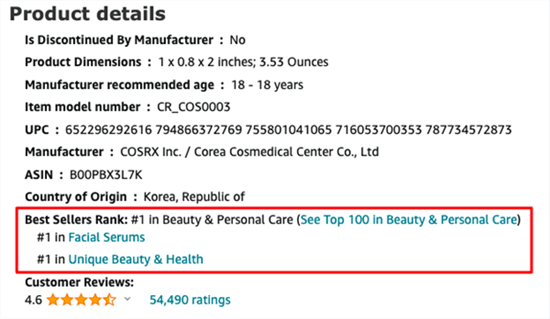
Inside that section, look for the row explicitly labeled "Amazon Best Sellers Rank" or "Best Sellers Rank." Here you'll see the product's numeric rank in its primary parent category, along with its rankings in any sub-categories.
For example, a listing might show:
Best Sellers Rank: #1,245 in Home & Kitchen
#47 in Cutting Boards
#89 in Kitchen Utensils & Gadgets
The first number (#1,245) is the rank in the broad parent category. The subsequent numbers (#47, #89) are ranks within narrower sub-categories. Both matter — but the sub-category rank is often where sellers compete strategically for the "Best Seller" badge.
Step 4: Don't Trust a Single Snapshot — Track the Trend
A product's BSR at any given moment is just a snapshot. It could have spiked because of a Lightning Deal that just ended or dipped because of a temporary stockout.
For a single ASIN, tools like Keepa, Helium 10, and Jungle Scout can help you review historical BSR trends. But marketers often need to monitor a wider set of competitor listings, campaign pages, pricing changes, and content updates.
AllyHub fits into this workflow as a browser-native AI autopilot. Instead of asking your team to open the same Amazon pages every week, copy BSR numbers, check listing changes, and rebuild the same spreadsheet, AllyHub can help execute repeatable browser research workflows and organize the findings into a structured report.
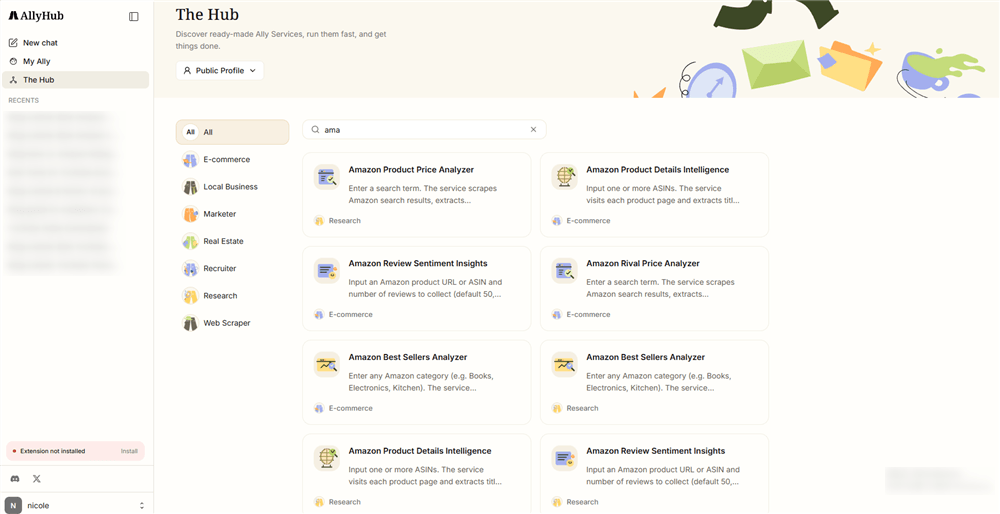
- Automate Competitor Tracking: You can deploy AllyHub to automatically visit a list of competitor Amazon pages, scrape their current BSR numbers, extract recent listing changes, and pull data into structured reports without any manual effort.
- Turn Workflows into Assets: The best part is that you only need to explain this monitoring task once. You can package this exact data-collection routine into a one-click "Service" card within AllyHub.
- Compounding Efficiency: Your AllyHub never starts from scratch again. Every time you run this competitive audit, the system builds on what it already knows, maximizing your ROTI (Return on Token Investment) and freeing your time for strategic decisions that truly matter.
For marketers, the goal is not just to find BSR and record the number. Track it alongside campaign dates, coupon changes, price changes, content updates, and competitor promotions so you can see what may be driving movement.
How Is Amazon BSR Calculated? (And What It Ignores)
Amazon has never published the exact BSR formula — and it likely never will. But years of seller experimentation and data analysis have revealed the core mechanics.
Amazon's BSR algorithm is best understood as a recency-weighted sales velocity meter. Here's what that means in practice:
- Recent sales dominate the calculation. If a product sells 50 units in one hour during a Lightning Deal, its BSR will drop dramatically within that same hour. If it sells nothing for the next three days, the rank will decay just as quickly. Amazon's system is designed to reflect what's hot right now, not what was popular last month.
- Historical sales provide a baseline. Long-term sales patterns are still factored in — they prevent a single viral hour from permanently distorting the rank. But historical weight decays rapidly. The algorithm cares far more about what happened in the last 24–72 hours than what happened 30 days ago.
- The calculation is category-relative. Your BSR is determined entirely by how your sales velocity compares to other products in the same category. If every product in your category suddenly sells more, your BSR might actually worsen even if your own sales are steady — because you're being outcompeted relative to the field.
What BSR Safely Ignores (Common Myths Busted)
Just as important as what BSR includes is what it explicitly ignores:
BSR Does Not Tell You | Why It Matters for Marketers |
|---|---|
Exact unit sales | You still need trend tools or internal sales data |
Profitability | A product can sell fast and still have weak margins |
Search ranking | BSR and keyword rank are related, but not the same |
Customer satisfaction |
What Is a "Good" Amazon Sales Rank?
A “good” Amazon Sales Rank depends entirely on the category, marketplace, and competitive set. A BSR that looks strong in one category may mean very little in another, so marketers should avoid judging the number in isolation.
Instead, compare a product’s BSR with similar competitor ASINs, watch whether the rank is improving or declining over time, and check what changed around it — pricing, coupons, reviews, ads, seasonality, or listing updates. For marketers, the real value of BSR is not finding a universal “good” number, but understanding sales momentum in context.
What BSR Changes Can Tell Marketers
Here are a few common BSR movement patterns marketers can use when reviewing competitors, campaigns, or category demand.
BSR Pattern | What It May Suggest | What Marketers Should Check |
|---|---|---|
BSR improves suddenly | Promo, deal, influencer traffic, PPC push | Coupon, price, external traffic, ad timing |
BSR improves steadily | Growing product demand | Listing updates, reviews, content, keyword visibility |
How BSR Connects to Amazon Marketing Performance
Improving BSR comes down to one core principle: increase consistent sales velocity.
Strategy 1. Benchmark against direct competitors. Don’t compare your product with the entire category. Track similar ASINs with similar price points, audiences, and use cases so BSR movement has real context.
Strategy 2. Drive high-intent traffic. All sales count equally toward BSR, so combine Amazon PPC (focused on profitable keywords) with external traffic from platforms like TikTok or blogs, plus retargeting to convert interested shoppers.
Strategy 3. Use promotions to create sales spikes. Tactics like Lightning Deals, 20–30% coupons, or lower launch pricing can quickly boost sales velocity and improve BSR—though results are temporary without ongoing demand.
Strategy 4. Improve conversion rate (CRO). Strong main images, benefit-driven bullet points, A+ Content, and competitive pricing all help turn traffic into buyers, directly supporting better BSR.
Strategy 5. Maintain consistent inventory. Running out of stock stops sales instantly and damages your ranking, so keep a 2–4 week buffer, set alerts, and plan ahead for peak seasons.
Bottom line: Consistent traffic, strong conversion, and stable inventory are the keys to sustained BSR growth.
Conclusion
Amazon BSR is a powerful signal of sales performance and market demand. For marketers, the value of BSR is in the pattern: what changed, when it changed, and what other listing or campaign signals changed with it.
Focus on the fundamentals: steady traffic, strong conversion, competitive pricing, and reliable inventory. Get these right, and BSR will naturally improve.
Frequently Asked Questions About Amazon BSR
What does BSR mean on Amazon?
BSR (Best Sellers Rank) measures how fast a product sells compared to others in the same category. Lower = better.
How often does Amazon update BSR?
Amazon updates BSR frequently, but the exact timing can vary. Instead of reacting to every short-term movement, marketers should focus on daily or weekly trends.
What is a good Amazon sales rank?
It depends on the category. Instead of chasing a number, compare your rank with direct competitors.
Does BSR affect organic search ranking on Amazon?
Not directly. BSR and organic search rank are separate systems — BSR is driven by sales velocity, while organic rank is driven by keyword relevance, CTR, and conversion history. However, the sales velocity behind a strong BSR also signals to Amazon's search algorithm that the product converts well, which can indirectly improve organic placements.
Can I check historical BSR trends for a product?
Yes. Third-party tools like Keepa, Helium 10, and Jungle Scout display historical BSR charts going back months or years. These trendlines are far more valuable than any single BSR snapshot — they reveal whether a product's sales are stable, growing, seasonal, or declining. For marketers tracking multiple competitor products, AllyHub can automate BSR monitoring and surface trend changes without manual checking.
Does Amazon BSR include sales from all marketplaces?
No. BSR is marketplace-specific. A product's rank in the US is entirely separate from its rank in the UK, Canada, or any other marketplace. Each marketplace maintains its own independent BSR leaderboard.
Can a product have multiple BSR rankings?
Yes. Products can be ranked in multiple categories and sub-categories simultaneously. For example, a yoga mat might appear as #150 in "Sports & Outdoors," #12 in "Yoga Mats," and #45 in "Exercise & Fitness Equipment" — all at the same time. The sub-category ranking is often where sellers strategically compete for the Best Seller badge.