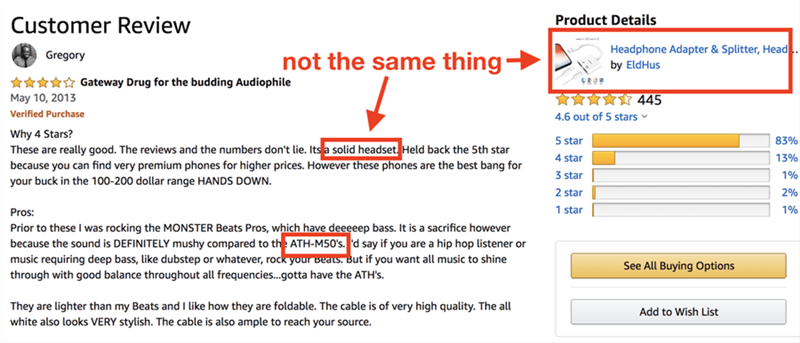
Have you ever clicked a 4.7-star Amazon product, only to scroll down and find reviews praising a completely different item?
This frustrating mismatch isn't always a glitch. On Amazon, mismatched reviews usually happen for five reasons:
- Product Variations: Amazon pools reviews for different colors, sizes, or styles under one listing.
- Product Updates: A brand replaces an older model with a "2.0 version" on the same listing.
- Listing Merges: Amazon’s backend occasionally merges two similar ASINs incorrectly.
- Customer Error: Buyers accidentally post feedback on the wrong product page.
- Review Hijacking (The Scam): Shady sellers deliberately exploit loopholes to "steal" positive ratings from dead or unrelated products to boost a new item overnight.
While some mismatches are harmless catalog errors, a massive category jump (like towels to headphones) is a clear sign of a black-hat scheme. Here is how to tell the difference and how to spot a hijacked listing in under 30 seconds.
Key Takeaways
- Legitimate vs. Deceptive: Product mismatches stem from either benign platform features (variations, merges) or deliberate manipulation.
- The Hijacking Tactics: Fraudulent sellers use Variation Abuse, Zombie Listings, and Black-Hat Merging to pool unearned 5-star ratings.
- The 2026 Crackdown: Amazon’s tighter variation policies and strict FTC enforcement (fines up to $51,744) are actively raising the cost of this fraud.
- 30-Second Verification: Protect your wallet or your brand's ad spend by checking review attribute labels, sorting by "Oldest" reviews, or using AI review analyzers.
What Is "Review Hijacking" on Amazon?
Review hijacking is the practice of taking an existing Amazon product listing that has already accumulated a strong history of positive reviews — and then altering its title, images, description, and category to sell a completely different product. The new product inherits all the old reviews, instantly appearing established, trustworthy, and algorithmically favored.
Think of it as a sleazy shortcut. Instead of spending months (or years) earning real customer reviews through product quality and legitimate marketing, a bad actor simply steals the reputation that someone else's product already built.
On Amazon, reviews are everything. They influence:
- Search ranking: Products with more and better reviews appear higher in Amazon search results.
- Conversion rate: A 4.5-star product with 1,000+ reviews converts dramatically better than a 4.5-star product with 12 reviews.
- Best Seller Rank (BSR): Review volume and velocity are strong ranking signals that push a product into top category positions.
- Buy Box eligibility: Amazon's algorithm favors listings with established review histories when deciding who gets the Buy Box.
For a new or low-quality product, earning genuine 5-star reviews organically can take months — or never happen at all. By hijacking an existing listing's reviews, a scammy product gains instant algorithmic visibility, unearned consumer trust, and a BSR boost — all before a single real customer has even touched the product.
⚠️ Important for marketers: If you're running Amazon PPC campaigns or managing a brand on the platform, review hijacking directly threatens your ROI. A hijacked competitor listing can outrank your legitimate product overnight, siphoning traffic and sales you've worked to earn. Understanding this tactic isn't just consumer self-defense — it's competitive intelligence.
Why Do Amazon Reviews Misalign? (The Honest vs. Shady Reasons)
Before assuming a listing is a scam, it’s important to understand that Amazon’s backend architecture sometimes causes reviews to mix naturally. Here is how to tell the difference:
- Legitimate Variation Sharing: Amazon pools reviews for different sizes, colors, or flavors of the same product line to help buyers. (e.g., seeing a review for "Navy Blue" on a "Jet Black" phone case page).
- Product Iterations: A brand may update a product to a "2.0 version" under the same listing, causing older reviews to reference the previous model.
- System & Catalog Glitches: With billions of data points, Amazon occasionally suffers from marketplace page caching issues or accidental ASIN merges by support staff.
- Review Hijacking (The Scam): This happens when the underlying product is completely unrelated (e.g., a massage gun displaying reviews for a bath towel). This is the black-hat boundary.
How Do Sellers Misalign Reviews? (The 3 Main Schemes)
There are three primary technical loopholes that shady sellers exploit to misalign Amazon product reviews. Each exploits a different part of Amazon's catalog infrastructure.
The Tactic | How It Works | Deception Rating |
1. Variation Abuse (Parent-Child Exploitation) | Sellers bundle completely unrelated products under one listing as different "colors," "styles," or "sizes" — pooling all reviews together. For example, a "Massage Gun" listed as a color variant of a "Coffee Mug" inherits the mug's 5-star rating. | ⭐⭐⭐ |
2. Zombie Listing Hijacking (Abandoned ASINs) | Scammers find dead, out-of-stock, or discontinued listings that still hold thousands of old 5-star reviews. They change the title, images, and description to overwrite the old product with an entirely new item. |
💡 Marketer's note: If you see a competitor launch a "new" product that suddenly has 5,000 reviews on day one, it's not a marketing miracle — it's almost certainly a merged listing. Flag it to Amazon's seller support and document the evidence.
Why Doesn’t Amazon Stop This Fraud Instantly?
Despite Amazon’s massive resources, stopping listing fraud in real time isn’t straightforward. Three structural challenges explain why:
The Scale Problem
Amazon operates at an enormous scale, with millions of active sellers and billions of product listing updates each year. Detecting fraud isn’t just about spotting anomalies—it requires distinguishing between legitimate updates (like a new product version) and malicious listing swaps. At this scale, even advanced AI systems face accuracy trade-offs.
According to Amazon, its store includes millions of small and medium-sized businesses worldwide, making automated enforcement both essential and inherently complex.
The Variations Loophole
Amazon allows product variations (e.g., size or color) to share reviews to improve the shopping experience. This is useful for buyers—but it also creates a loophole that bad actors exploit by attaching unrelated products to high-rating listings.
Amazon has started tightening this system. Recent policy updates limit review sharing to true variations with minimal differences, but enforcement still depends heavily on accurate seller input and categorization.
The Cat-and-Mouse Dynamic
Fraud prevention is an ongoing arms race. Amazon continuously removes fake reviews and takes legal action, but bad actors adapt quickly.
Amazon reported that it blocked over 250 million suspected fake reviews in 2023 alone using machine learning and human moderation.
The company also works with regulators and has pursued legal action against fake review brokers, but the decentralized nature of e-commerce means no single system can eliminate fraud entirely.
The issue isn’t neglect—it’s scale, system design trade-offs, and constantly evolving abuse tactics.
How to Spot Mismatched Amazon Reviews
Whether you're a consumer trying to avoid buying junk or a marketer auditing competitor listings, these four verification steps will help you spot a hijacked listing before you waste your money — or your ad budget.
Step 1: Check the "Review Attributes" Label
Every Amazon review carries a small line of gray text above it indicating product-specific attributes — for example, "Style: 10-Pack Socks", "Size: Large", or "Color: Navy Blue".
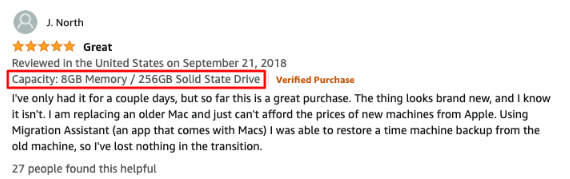
What to do: Scroll down to the review section and scan the attribute labels on the first 10-15 reviews. If you're looking at a smartphone case but the review tags say "Flavor: Vanilla" or "Size: Queen Bed," the listing has been hijacked. These attribute mismatches are the single fastest red flag.
Step 2: Sort Reviews by "Oldest"
This is the most revealing check and it takes 15 seconds.
What to do: In the review section, change the sort order from "Top reviews" to "Most recent" — and then scroll to the very last page of reviews to see what the earliest customers were actually reviewing. If a 2026 top-rated wireless earbud listing has 2022 reviews enthusiastically praising a winter beanie or a set of resistance bands, you're looking at its previous life. The listing was hijacked.
This works because even after a seller changes the product title and images, the historical review text remains — and those old reviews reveal what the listing originally sold.
✅ Pro tip for marketers: When auditing a competitor's listing, take screenshots of the oldest reviews that reference a different product. This is documentary evidence you can include in a report to Amazon's seller support if you're filing a hijacking complaint.
Step 3: Analyze Customer Images and Videos
Text can be rewritten. A listing's title, description, and bullet points can be entirely replaced. But buyer-uploaded photos and videos are persistent — they show what people actually received, not what the current seller claims to be selling.
What to do: Click into the "Customer Images and Videos" gallery (usually linked near the top of the review section). Scroll through the visual content and ask yourself: do these photos match the product currently shown on the page?
If the product page shows a sleek desk lamp but every customer photo shows a USB charging cable, you're looking at a hijacked listing. No amount of text manipulation can hide visual evidence.
Step 4: Automate Auditing with Browser-Native AI Copilots
Manually clicking through dozens of listings to cross-reference thousands of reviews is an efficiency killer for e-commerce marketers. Modern browser-native AI tools have moved far beyond standard chatbots—they can now control your browser to execute these audits for you at scale.
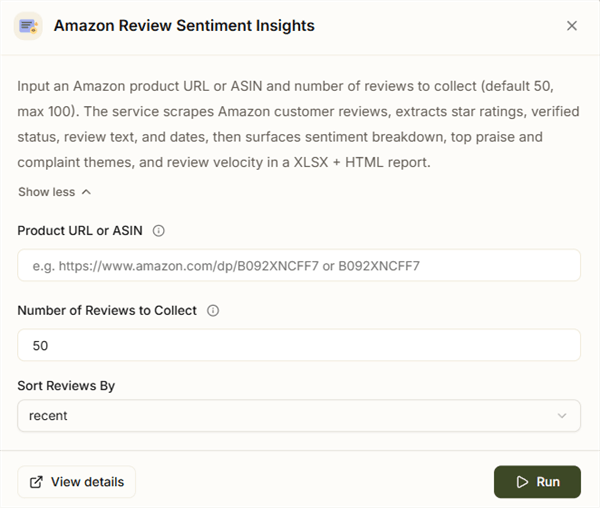
Instead of burning hours on manual inspection, you can use AllyHub, a browser-native AI autopilot designed to automate repetitive web workflows. Since it directly operates your browser, you can deploy it to:
- Scrape and Monitor at Scale: Automatically extract review metadata, text, and customer images across dozens of competitor listings simultaneously.
- Flag Anomalies Instantly: AllyHub can run sentiment and velocity analyses to instantly surface sudden spikes in ratings or repetitive black-hat language patterns.
- Turn Audits into Assets: You can package this Amazon auditing sequence into a one-click "Service" card within AllyHub. The next time you need to audit a competitor, your AllyHub never starts from scratch again—it executes the entire investigation automatically, delivering structured reports to protect your brand and ad spend.
📌 Note: AI is your navigation partner, but you remain the captain. Use AI automation to filter out the noise and surface suspicious listings, then apply steps 1–3 for final verification.
Conclusion
Amazon star ratings aren’t always trustworthy anymore—review hijacking has weakened them as a reliable signal of quality.
The upside: it’s easy to spot once you know what to check. A quick 30-second scan—review history, oldest reviews, customer photos, or AI tools—can expose most manipulated listings.
Regulation is also catching up. Amazon’s tighter variation policies and stronger FTC enforcement are raising the cost of fraud, even if the problem isn’t fully solved.
If a product has suspiciously perfect reviews or an unreal deal, take a moment to verify before buying.
FAQ: Amazon Product Reviews and Review Hijacking
Why do some Amazon reviews talk about a completely different product?
Not always. It could be legitimate variation sharing (like seeing a review for a different size or color) or a product update. However, if the reviews describe a completely unrelated category (e.g., towel reviews on a tech product), it is a strong sign of review hijacking.
How does Amazon allow reviews to not match the product?
Amazon's catalog system allows sellers to update product details and manage variations. Bad actors exploit these legitimate features — variation relationships, ASIN updates, and listing merges — to attach old reviews to new, unrelated products.
Is review hijacking illegal?
Yes. Review hijacking violates Amazon's seller policies and can result in listing removal or account suspension. The FTC also considers it a deceptive business practice and can now impose fines of up to $51,744 per violation under its 2024 rule on fake reviews.
How can I tell if an Amazon product has fake or hijacked reviews?
Check four things: (1) review attribute labels above individual reviews — do they match the product? (2) sort reviews by oldest — what were early buyers actually reviewing? (3) browse customer-uploaded images — do the photos match the listed product? (4) run the listing through an AI review analyzer to flag unusual patterns.
How many 5-star reviews does it take to cancel out a 1-star review?
It depends on the existing average. For a product with 10 reviews averaging 4.5 stars, one 1-star review drops the average to approximately 4.18. The more reviews a product has, the more 5-star reviews it takes to offset a single negative one — which is exactly why hijackers target listings with thousands of existing positive reviews.
Can I use AI tools to analyze Amazon reviews for my own brand's protection?
Yes. AI-powered review analysis tools can monitor your Amazon listings for suspicious review patterns, flag competitor listings that appear to use hijacked reviews, and generate structured reports for Amazon's enforcement teams. For e-commerce marketers managing multiple brands or product lines, this kind of automated monitoring is significantly more practical than manual review-by-review inspection.
What should I do if I find my own brand's listing has been hijacked?
Document everything with screenshots showing the mismatched reviews, contact Amazon Seller Support immediately with a detailed report, and specifically reference "ASIN review hijacking" in your communication. If the hijacking is severe and affecting your sales, consider filing an intellectual property complaint through Amazon Brand Registry if you're enrolled.