For digital marketing and e-commerce teams, continuous research is vital but highly time-consuming. Fortunately, AI research tools in 2026 have matured to compress hours of manual tracking and data synthesis into minutes.
Some of AI research tools answer research questions, some monitor competitors, some analyze audience or consumer data, and some automate the research workflow itself. This guide includes all four types because marketers rarely need just one kind of research.
Explore the 10 best AI research tools now, spanning market research, competitive intelligence, and business strategy to fit any workflow.
Key Takeaways
- Top pick overall: Perplexity AI for fast, real-time cited answers across market and business research.
- Best for competitive intelligence: Crayon for automated, real-time tracking of competitor pricing, products, and messaging.
- Best for SEO + market research: Semrush to seamlessly combine keyword intelligence with competitive search benchmarking.
- Best for automating workflows: AllyHub for turning repeatable browser-based research into reusable workflow assets.
- Best free option: ChatGPT for ad-hoc secondary research, document summarization, and brainstorming.
- What to look for: Prioritize data depth, your specific research type (market vs. competitor), and how well the tool integrates into your existing workflow.
Why AI Research Tools Matter for Marketers
Traditional market research is slow, expensive, and often outdated by the time it reaches your desk.
AI research tools change the equation. They can synthesize information from thousands of sources in seconds, surface patterns in customer sentiment, monitor competitors in real time, and generate structured research outputs that used to require an analyst.
For marketers specifically, the value shows up in three areas:
- Market research: Understanding customer needs, sizing opportunities, and validating assumptions before you invest in a campaign or product.
- Competitive intelligence: Knowing what competitors are doing — their messaging, pricing, product changes, and content strategy — so you can position more effectively.
- Business research: Pulling together industry data, trend analysis, and strategic context to support decisions at the leadership level.
For teams that want to go deeper than what any single platform surfaces, tools that let you extract Reddit community data or automate search trend tracking can fill the gaps that traditional research platforms leave behind.
The tools in this list cover all three. Some specialize in one area; others span all three. We've noted which is which.
How We Selected These AI Research Tools
We evaluated over 20 AI research tools based on the following criteria:
- Research depth: Does the tool go beyond surface-level summaries? Can it handle nuanced, multi-part research questions?
- Data freshness: Does it access real-time or near-real-time data, or is it limited to training data with a knowledge cutoff?
- Marketer-specific utility: Does it address the actual research tasks marketers face — competitive analysis, audience insights, keyword intelligence, trend tracking?
- Workflow integration: Can it fit into how marketers actually work, or does it require a separate research process?
- Output quality: Are the outputs structured, citable, and actionable — not just walls of text?
- Pricing accessibility: Is there a meaningful free tier or a pricing model that makes sense for marketing teams?
Only tools that meaningfully accelerate research for marketers made this list.
Best AI Research Tools: Quick Comparison Table
Tool | Best For | Pricing | Key Strength | Rating |
Perplexity AI | General market & business research | Free / $20/mo Pro / $200/mo Max | Real-time cited answers |
10 Best AI Research Tools in 2026
Perplexity AI — Best AI Research Assistant for Fast, Cited Answers
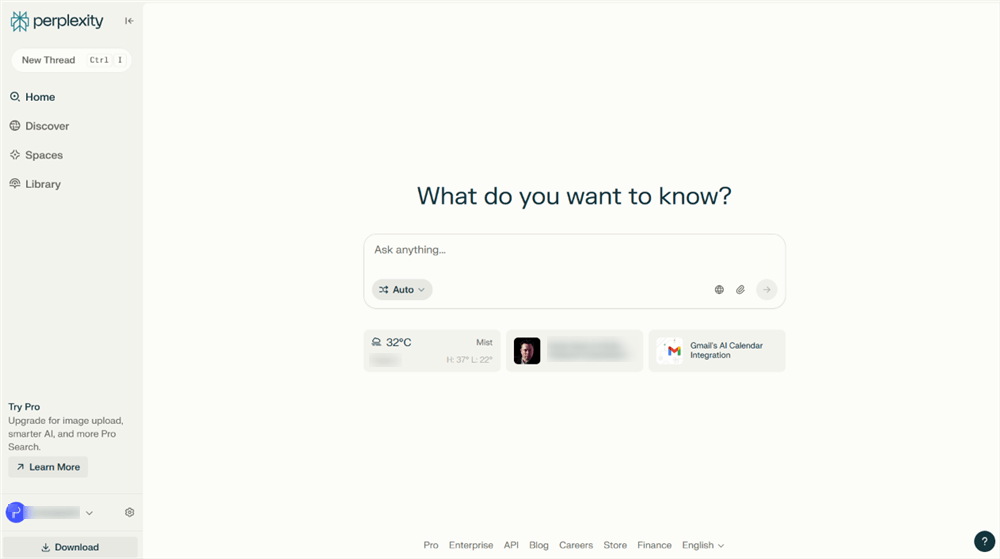
Perplexity AI has quickly become the go-to AI research assistant for marketers who need accurate, up-to-date answers with sources attached. Unlike ChatGPT's base model, Perplexity searches the web in real time and cites every claim — which matters enormously when you're building a business case or competitive brief.
For marketers, it's particularly useful for quick market sizing questions, industry trend summaries, and pulling together background research before a campaign or pitch. The Pro version adds access to multiple AI models (including GPT-4o and Claude) and deeper research modes.
Key features:
- Real-time web search with inline citations
- "Deep Research" mode for multi-step, report-style outputs
- Follow-up question threading for iterative research
- Collections for organizing research by project
- API access for teams building research workflows
Pricing: Free tier available. Pro plan at $20/month ($200/year); Max plan at $200/month for multi-model orchestration and advanced computing capacity.
Best for: Marketers who need fast, reliable answers to market research and business research questions — with sources they can actually cite in a deck or report.
Limitations: Not purpose-built for competitive intelligence (no automated monitoring). Research depth depends on what's publicly indexed. Not ideal for proprietary or niche B2B data.
Semrush — Best AI Research Tool for SEO and Competitive Intelligence
Semrush is the closest thing to an all-in-one marketing intelligence platform. It started as an SEO tool but has expanded into a comprehensive competitive research suite — covering keyword intelligence, traffic analysis, content gap analysis, backlink research, and advertising intelligence.
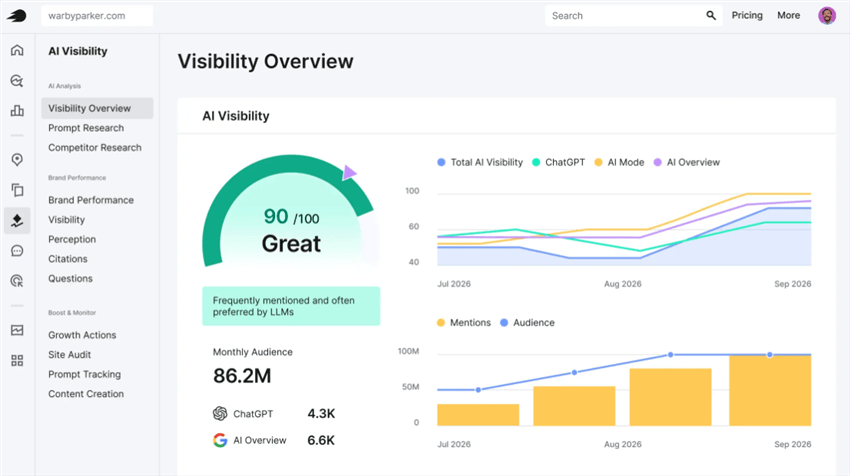
For digital marketers, Semrush's AI-powered features (including its Copilot assistant and AI-generated content briefs) make it a strong AI research assistant for competitive intelligence. You can track competitor keyword rankings, see what content is driving their traffic, and identify gaps in your own strategy — all from one dashboard.
Key features:
- Keyword research with AI-powered intent classification
- Competitor traffic and audience overlap analysis
- Content gap analysis and topic clustering
- Advertising research (Google Ads, display, social)
- AI Copilot for summarizing competitive insights
- Position tracking and SERP feature monitoring
Pricing: Free limited plan. Pro starts at $139.95/month ($117.33/mo billed annually); Guru at $249.95/month. The new AI-inclusive Semrush One suite ranges from $199 to $549/month.
Best for: Digital marketers and SEO teams who need deep competitive intelligence on search visibility, content strategy, and paid advertising.
Limitations: Expensive for solo marketers or small teams. Data is strongest for high-traffic domains; less reliable for niche or low-traffic competitors. The learning curve is steep.
💡 Pro tip: Use Semrush's Traffic Analytics + Audience Overlap tools together to map the competitive landscape before launching a new campaign or entering a new market.
Crayon — Best AI Research Tool for Real-Time Competitive Intelligence
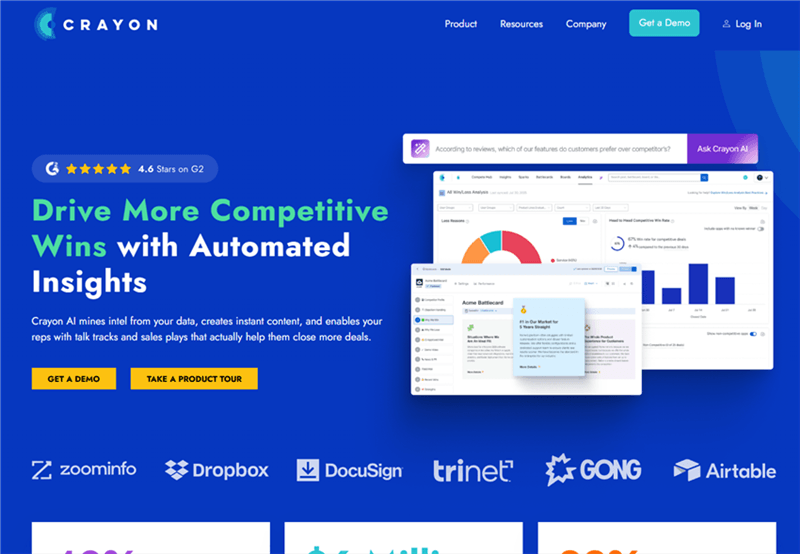
If competitive intelligence is your primary research need, Crayon is the most purpose-built tool on this list. It automatically monitors competitor websites, pricing pages, job postings, social media, and review sites — then surfaces changes in a structured feed your team can act on.
Crayon's AI layer summarizes what changed, why it might matter, and how it compares to your own positioning. For product marketers and competitive intelligence teams, this replaces hours of manual monitoring with an automated, always-on system.
Key features:
- Automated competitor monitoring across 100+ data types
- AI-generated battlecards and competitive summaries
- Pricing change and product update alerts
- Integration with Salesforce, Slack, and CRM tools
- Win/loss analysis tied to competitive data
Pricing: Custom enterprise pricing only. Mid-market procurement benchmarks for tracking 3 to 5 core competitors typically start around $15,000 to $20,000/year.
Best for: Product marketers and competitive intelligence teams who need to track competitor moves in real time and arm sales teams with up-to-date battlecards. For a practical framework on structuring this work, see our guide on how to do Amazon competitor analysis — the same principles apply across categories.
Limitations: Pricing is not transparent and tends to be enterprise-level. Overkill for solo marketers or small teams with limited competitive research needs. Setup requires time to configure monitoring properly.
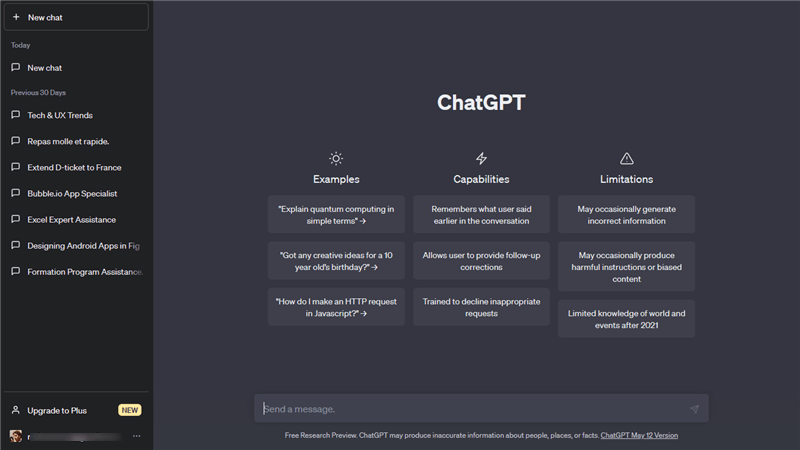
ChatGPT — Best Free AI Research Assistant for Secondary Research
ChatGPT remains one of the most versatile AI research assistants available — and the free tier is genuinely useful for marketers on a budget. For secondary research tasks (summarizing reports, synthesizing industry articles, drafting research frameworks, generating survey questions), it's hard to beat.
With GPT-4o now available on the free tier, ChatGPT can handle complex, multi-part research questions, analyze uploaded documents, and generate structured outputs like SWOT analyses, competitive matrices, and customer persona drafts.
Key features:
- Document upload and analysis (PDFs, spreadsheets, reports)
- Web browsing for real-time research (Plus/Pro plans)
- Custom GPTs for specialized research workflows
- Code interpreter for data analysis
- Long context window for processing large research documents
Pricing: Free tier available. Plus plan is $20/month; Pro plans are available at $100/month and $200/month for power users handling massive data operations
Best for: Marketers who need a flexible AI research assistant for secondary research, document analysis, and synthesizing information from multiple sources.
Limitations: Free tier has usage limits during peak hours. Without web browsing enabled, knowledge has a training cutoff. Outputs require fact-checking — ChatGPT can confidently generate inaccurate information, especially for niche or recent topics.
⚠️ Warning: ChatGPT is not reliable for real-time competitive intelligence or precise market data. Always verify statistics and claims against primary sources before using them in client-facing work.
AllyHub — Best AI Research Tool for Automating End-to-End Research Workflows
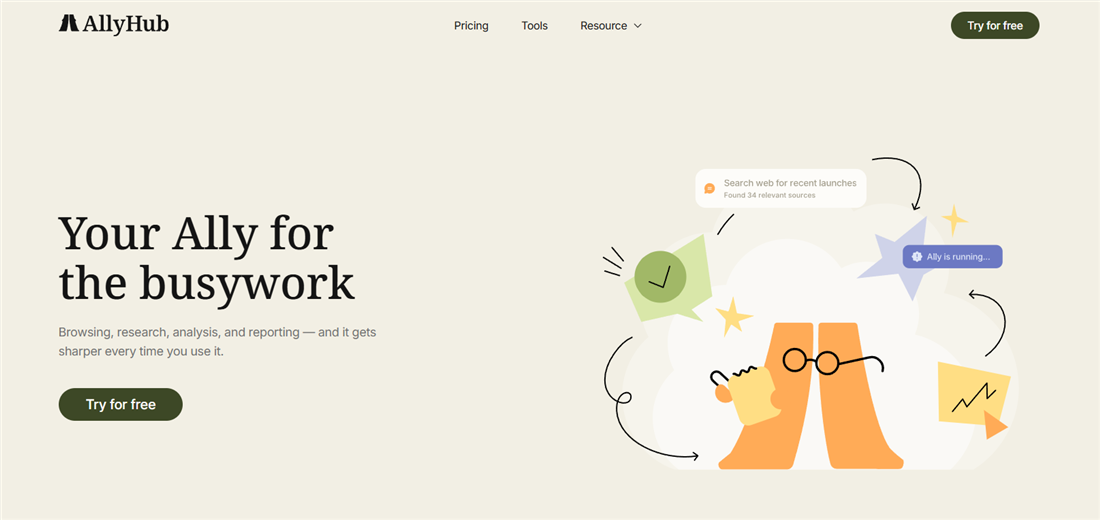
Most AI research tools answer questions. AllyHub executes research tasks.
AllyHub is a browser-native AI copilot that doesn't just generate research outputs — it operates your browser directly to complete multi-step research workflows: browsing competitor sites, extracting pricing data, pulling product reviews, compiling SERP analysis, and generating structured reports. For marketers who find themselves doing the same research tasks repeatedly, AllyHub's real differentiator is that it builds reusable research assets over time.
Every completed research task you run with AllyHub creates Skills, web notes, and Service assets — it continuously learns your preferences. As repeatable workflows become reusable assets, the effort required for each future run can decrease.
Key features:
- Direct browser execution — clicks, scrolls, extracts data from live web pages
- Multi-step research workflow automation (competitive audits, SERP analysis, review mining) — see the best Amazon seller tools for a sense of the e-commerce workflows it handles
- Reusable Service assets — package any research workflow into a one-click trigger
- Skills accumulation — AllyHub learns your research preferences and improves over time
- Web Notes — saves operational knowledge about specific websites for faster future research
- Report generation — produces structured research outputs in your preferred format
Pricing: Free tier available with daily task credits. Paid tiers start at $15.99/month (Starter), scaling to $39.99/month (Professional) and $159.99/month (Intensive Usage), with a 20% discount on annual billing.
Best for: Digital marketers and e-commerce teams who run the same research workflows repeatedly and want an AI research assistant that gets faster and smarter with every task — not one that starts from scratch each time.
Limitations: Best value emerges over repeated use — the compounding benefit takes a few tasks to kick in. Requires the Chrome extension. Not a replacement for specialized tools like Semrush (SEO data) or Brandwatch (social listening) — it's the layer that automates how you use those tools and synthesizes their outputs.
✅ Recommended: If you're a marketer who runs weekly competitive reports, monthly market overviews, or recurring research briefs, AllyHub's workflow automation and compounding intelligence can make it one of the highest-ROI options for teams with recurring research workflows.
Brandwatch — Best AI Research Tool for Consumer Intelligence and Social Listening
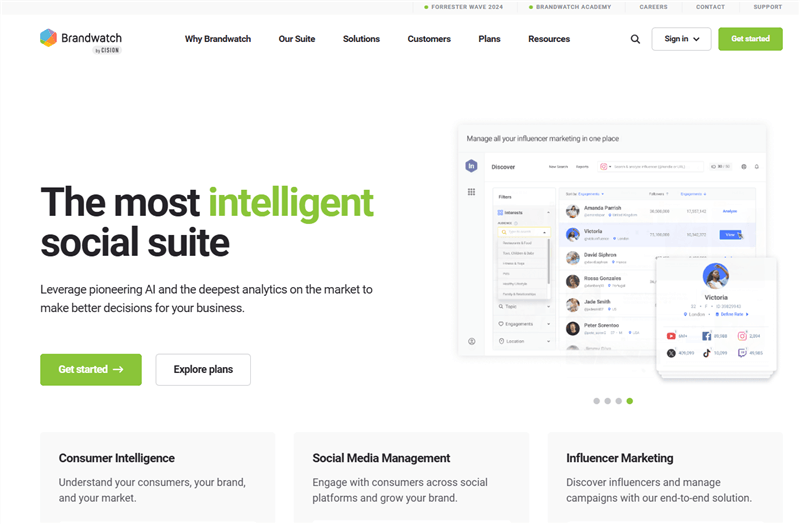
Brandwatch is the leading platform for social listening and consumer intelligence at scale. For marketers who need to understand what customers are actually saying — across social media, forums, news, and review sites — Brandwatch's AI layer surfaces sentiment trends, emerging topics, and audience insights that traditional surveys miss.
Its AI research assistant, Iris, can answer natural language questions about your brand, competitors, or market — pulling from Brandwatch's massive data index of consumer conversations. For teams that also want to automate social listening on Twitter alongside broader social channels, pairing Brandwatch with a dedicated sentiment tool can sharpen the signal.
Key features:
- Real-time social listening across 100M+ sources
- AI-powered sentiment analysis and trend detection
- Audience segmentation and consumer profiling
- Competitive benchmarking on share of voice
- Crisis detection and brand health monitoring
- Integration with major marketing and CRM platforms
Pricing: Custom enterprise pricing based on query volume and mentions, with mid-to-large marketing team contracts averaging around $50,000/year.
Best for: Brand marketers, social media teams, and consumer insights professionals who need to track brand perception, monitor trends, and understand audience sentiment at scale.
Limitations: Enterprise pricing puts it out of reach for most small teams. The volume of data can be overwhelming without a clear research framework. Requires time to set up meaningful queries and filters.
Similarweb — Best AI Research Tool for Digital Market Intelligence
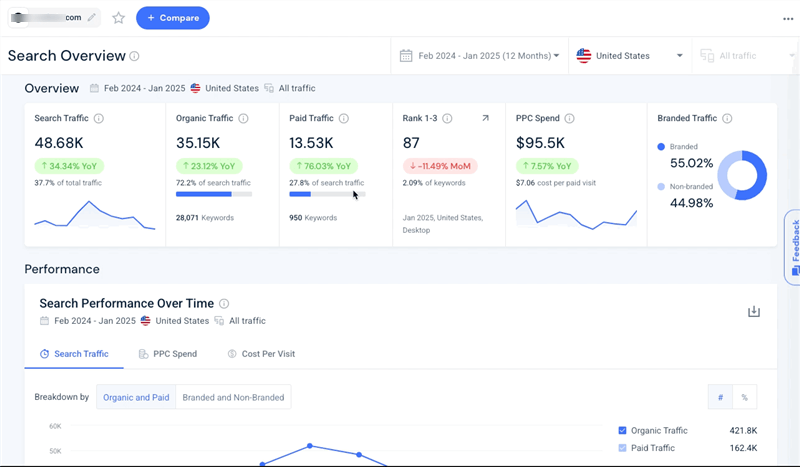
Similarweb gives marketers a clear view of the digital competitive landscape — traffic volumes, audience demographics, traffic sources, and engagement metrics for any website. For e-commerce marketers and digital strategists, it's an essential benchmarking tool.
The platform's AI features include automated competitive summaries, traffic trend analysis, and audience overlap mapping — helping you understand not just where competitors get their traffic, but who their audience is and how it overlaps with yours.
Key features:
- Website traffic and engagement benchmarking
- Traffic source breakdown (organic, paid, social, referral)
- Audience demographics and interest profiling
- Keyword gap analysis and paid search intelligence
- App intelligence for mobile market research
- Industry benchmarking reports
Pricing: Free limited plan. Digital Research Intelligence plans start from $125/month; custom enterprise contracts apply for full historical data and API access.
Best for: E-commerce marketers and digital strategists who need to benchmark their digital performance against competitors and identify traffic acquisition opportunities.
Limitations: Free plan data is heavily limited. Traffic estimates for smaller sites can be inaccurate. Less useful for B2B companies with low web traffic volumes.
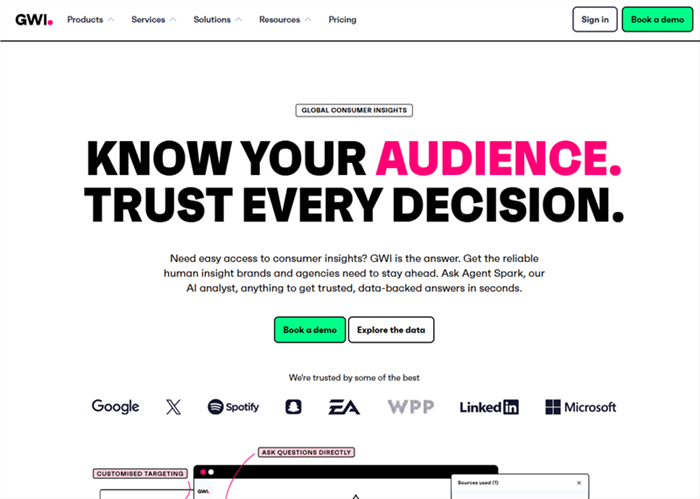
GWI Spark — Best AI Research Assistant for Audience and Consumer Research
GWI Spark is an AI-powered research assistant built on top of GWI's global consumer survey data — covering 50+ markets and 250,000+ data points on consumer attitudes, behaviors, and preferences. For marketers who need to understand their target audience at a demographic and psychographic level, it's one of the most powerful tools available.
Spark lets you ask natural language questions about your audience — "What do 25–34 year old e-commerce shoppers in the US care about most?" — and get structured, data-backed answers in seconds.
Key features:
- Natural language queries against global consumer survey data
- Audience profiling by demographics, interests, and behaviors
- Cross-market comparison for international campaigns
- Brand perception and category usage data
- Trend tracking across consumer attitudes over time
Pricing: Free tier available (up to 20 AI prompts/mo). Plus plan is $150/user/month for unlimited AI queries; full platform access rolls into custom Pro team plans.
Best for: Brand strategists, media planners, and e-commerce marketers who need deep audience intelligence to inform targeting, messaging, and campaign strategy.
Limitations: Data is survey-based, so it reflects stated preferences rather than actual behavior. Not useful for real-time or social media research. Pricing is enterprise-oriented.
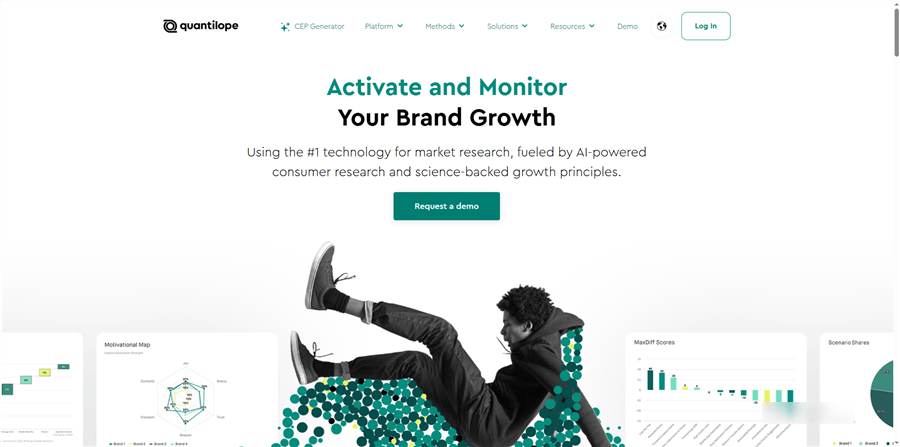
Quantilope — Best AI Research Tool for Automated Survey and Consumer Insights
Quantilope automates the end-to-end process of quantitative consumer research — from survey design to data collection to analysis and reporting. For marketing teams that regularly commission consumer research, it dramatically reduces the time and cost compared to traditional research agencies.
Its AI layer handles survey logic, automated analysis, and insight generation — turning raw survey data into structured findings with statistical significance testing built in.
Key features:
- Automated survey design with validated methodologies
- Real-time data collection and analysis
- AI-generated insight summaries and reports
- Advanced methods (conjoint, MaxDiff, segmentation) without manual setup
- Continuous tracking studies for brand health monitoring
Pricing: Custom pricing based on methodology. The automated Business tier starts at $2,000/month (billed annually at $22,000/year), covering core automated methodologies and AI analytics.
Best for: Marketing researchers and insights teams who need to run rigorous consumer research faster and more cost-effectively than traditional agency models.
Limitations: Not a self-serve tool for quick ad-hoc research — requires onboarding and setup. Overkill for teams that only need occasional research. Pricing reflects its enterprise positioning.
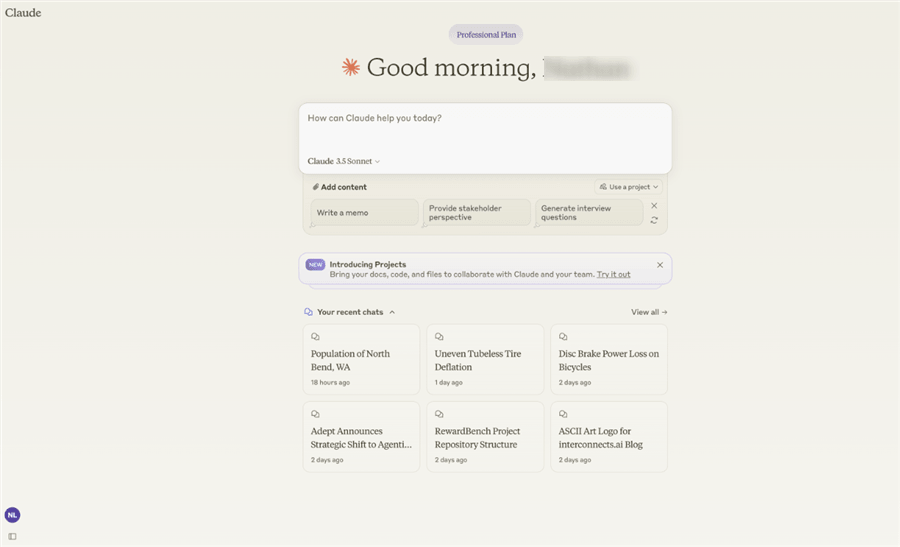
Claude — Best AI Research Assistant for Deep Document Analysis
Claude (by Anthropic) is the AI research assistant of choice when you need to process large volumes of text — lengthy reports, research papers, competitor content, or internal documents. Its extended context window (up to 200K tokens on Claude 3.5) means it can read and synthesize entire research reports in a single session.
For marketers doing deep competitive analysis, content audits, or synthesizing multiple industry reports, Claude's ability to hold and reason across large documents is a genuine differentiator.
Key features:
- 200K token context window for processing large documents
- Strong analytical reasoning for complex research questions
- Document comparison and synthesis across multiple files
- Nuanced, well-structured long-form outputs
- Available via API for custom research workflow integration
Pricing: Free tier available with hourly usage limits. Pro plan is $20/month; Max tier is available at $100/month for heavy document analysis and high-volume text audits.
Best for: Marketers and analysts who need to synthesize large research documents, conduct content audits, or perform deep competitive analysis across multiple sources.
Limitations: No real-time web access on the base model (requires tool use or API integration). Less useful for quick, real-time research queries. Outputs can be verbose — requires clear, specific prompting to get concise answers.
💡 Pro tip: Upload competitor whitepapers, annual reports, or long-form content to Claude and ask it to extract positioning claims, key messages, and content gaps relative to your own material.
How to Choose the Right AI Research Tool for Your Needs
With ten strong options on this list, the right choice depends on your primary research use case and team size.
For AI Research Assistant for Market Research
If your main need is understanding markets, audiences, and consumer trends, start with Perplexity AI for fast secondary research and GWI Spark if you need structured audience data. Quantilope is the right choice if you run formal consumer research studies.
For AI Research Assistant for Competitive Intelligence
Crayon is the gold standard for automated competitive monitoring. Semrush is the best choice if competitive intelligence overlaps heavily with SEO and content strategy. Similarweb adds the digital traffic layer.
For AI Research Assistant for Business Research
Claude handles deep document analysis and synthesis. Perplexity AI covers real-time business research with citations. ChatGPT is the most flexible general-purpose option.
For Automating Recurring Research Workflows
AllyHub is the strongest fit when you need to execute research tasks end-to-end and build reusable assets from every run — making it the right choice for marketers who want their research operation to compound in efficiency over time.
Quick Decision Guide
If you need... | Start with... |
Fast answers with citations | Perplexity AI |
SEO + competitive data | Semrush |
Real-time competitor monitoring | Crayon |
FAQ: AI Research Tools
What is the best AI research tool for marketers in 2026?
It depends on your core need: Perplexity AI is best for fast, cited general research; Crayon leads in real-time competitor tracking; and AllyHub is the strongest choice for automating recurring, end-to-end research workflows.
Can AI tools replace traditional market research?
No. AI dramatically accelerates secondary research (synthesizing data and tracking trends), but it cannot replace primary research (surveys, interviews, focus groups) for high-stakes decisions. Use AI to handle the heavy lifting, freeing up budget for targeted primary research.
What's the difference between an AI research assistant and a competitive intelligence tool?
AI research assistants (like Perplexity or ChatGPT) are general-purpose tools designed to answer ad-hoc questions. Competitive intelligence tools (like Crayon or Semrush) are purpose-built platforms that automatically track, alert, and analyze competitor activity like pricing and messaging shifts.
How do AI research tools handle data accuracy?
It varies. Platforms like Perplexity and Semrush fetch real-time web data and provide inline citations for verification. General LLMs like ChatGPT can confidently generate inaccurate information (hallucinations), so always double-check key data points before using them.
Are AI research tools worth the cost for small marketing teams?
Yes. Start with robust free tiers (Perplexity, ChatGPT, Similarweb) to find what fits. For small teams, the highest ROI comes from investing in a tool that automates your most time-consuming, repetitive research tasks.
What AI tools are best for e-commerce market research?
The ultimate e-commerce stack includes: Semrush for search intent, Similarweb for traffic benchmarking, Brandwatch for consumer sentiment, and AllyHub for automated competitor monitoring and review mining.
How is AllyHub different from other AI research assistants?
Most assistants just answer questions; AllyHub executes tasks. It directly operates your browser to click, scroll, and extract live data. Crucially, it saves these workflows as reusable assets, meaning your recurring research reports get faster and cheaper to run over time.