Relevance AI’s pricing model and workflow complexity are the main reasons marketers look for alternatives.
Action credits, Vendor credits, and usage-based billing make costs difficult to predict, while multi-agent workflows often require more setup time than expected. For teams that need fast execution and clear ROI, this creates immediate friction.
At the same time, limited native integrations and a steep learning curve make it harder to fit Relevance AI into everyday marketing workflows like content production, data extraction, and campaign operations.
This guide compares 8 Relevance AI alternatives that address these exact issues — focusing on transparent pricing, faster setup, and tools built for real-world marketing use cases.
Key Takeaways
- Best overall alternative: Zapier is the most versatile Relevance AI alternative for marketers who need broad app integrations and predictable task-based pricing.
- Best for browser-native automation: AllyHub is the strongest pick for marketers who need to automate real browser tasks — research, scraping, content workflows — without cloud VMs or complex setup.
- Best free alternative: n8n's self-hosted Community Edition is free forever, making it the top choice for technically comfortable marketers on a tight budget.
- Best for visual workflow building: Make offers the most intuitive drag-and-drop scenario builder among all Relevance AI alternatives.
- Relevance AI is still worth it if: You need multi-agent orchestration with 400+ pre-built templates and your team has the technical bandwidth to manage credit consumption carefully.
- Bottom line: Most marketers switching from Relevance AI are looking for either simpler pricing, broader integrations, or more direct browser-level automation — the alternatives below cover all three.
Quick Comparison: Top Relevance AI Alternatives at a Glance
Alternative | Best For | Starting Price | Free Plan? |
AllyHub | Browser-native automation, research & scraping | $19.99/mo | ✅ Yes |
Zapier |
8 Best Relevance AI Alternatives
AllyHub — Best for Browser-Native Automation and Research Workflows
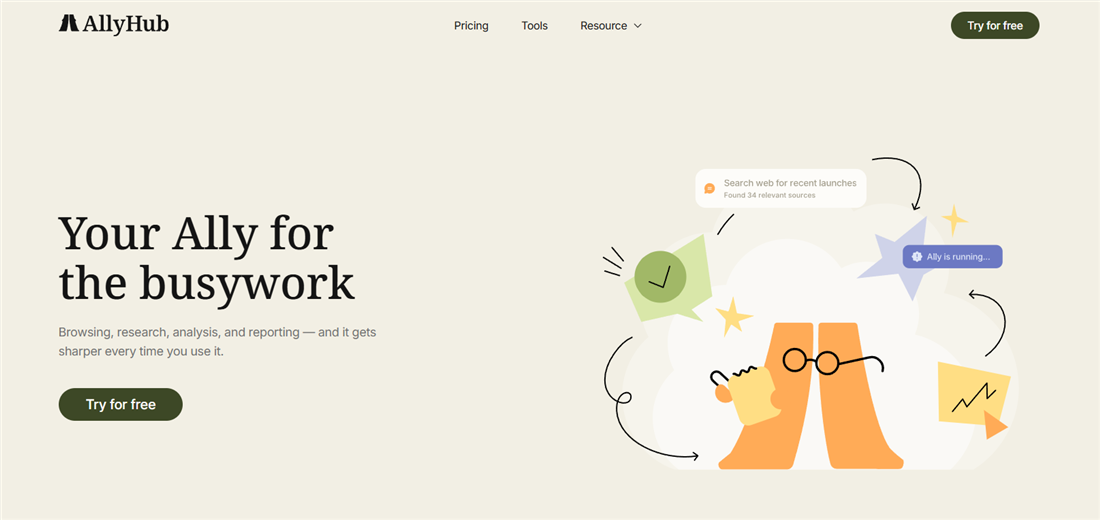
Unlike API-driven automation tools, AllyHub operates at the interface level — interacting with websites in real time to gather data, move across pages, and complete workflows that usually require manual effort. For marketers who need to handle real-world workflows like competitor research, review analysis, and cross-platform data collection, it solves a gap that traditional agent platforms often struggle with.
Why it stands out vs. Relevance AI: Relevance AI is designed around structured data pipelines and API-connected agents. AllyHub, by contrast, operates your actual Chrome browser using your existing sessions, allowing it to work across sites that require logins, dynamic content, or multi-step navigation. This makes it especially effective for workflows like extracting authenticated data, monitoring competitor pages, or running end-to-end research tasks across multiple platforms.
Key features:
- Browser-native execution via Chrome extension — no setup or infrastructure required
- Pre-built one-click Services to package and reuse common workflows
- Self-evolving Skills system — each completed task builds reusable assets that improve future runs
- Continuous learning via memory (preferences, context, workflows)
- Credit-based system designed around ROTI (Return on Token Investment), where each run contributes to long-term efficiency
Pricing vs. Relevance AI: Pricing vs. Relevance AI: Relevance AI has shifted toward a usage-based and sales-led pricing model, with limited public visibility into paid tiers beyond its free plan. Costs are driven by Actions and Vendor Credits, which can make total spend harder to estimate upfront. AllyHub, by contrast, offers a simpler entry point with a fixed monthly plan and a free tier with daily credits.
Best for: Marketers and e-commerce teams who need to automate browser-based research tasks — Amazon review analysis, competitor monitoring, social media listening, web scraping — without managing cloud infrastructure or complex agent configurations.
Limitations vs. Relevance AI: AllyHub doesn't have Relevance AI's multi-agent orchestration depth or its 400+ pre-built templates for sales/ops workflows. It also lacks enterprise features (no SSO, no SOC2 certification, no team collaboration workspace). Since it runs on your local browser, you need to stay online during task execution — there's no background cloud execution.
Zapier — Best for Broad App Integrations and Predictable Pricing
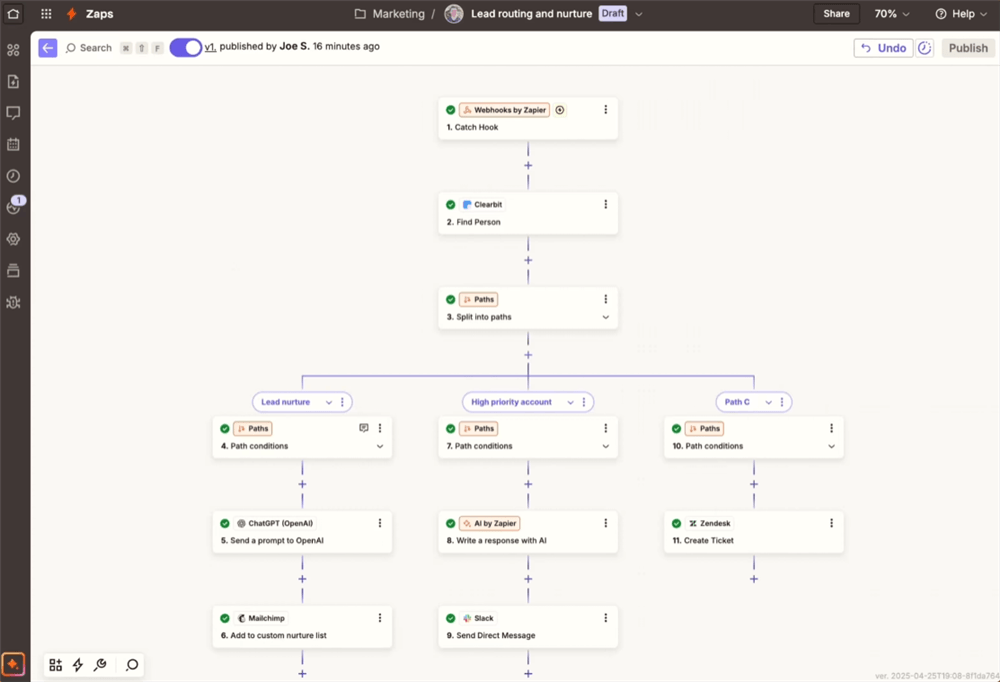
Zapier is the most widely used workflow automation platform for marketers, connecting 9,000+ apps with a straightforward task-based pricing model. If your main frustration with Relevance AI is unpredictable credit consumption or limited native integrations, Zapier solves both directly.
Why it beats Relevance AI for integration breadth: Relevance AI connects to roughly 2,000 tools; Zapier connects to 9,000+. For marketers running workflows across HubSpot, Salesforce, Mailchimp, Slack, Google Ads, and dozens of other platforms, Zapier's connector library is simply unmatched. Pricing is also straightforward: you pay per task run, and tasks don't expire.
Key features:
- 9,000+ app integrations (largest library of any automation platform)
- Zapier AI steps for generative tasks within workflows
- Zapier Agents for multi-step AI decision automation
- Multi-step Zaps with conditional logic and filters
- Tables and Interfaces for lightweight data management
Pricing vs. Relevance AI: Zapier’s Professional plan starts at $29.99/month, offering predictable entry-level pricing. Relevance AI, by contrast, has moved to custom pricing, making direct comparisons less transparent. Zapier’s Team plan is $103.5/month, positioning it as a more cost-efficient and clearly defined option for scaling teams.
Best for: Marketing teams that need to connect many different SaaS tools and want simple, predictable per-task pricing without managing credits or vendor compute costs.
Limitations vs. Relevance AI: Zapier's AI capabilities are less sophisticated than Relevance AI's multi-agent orchestration. It's better for connecting existing tools than for building autonomous AI agents that reason and make decisions. Complex branching logic can also get expensive quickly as task counts multiply.
Make — Best for Visual Workflow Building
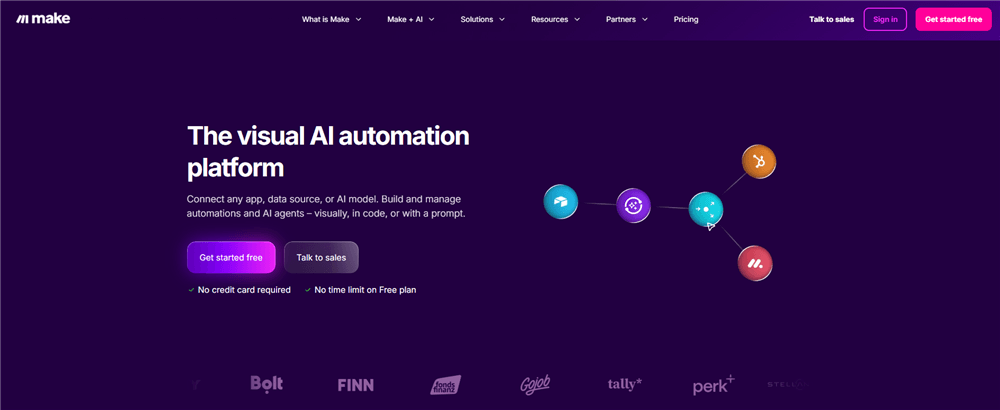
Make (formerly Integromat) offers the most visually intuitive workflow builder among all Relevance AI alternatives. Its drag-and-drop scenario canvas makes it easy to see exactly how data flows between steps — a significant advantage for marketers who want to understand and troubleshoot their automations without writing code.
Why it beats Relevance AI for visual clarity: Relevance AI's workflow canvas is functional but can become hard to navigate as agent complexity grows. Make's visual scenario builder shows every module, connection, and data transformation in a clear, readable layout. Non-technical marketers consistently find it easier to build and maintain.
Key features:
- Visual drag-and-drop scenario builder with real-time data flow visualization
- 3,000+ app integrations
- AI modules for content generation, classification, and data extraction
- Webhooks, scheduling, and error handling built in
- Mobile app with GPS triggers for location-based automations
Pricing vs. Relevance AI: Make's Core plan starts at $10.59/month for 10,000 operations — significantly cheaper than Relevance AI's Pro plan. Note that Make counts "operations" per module step, not per workflow run, so complex multi-step scenarios consume operations faster.
Best for: Marketers who want to build and maintain their own automations visually, without relying on a developer, and who value being able to see exactly what their workflow is doing at each step.
Limitations vs. Relevance AI: Make doesn't have Relevance AI's AI agent capabilities or multi-agent orchestration. It's a workflow automation tool, not an AI agent platform — so tasks requiring autonomous reasoning or dynamic decision-making are outside its scope.
n8n — Best for Open-Source Flexibility and Self-Hosting
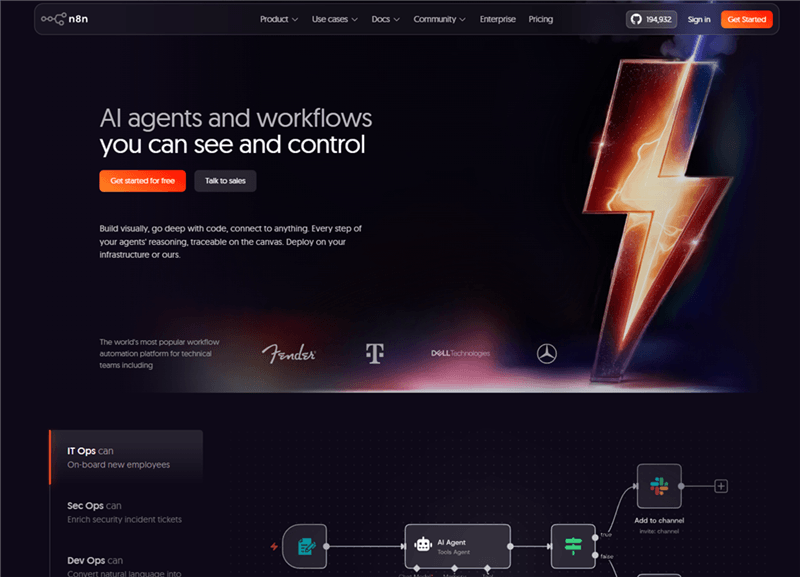
n8n is an open-source workflow automation platform that gives technically comfortable marketers full control over their data, infrastructure, and costs. Its self-hosted Community Edition is free forever — making it the most cost-effective Relevance AI alternative for teams willing to manage their own server.
Why it beats Relevance AI for cost control: Relevance AI's pricing is opaque and can escalate quickly at production volume. n8n's self-hosted option costs only what you pay for server infrastructure (typically $3–7/month on a basic VPS). Even the cloud-hosted plans are significantly cheaper than Relevance AI's Team tier.
Key features:
- Open-source (Apache 2.0 license) — full code access and customization
- 500+ integrations with a code + visual hybrid builder
- AI agent nodes with LLM integration (OpenAI, Anthropic, and more)
- MCP (Model Context Protocol) support for connecting AI models to tools
- Self-hosted or cloud-hosted options
Pricing vs. Relevance AI: n8n's cloud Starter plan is $24/month for 2,500 workflow executions. Self-hosting is free (server costs only). Relevance AI, by contrast, uses custom pricing, making costs less predictable. For teams with technical resources, n8n can be a significantly more cost-efficient option.
Best for: Marketing teams with a developer or technically skilled member who want maximum flexibility, data ownership, and cost control — and are comfortable managing infrastructure.
Limitations vs. Relevance AI: n8n requires more technical setup than Relevance AI, especially for self-hosting. It doesn't have Relevance AI's pre-built AI agent templates or its no-code-first experience. Non-technical marketers will find the learning curve steeper.
Lindy AI — Best for No-Code AI Agents for Email and CRM
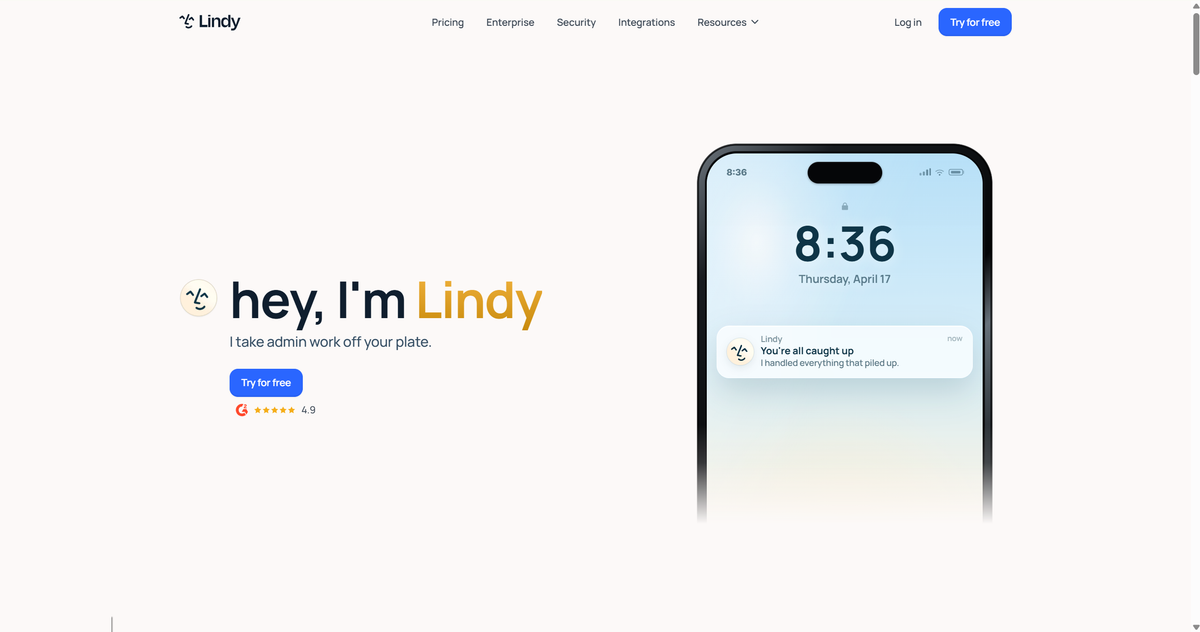
Lindy AI is a no-code AI agent builder specifically designed for business workflows — email automation, meeting scheduling, CRM updates, and customer support. If you're using Relevance AI primarily for sales and marketing outreach automation, Lindy is a more focused and polished alternative.
Why it beats Relevance AI for email and CRM workflows: Lindy has deeper native integrations with email clients, calendars, and CRM platforms than Relevance AI. Its agents are purpose-built for common business communication tasks, with a more intuitive setup experience for non-technical users.
Key features:
- Hundreds of integrations including Gmail, Outlook, HubSpot, Salesforce, Slack
- Pre-built AI agents for email triage, meeting scheduling, lead qualification, and CRM updates
- SOC2 and HIPAA compliance (enterprise-ready)
- Multi-agent workflows with human-in-the-loop approval steps
- 7-day free trial on all paid plans
Pricing vs. Relevance AI: Lindy’s Plus plan starts at $49.99/month, positioning it as a higher entry point. Relevance AI, by contrast, uses custom pricing, making direct comparisons less transparent. Lindy’s usage-based allowances can also become less predictable as usage scales.
Best for: Marketing and sales teams that want AI agents specifically for email automation, lead nurturing, and CRM management — with enterprise-grade security compliance.
Limitations vs. Relevance AI: Lindy is more narrowly focused on communication and CRM workflows. It doesn't have Relevance AI's breadth of agent templates for content creation, SEO, or market research. Pricing is also higher than most alternatives on this list.
Gumloop — Best for AI-Native Marketing Workflows
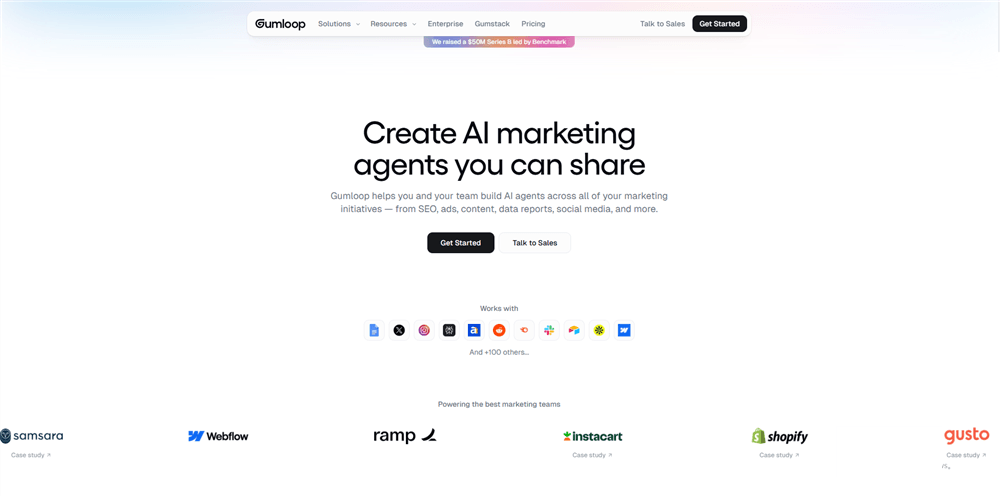
Gumloop is a visual AI workflow builder designed specifically for growth and marketing teams. Unlike general automation platforms, Gumloop is built AI-first — every workflow can incorporate LLM steps, web scraping, and data enrichment natively.
Why it beats Relevance AI for marketing-specific AI workflows: Gumloop's interface is designed around marketing use cases — content generation, lead enrichment, SEO workflows, and competitive research. It's more approachable than Relevance AI for marketers who want AI-powered workflows without the complexity of multi-agent orchestration.
Key features:
- Visual AI workflow builder with native LLM integration
- Web scraping and data extraction nodes built in
- Chrome extension for browser-based workflow triggers
- MCP Server hosting for connecting AI models to external tools
Pricing vs. Relevance AI: Gumloop’s Pro plan starts at $37/month, offering a mid-range entry point. Relevance AI, by contrast, uses custom pricing, making direct comparisons less transparent. Like Relevance AI, Gumloop’s credit-based usage can vary depending on model complexity, which may impact cost predictability at scale.
Best for: Growth marketers and content teams who want to build AI-powered workflows for content creation, lead enrichment, and competitive research without deep technical expertise.
Limitations vs. Relevance AI: Gumloop is less mature than Relevance AI and has a smaller template library. Its multi-agent capabilities are more limited, and enterprise features (SSO, audit logs) are not yet available.
MindStudio — Best for Multi-Model AI Agents at Cost-at-Use Pricing
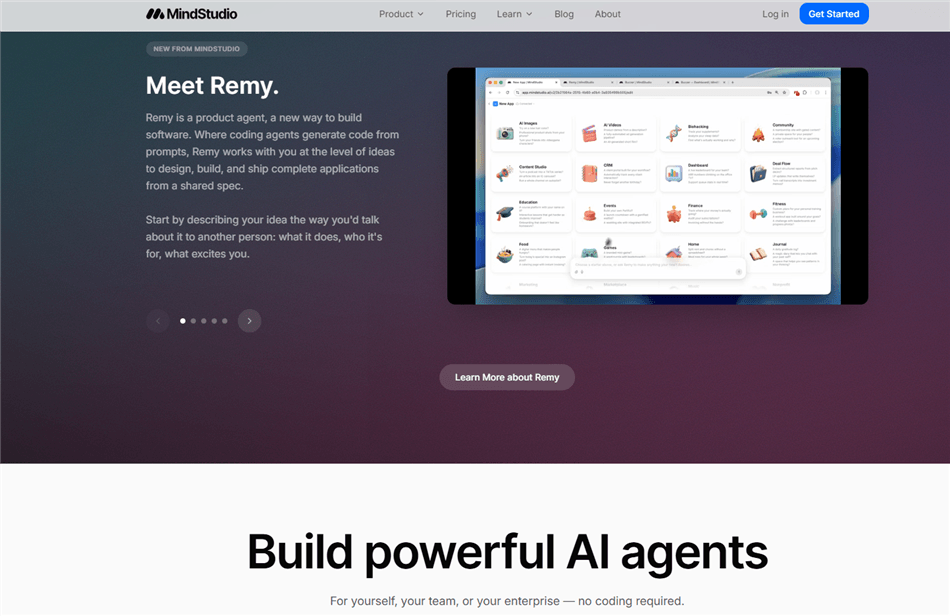
MindStudio is a no-code platform for building and deploying AI agents with access to 200+ AI models. Its pricing model is notably different from Relevance AI: the platform subscription is flat-rate, and AI model usage is billed at cost (no markup) — making it more predictable for marketers who want to control their LLM spend.
Why it beats Relevance AI for pricing transparency: Relevance AI charges a 20% markup on LLM costs if you don't bring your own API key. MindStudio bills AI model usage at cost, with no markup. For marketers running high-volume content or research workflows, this difference adds up quickly.
Key features:
- 200+ AI models accessible from one platform
- 1,000+ integrations via Zapier and native connectors
- No-code agent builder with visual workflow design
- Individual plan: unlimited agents and runs for $20/month
- Free tier: 1 agent, 1,000 runs/month
Pricing vs. Relevance AI: MindStudio’s Individual plan starts at $20/month, with AI model usage billed separately at cost. Relevance AI, by contrast, uses custom pricing, making overall costs less predictable. This model can offer more flexibility, but total spend depends heavily on usage.
Best for: Marketers who want to experiment with multiple AI models for different tasks — content generation, classification, research — and want transparent, at-cost model pricing without platform markups.
Limitations vs. Relevance AI: MindStudio has less sophisticated multi-agent orchestration than Relevance AI. Its template library is smaller, and it lacks Relevance AI's enterprise governance features (SSO, audit logs, multi-region storage).
Bardeen — Best for GTM Automation with AI-Observed Workflows
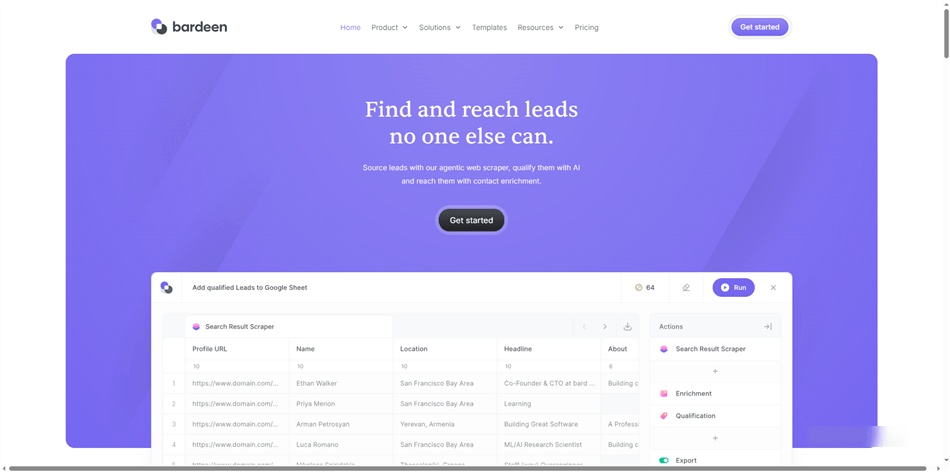
Bardeen is a browser extension-based automation tool built specifically for go-to-market (GTM) teams. Its standout feature is AI-observed workflow creation — Bardeen can watch you perform a task in the browser and automatically generate an automation from it.
Why it beats Relevance AI for GTM teams: Relevance AI requires you to build agents from scratch using its workflow canvas. Bardeen's AI can observe your existing browser workflows and turn them into automations — dramatically reducing setup time for sales and marketing teams who want to automate repetitive prospecting, outreach, and research tasks.
Key features:
- AI-observed workflow creation (watches and learns from your browser actions)
- Chrome extension with many integrations
- Pre-built playbooks for sales prospecting, LinkedIn outreach, and CRM enrichment
- Scraping and data extraction from any website
- Free plan available; Basic plan at $10/month
Pricing vs. Relevance AI: Bardeen’s Basic plan starts at $10/month, offering a low-cost entry point, along with a relatively generous free tier. Relevance AI, by contrast, uses custom pricing, making costs less transparent. Bardeen is a more accessible option for simple automation needs.
Best for: Sales and marketing teams that want to automate browser-based GTM workflows — LinkedIn prospecting, CRM data entry, competitor research — with minimal setup time.
Limitations vs. Relevance AI: Bardeen is focused on browser-based task automation rather than multi-agent AI orchestration. It doesn't have Relevance AI's depth for complex, multi-step AI reasoning workflows or its enterprise governance features.
The Final Verdict: How to Build Your Marketing Automation Stack
Choosing the right alternative comes down to how you prefer to work:
The Builders: If you have the technical patience to map out complex logic trees and just want a cheaper, more transparent canvas than Relevance AI, use Gumloop or Make.
The Executors: If you want an AI that acts like a human assistant—operating directly in your Chrome browser to scrape data, research competitors, and run repetitive web tasks—install AllyHub.
FAQ: Relevance AI Alternatives
What is Relevance AI used for?
Relevance AI is an AI agent platform used by sales, marketing, and operations teams to automate workflows like lead qualification, content generation, outreach, and data processing.
Is Relevance AI worth it for small marketing teams?
It can be powerful, but pricing is less predictable and workflows can be complex. Many small teams prefer simpler tools like Zapier, Make, or Bardeen for ease of use and clearer costs.
What is the best free Relevance AI alternative?
n8n’s self-hosted version is free (you only pay for hosting). Zapier, Make, and Gumloop also offer free tiers suitable for testing workflows.
How does Relevance AI compare to Hugging Face?
Relevance AI is a no-code tool for business users, while Hugging Face is built for developers working with AI models. Most marketers will find Relevance AI or its alternatives easier to use.
Can AllyHub replace Relevance AI for marketing automation?
They focus on different use cases. Relevance AI is better for structured workflows, while AllyHub excels at browser-based tasks like scraping and interacting with websites. For many marketers, AllyHub works well as a standalone tool.
Is there a Relevance AI alternative with better enterprise features?
Yes — Lindy AI, n8n (self-hosted), and Zapier all offer strong enterprise capabilities like security controls and scalability. Relevance AI also supports enterprise use, but with custom pricing.
What’s the easiest Relevance AI alternative to get started with?
Bardeen and Make are the easiest for non-technical users. AllyHub is also quick to start with its Chrome extension and pre-built workflows.