Amazon ranking isn’t just a keyword problem — it’s a problem of optimizing every component of your listing and the workflow behind it.
Most listings don’t fail due to a lack of data, but because that data is fragmented. Keywords sit in one tool, competitor insights in another, and real customer language is buried in reviews. Turning all of this into a structured, high-converting listing becomes a slow, manual process.
That’s where most marketers get stuck — not knowing what to do, but struggling to execute efficiently at scale.
The best Amazon listing optimization tools solve this gap. They don’t just provide keyword data — they connect research, competitor analysis, and customer insights into a streamlined workflow that produces optimized listings faster, with better ranking and conversion outcomes.
Key Takeaways
- Best overall: AllyHub — full workflow from research to ready-to-publish listing
- Best keyword tool: Helium 10 — deepest database + advanced listing toolkit
- Best free option: SellerApp — solid audits and keyword research at no cost
- Best for beginners: Jungle Scout — easy to use with built-in AI copywriting
- Best for launches: Viral Launch — optimized for ranking speed and campaigns
- Best for multi-channel: Listing Mirror — centralized cross-platform listing management
- What matters: Keyword depth, competitor/review insights, AI quality, and workflow efficiency
- Bottom line: Use AllyHub for end-to-end execution; Helium 10 for data-driven keyword optimization
Why Amazon Listing Optimization Matters for Marketers
Amazon's A10 algorithm rewards listings that match buyer intent with precision—across keywords, content quality, and conversion signals. For marketers, listing optimization is continuous: tracking rankings, analyzing competitors, mining reviews, and updating listings at scale. The right tool doesn’t just save time — it uncovers missed opportunities and turns data into high-converting copy.
Best Amazon Listing Optimization Tools: Quick Comparison Table
Tool | Best For | Free Option | Starting Price | AI Writing | Rating |
AllyHub | End-to-end listing optimization workflow | ✅ Yes |
10 Best Amazon Listing Optimization Tools
AllyHub — Best End-to-End Amazon Listing Optimization Workflow
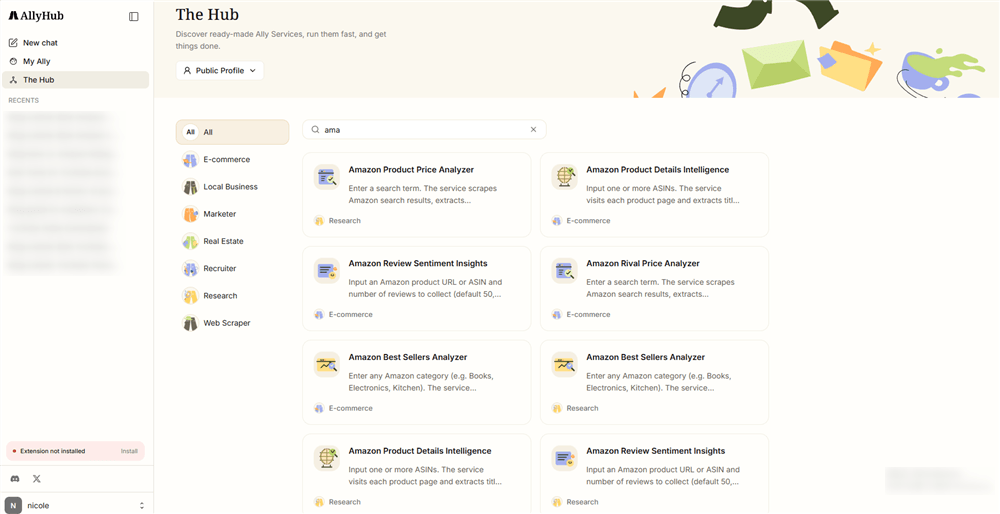
AllyHub is the only tool on this list that handles the entire Amazon listing optimization process in a single, connected workflow — from keyword research and competitor analysis to review mining and AI-generated listing copy — without requiring you to switch between platforms or manually transfer data between steps.
Here's what makes AllyHub's approach different from every other tool on this list: most Amazon optimization tools give you data and leave the synthesis to you. AllyHub closes that gap. You describe what you want — "analyze the top 20 listings in this category, extract the keywords they're targeting, mine the top reviews for customer language, and write me an optimized listing" — and AllyHub executes the entire workflow end-to-end, delivering a structured, ready-to-publish listing as output.
How it works:
Step 1. Keyword Research: Extracts live keyword signals and competitor listing data directly from Amazon.
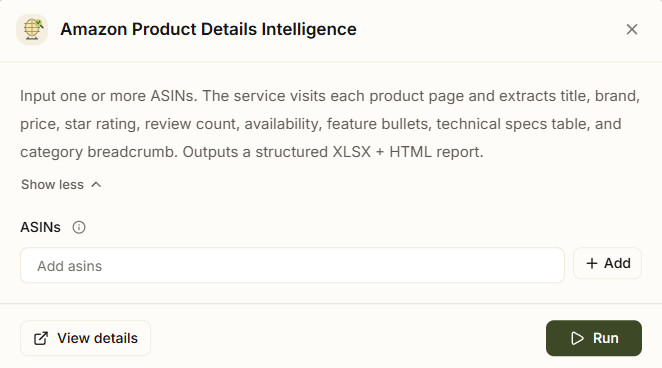
Step 2. Competitor Analysis: Identifies positioning patterns, gaps, and high-performing angles.
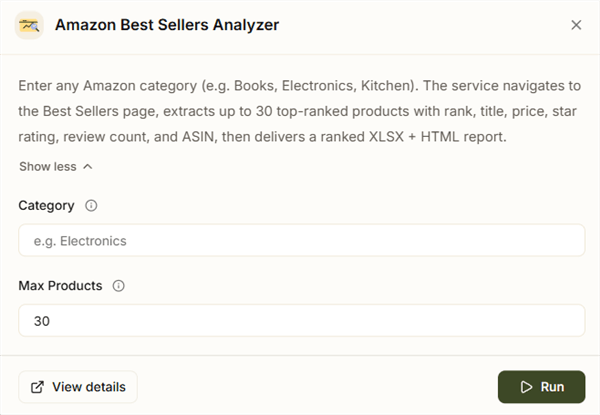
Step 3. Review Mining: Mines reviews to surface real buyer language and pain points.
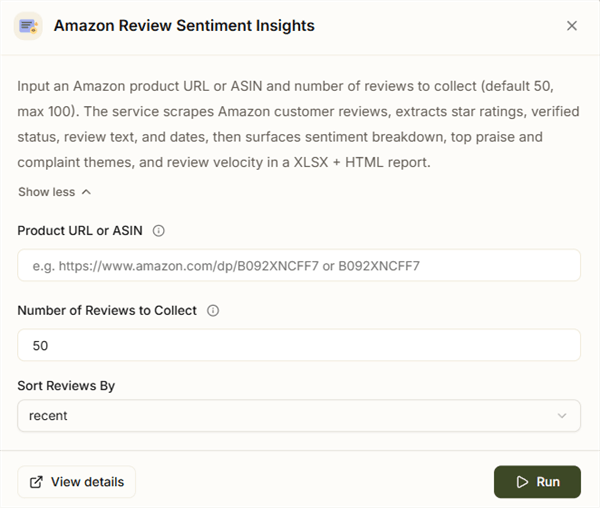
Step 4. AI Listing Generation: Generates a complete, optimized listing (title, bullets, description, backend keywords).
The result compounds over time. Every Amazon workflow AllyHub runs builds on what it already knows about the site — navigation patterns, data structures, pagination behavior — so each subsequent task runs faster and more efficiently than the last.
Key features:
- End-to-end listing workflow: keyword research → competitor analysis → review mining → AI copywriting in one pipeline
- Bulk competitor scraping: extract listing data from hundreds of ASINs without code
- Review sentiment analysis: identify customer pain points, praise patterns, and conversion language from real reviews
- AI listing generation: produces optimized title, bullets, description, and backend keywords grounded in live research data
- Best Seller monitoring: track category rankings and competitor listing changes over time
- Compounding efficiency: each Amazon workflow makes the next one faster — knowledge accumulates across tasks
- No-code operation: plain-language instructions, no technical setup required
Pricing: Free to start. Paid plans available for higher usage.
Best for: E-commerce marketers and agencies who want a single workflow that goes from zero to a finished, research-backed, optimized Amazon listing — without stitching together multiple tools or manually transferring data between steps.
Limitations: AllyHub doesn't have a pre-built Amazon keyword database with historical search volume trends the way Helium 10 does — its keyword intelligence comes from live scraping of current listings. For marketers who need long-term keyword trend data or PPC bid recommendations, pairing AllyHub with a dedicated tool like Helium 10 gives you the best of both approaches.
💡 Pro tip: Give AllyHub a target ASIN and a category keyword, and ask it to: (1) scrape the top 20 competitor listings, (2) mine the top 100 reviews for customer language, and (3) write an optimized listing using the patterns it found. The entire workflow runs automatically — and because AllyHub builds on what it learns, running it again for a different product in the same category takes a fraction of the time.
Helium 10 — Best Dedicated Amazon Listing Optimization Suite
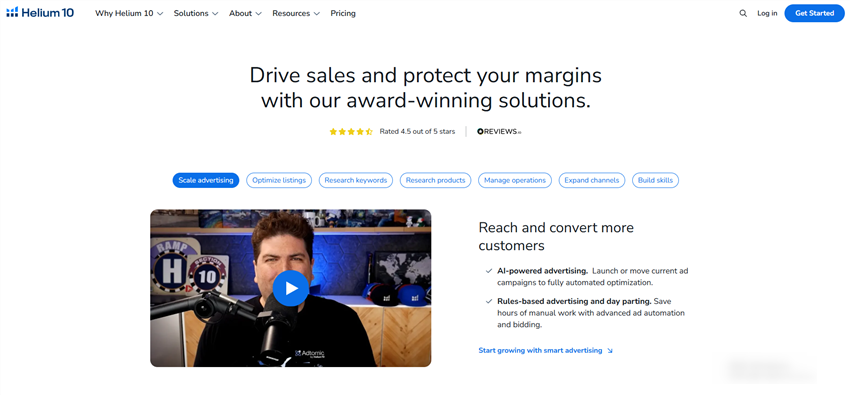
Helium 10 is the most comprehensive dedicated Amazon seller platform available, and the benchmark for keyword database depth and listing-specific tooling. For marketers who want a pre-built, structured suite with historical search volume data, PPC integration, and a proven track record across millions of sellers, Helium 10 remains the gold standard.
The listing-specific tools are where Helium 10 earns its reputation. Scribbles ensures you've placed every target keyword in the right listing field. Frankenstein processes bulk keyword lists and removes duplicates. The AI Listing Builder generates full listing copy from a product description and keyword set — a genuine time-saver for teams producing listings at scale.
Key features:
- Scribbles: keyword integration tracker that flags missing terms in real time
- Frankenstein: bulk keyword processor and deduplicator
- AI Listing Builder: generates title, bullets, and description from keywords + product info
- Index Checker: confirms which keywords Amazon has indexed for your listing
- Cerebro: reverse ASIN lookup to mine competitor keyword strategies
- Rank Tracker: monitors keyword position over time
Pricing: Platinum ($129/mo), Diamond ($359/mo). Annual billing saves ~20%.
Best for: E-commerce marketers and agencies who need a complete, structured toolkit with a deep historical keyword database, listing optimization, and rank tracking — all in one dedicated Amazon platform.
Limitations: The sheer number of tools creates a steep learning curve for new users. The Diamond tier is expensive for solo sellers or small teams. Some data features are US-centric and less reliable for non-US marketplaces.
💡 Pro tip: Combine Helium 10's Cerebro (reverse ASIN keyword mining) with AllyHub's review analysis — Helium 10 tells you which keywords competitors rank on, AllyHub tells you what customers actually say. Together, they produce listing copy that's both algorithmically optimized and conversion-focused.
Jungle Scout — Best for Beginners and Scaling Sellers
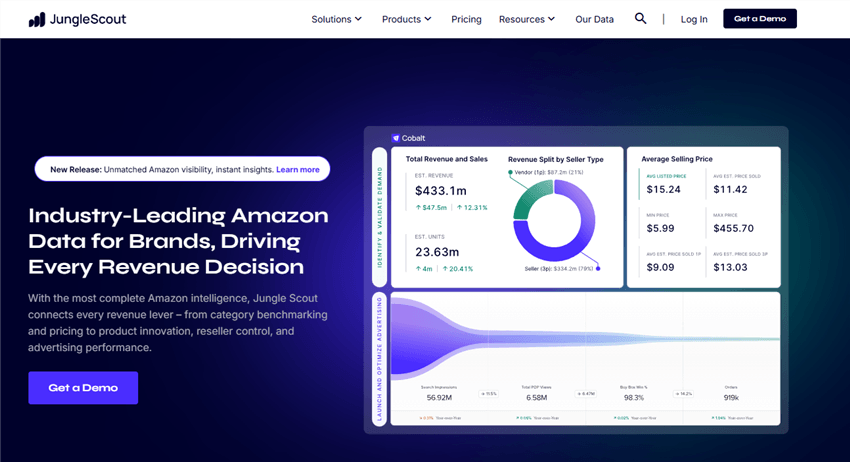
Jungle Scout built its reputation on product research, but its listing optimization suite has matured significantly. The Listing Quality Score gives every listing a clear, actionable grade — and tells you exactly what to fix. The AI Assist feature generates listing copy suggestions based on your product category and target keywords, making it one of the most accessible AI writing tools in the Amazon space.
For marketers who are newer to Amazon or managing a growing catalog without a dedicated SEO team, Jungle Scout's interface is notably easier to navigate than Helium 10's. The educational resources — including guided workflows and in-app tutorials — reduce the time-to-value significantly.
Key features:
- Listing Quality Score: grades your listing and identifies specific improvement areas
- AI Assist: generates and refines listing copy (titles, bullets, descriptions)
- Keyword Scout: Amazon-specific keyword research with search volume and trend data
- Rank Tracker: monitors keyword position changes over time
- Competitor Intelligence: tracks competitor listing changes and keyword strategies
Pricing: Starts at $49/month. No permanent free plan, but a limited free trial (typically 7 days) may be available depending on promotions.
Best for: Digital marketers new to Amazon optimization, or scaling sellers who want a balance of product research and listing tools without a heavy learning curve.
Limitations: Some advanced features — including deeper competitor analysis and historical data — are locked behind the Suite and Ultimate tiers. No free plan means you need to commit to a trial before evaluating.
💡 Pro tip: Run your listing through the Listing Quality Score before and after any optimization pass. It gives you a concrete before/after metric to report to clients or stakeholders — much more convincing than "we updated the keywords."
SellerApp — Best Free Amazon Listing Optimization Tool
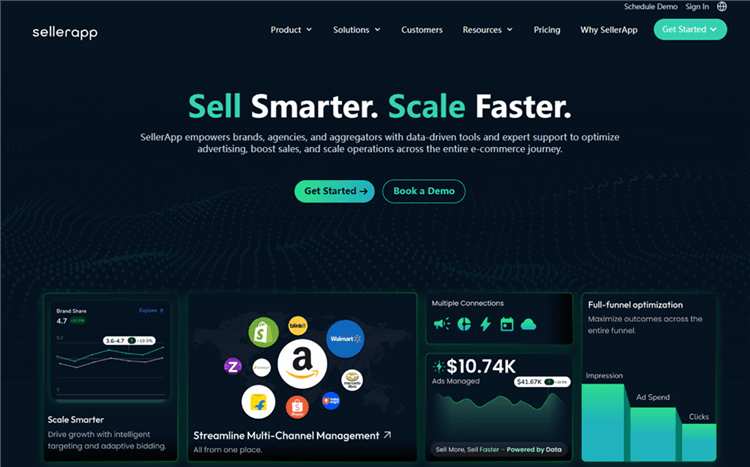
SellerApp is the answer if you're looking for the best Amazon listing optimization tool free option that actually delivers. Its free tier includes listing quality audits, keyword research, and basic PPC insights — enough to meaningfully improve a listing without spending a dollar.
The paid Pro tier adds depth: automated PPC optimization, profit analytics, and more granular keyword data. But for marketers testing the waters or managing a small catalog, the free version is genuinely useful — not a stripped-down teaser.
Key features:
- Listing Quality Audit: scores your listing and flags specific issues (keyword gaps, thin content, missing fields)
- Keyword Research: search volume, competition score, and relevance ranking
- PPC Automation: automated bid management and campaign optimization (Pro)
- Profit Analytics: real-time profitability tracking per ASIN
- Product Intelligence: competitor pricing and sales estimate data
Pricing: Free tier available. Pro plans start at $99/mo.
Best for: Budget-conscious e-commerce marketers, new Amazon sellers, or anyone who wants to audit and improve listings without an upfront financial commitment.
Limitations: Data depth on the free tier is limited — search volume estimates and competitor data are less granular than Helium 10 or Jungle Scout. Enterprise-scale operations will outgrow the free tier quickly.
✅ Recommended: SellerApp's free listing audit is the fastest way to get a baseline score on any ASIN. Run it before any optimization project to establish a starting point.
Viral Launch — Best for Product Launches and Ranking Velocity

Viral Launch is purpose-built for one thing: getting products to rank fast. Its keyword research and competitor intelligence tools are specifically calibrated for Amazon's ranking algorithm, with a focus on launch velocity and search rank improvement rather than general listing health.
For marketers running aggressive launch campaigns — new product releases, seasonal pushes, or competitive category entries — Viral Launch's specialized approach outperforms more generalist tools. The Market Intelligence feature provides real-time data on search trends and competitor positioning to inform launch timing and keyword targeting.
Key features:
- Keyword Research: Amazon-specific search volume, trend data, and ranking difficulty scores
- Competitor Intelligence: tracks competitor keyword strategies and listing changes
- Market Intelligence: real-time market trend data for launch timing decisions
- Listing Analyzer: audits listing quality against top competitors in the category
- Split Testing: A/B tests listing elements to optimize conversion rate
Pricing: Single Amazon Account ($59/mo), Unlimited Amazon Accounts ($119/mo).
Best for: E-commerce marketers running product launches or aggressive ranking campaigns who need specialized launch-velocity tools rather than a general-purpose suite.
Limitations: The interface feels dated compared to newer competitors. Less comprehensive for ongoing listing maintenance once a product is established. No free plan.
ZonGuru — Best for Clean Data and Intuitive UX

ZonGuru occupies a specific niche: high-quality data with a clean, uncluttered interface. For marketers who find Helium 10 overwhelming or Jungle Scout's data insufficient, ZonGuru hits a useful middle ground.
The Keywords on Fire tool surfaces high-opportunity keywords based on search volume and competition balance — particularly useful for finding terms where ranking is achievable without massive PPC spend. The Listing Optimizer walks you through keyword placement step by step, making it accessible even for marketers without deep Amazon SEO experience.
Key features:
- Keywords on Fire: identifies high-opportunity keywords with favorable competition ratios
- Listing Optimizer: step-by-step keyword integration guide for titles, bullets, and descriptions
- Niche Finder: identifies underserved product categories with strong demand
- Business Dashboard: centralized performance metrics across your catalog
- Email Automator: post-purchase review request sequences
Pricing: Researcher ($49/mo), Seller ($79/mo). No free plan; free trial available.
Best for: Marketers who want accurate, actionable data without the complexity of a full enterprise suite — particularly useful for sellers in competitive niches where keyword selection precision matters.
Limitations: Smaller feature set than Helium 10 or Jungle Scout. No free plan. Less suitable for large-scale enterprise operations or agencies managing many client accounts.
AMZScout — Best for New Sellers on a Tight Budget
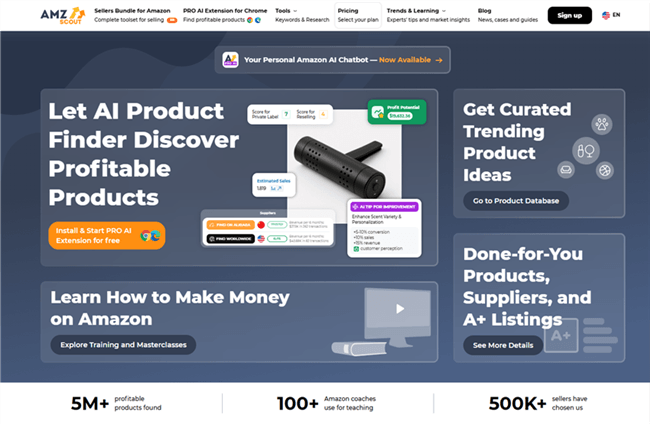
AMZScout is the most accessible entry point for new Amazon sellers who need basic listing optimization without a significant financial commitment. The tool covers keyword research, product database access, and listing optimization fundamentals — enough to get a new listing properly structured and keyword-targeted.
For experienced marketers or agencies, AMZScout will feel limited. But for someone launching their first few products and learning the Amazon optimization process, it removes the barrier to getting started.
Key features:
- Keyword Search: search volume data and keyword suggestions for listing optimization
- Product Database: market research and product opportunity identification
- Listing Optimizer: basic keyword placement guidance
- Chrome Extension: in-browser product and keyword research while browsing Amazon
Pricing: Starts at $59.99/month. 3-month plan at $169.99, or $399.99/year (includes 3 extra months). AI Review Analyzer and AI Listing Builder are included in the AI Bundle. No clearly advertised free plan.
Best for: New Amazon sellers or e-commerce marketers just starting out who need affordable, straightforward listing optimization tools without enterprise complexity.
Limitations: Data depth and accuracy lag behind premium tools. Not suitable for large-scale operations or competitive categories where data precision is critical. Limited AI writing capabilities.
DataHawk — Best for Enterprise Analytics and SEO Tracking
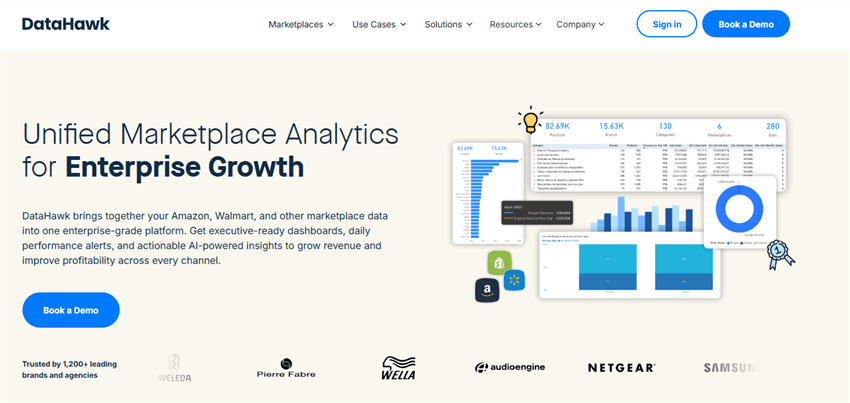
DataHawk is built for established brands and agencies that need sophisticated analytics dashboards, not just listing optimization checklists. Its SEO monitoring and rank tracking capabilities are enterprise-grade — tracking keyword position changes, indexation status, and competitive share of voice across large catalogs.
For marketing teams that need to report on Amazon SEO performance at scale — across hundreds of ASINs, multiple marketplaces, and over time — DataHawk provides the data infrastructure that lighter tools can't match.
Key features:
- SEO Monitoring: tracks keyword indexation, rank position, and listing change history
- Market Intelligence: competitive share of voice and category trend analysis
- Custom Dashboards: configurable analytics views for different stakeholders
- API Access: integrates with BI tools and custom reporting pipelines
- Multi-marketplace Support: covers Amazon US, EU, and other regional marketplaces
Pricing: Custom pricing based on catalog size and revenue. Generally enterprise-focused.
Best for: Enterprise brands, large agencies, or marketing teams that need robust analytics and SEO performance tracking across large Amazon catalogs — and have the budget to match.
Limitations: High price point makes it inaccessible for small sellers or individual marketers. Not a listing creation tool — it tracks and analyzes, but doesn't generate copy or walk you through optimization steps.
Listing Mirror — Best for Multi-Channel Brands
Listing Mirror solves a different problem than most tools on this list: not how to optimize a single Amazon listing, but how to manage listings consistently across multiple marketplaces simultaneously. If your brand sells on Amazon, Walmart, eBay, and Shopify, keeping listings synchronized — and optimized — across all channels is a significant operational challenge.
Listing Mirror centralizes that management, syncing inventory, orders, and listing content across platforms. For e-commerce marketers at brands with multi-channel distribution, it eliminates the manual work of updating listings in multiple places every time a product detail changes.
Key features:
- Multi-channel Listing Management: sync listings across Amazon, Walmart, eBay, Shopify, and more
- Inventory Synchronization: real-time inventory updates across all connected channels
- Order Fulfillment: centralized order management and routing
- Listing Templates: standardized listing structures for consistent cross-channel presentation
Pricing: Bronze $129/mo, Silver $199/mo, Gold $279/mo.
Best for: E-commerce marketers at brands or agencies managing product catalogs across multiple marketplaces who need centralized listing control and inventory synchronization.
Limitations: Not a keyword research or listing optimization tool in the traditional sense — it manages and syncs listings but doesn't generate copy or audit keyword coverage. Requires a separate tool for actual optimization work.
Scale Insights — Best for PPC and Listing Synergy
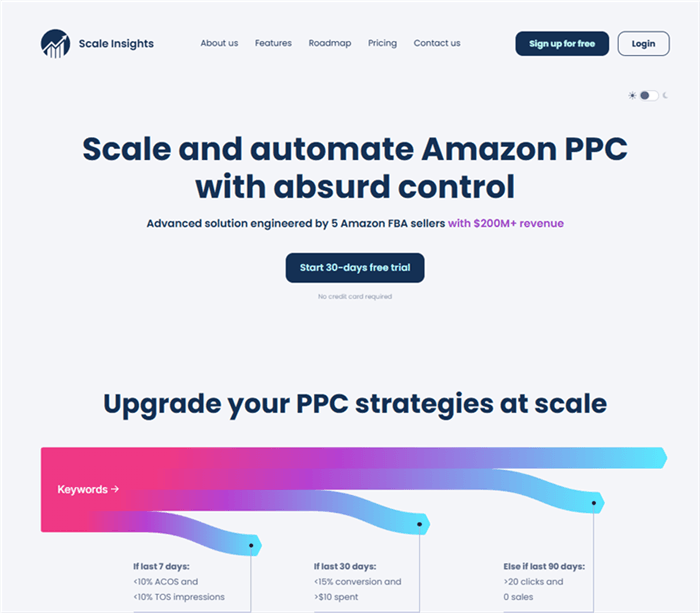
Scale Insights bridges the gap between listing optimization and PPC performance — a connection that most standalone tools treat as separate workflows. The platform's core insight is that listing quality and ad performance are interdependent: a poorly optimized listing wastes PPC spend, and PPC data reveals which keywords actually convert.
For performance marketers managing Amazon advertising alongside listing optimization, Scale Insights provides a unified view that helps allocate keyword investment more intelligently.
Key features:
- PPC Automation: rule-based and AI-driven bid management
- Keyword Harvesting: identifies high-converting search terms from PPC data for listing integration
- Listing Optimization: keyword placement guidance informed by actual conversion data
- Performance Analytics: unified view of organic rank and paid performance by keyword
Pricing: Starts at $78/mo. No free plan; free trial available.
Best for: Performance marketers and e-commerce teams who run Amazon PPC campaigns alongside listing optimization and want a unified platform that connects ad data to listing decisions.
Limitations: Less comprehensive for pure listing optimization without a PPC component. Smaller user base and community than Helium 10 or Jungle Scout. Not ideal for sellers who don't run paid campaigns.
How to Choose the Best Amazon Listing Optimization Tool for Your Needs
With ten solid options on this list, the right choice depends on where you are and what you're trying to accomplish:
- End-to-end listing creation: AllyHub — from research to ready-to-publish listing
- Getting started / low budget: SellerApp → then Jungle Scout or Helium 10
- Scaling multiple SKUs: Helium 10 — full keyword + optimization suite
- Agency workflows: AllyHub (execution) + Helium 10/DataHawk (data & reporting)
- Product launches: Viral Launch — optimized for ranking velocity
- Multi-channel selling: Listing Mirror — centralized listing management
- PPC-driven optimization: Scale Insights — connects ads with listing decisions
Choose based on your workflow, not just features — the best tool is the one that turns data into listings that actually convert.
FAQ: Best Amazon Listing Optimization Tools
Are Amazon listing optimization tools worth the cost?
Yes — especially if you manage multiple SKUs. Strong keyword research alone can uncover high-volume, low-competition terms you’d likely miss manually, often paying for the tool quickly. The ROI compounds as you scale across more listings.
What is the best free Amazon listing optimization tool?
AllyHub is free to start and covers the full workflow — keyword research, competitor analysis, review mining, and AI listing generation. SellerApp’s free tier is a solid alternative if you mainly need keyword data and listing audits.
Can one tool handle research, analysis, and copywriting?
Yes — AllyHub connects all steps into one workflow, turning data into a finished listing. Traditional tools like Helium 10 are strong in keyword research and scoring but typically stop short of generating complete, ready-to-publish copy.
Do Amazon SEO tools actually improve ranking?
They improve decision-making — helping you choose the right keywords and identify gaps. Rankings still depend on listing quality and conversion rate, but these tools make optimization faster and more accurate.
How do I optimize for the Amazon A10 algorithm?
Focus on three factors: keyword relevance (placement across title, bullets, backend), conversion rate (images, pricing, copy), and sales velocity. Most tools help with keyword coverage and optimization structure.
Can AI tools write better product descriptions than humans?
They can produce strong drafts quickly, especially when trained on competitor data and customer reviews. However, the best results come from combining AI output with human editing for brand voice and persuasion.
What’s the difference between Amazon SEO and listing optimization?
Amazon SEO focuses on keyword visibility. Listing optimization is broader — combining SEO with conversion optimization and complete listing structure. The best tools address both.
How many keywords should I include in a listing?
There’s no fixed number. Aim for full coverage without keyword stuffing: include primary terms in the title, secondary terms in bullets, and additional keywords in backend search fields.