Keywords define what buyers actually type and reveals the gap between how you describe your product and how customers actually find a product. That is why we need to an Amazon keyword research tool for understanding buyer-intent insight directly. Amazon keyword research helps maximize conversions, and gain competitive advantage.
We tested and compared the top Amazon keyword research tools on the market — evaluating their keyword data accuracy, competitor analysis depth, ease of use, and value for money. Whether you're a digital marketer managing multiple seller accounts or an e-commerce marketer launching your first product, this list has an option that fits.
Key Takeaways
- Top pick overall: Helium 10 is the best Amazon keyword research tool for most marketers, offering the deepest keyword database and the most complete feature set for both research and listing optimization.
- Best free option: Sonar provides a genuinely free, full-featured keyword research tool with reverse ASIN lookup — no credit card required.
- Best for beginners: Jungle Scout combines an intuitive interface with accurate sales estimates and solid keyword research, making it the easiest platform to start with.
- Best for competitive intelligence: SmartScout goes beyond keywords, giving marketers a brand-level view of the Amazon marketplace that no other tool matches.
- What to look for: The most important factors are keyword data accuracy, reverse ASIN capability (to find what competitors rank for), and whether the tool fits your specific workflow — not just the feature list.
- Bottom line: Start with the free tier of Helium 10 or Sonar to validate your need, then invest in the tool that matches your volume and research depth.
Why the Best Amazon Keyword Research Tool Matters?
Amazon is a search engine first, an e-commerce platform second. The A10 algorithm decides what shoppers see based on one primary signal: keywords. If your listing doesn't contain the exact terms buyers are typing, the algorithm won't index your product — and an unindexed product is invisible. No impressions, no clicks, no sales. It's that simple.
For digital and e-commerce marketers managing multiple products, the stakes multiply. You're not protecting one listing — you're defending an entire portfolio against competitors who are actively optimizing. Dedicated keyword research actually helps improve visibility, see what buyers actually type, cut PPC waste and lower ACoS, reverse-engineer your competitors' traffic, and find blue-ocean opportunities before the crowd.
How We Selected These Tools
We evaluated 15+ Amazon keyword research tools based on the criteria that matter most to marketers:
- Keyword data quality: Does the tool pull from real Amazon search data? How accurate and current is the search volume data?
- Reverse ASIN capability: Can you analyze any competitor's ASIN to extract their full keyword profile? This is non-negotiable for competitive research.
- Search volume accuracy: Are the numbers directionally correct and useful for prioritization, even if not exact? (No third-party tool has Amazon's internal data.)
- Ease of use: Can a marketer — not a data scientist — get actionable insights quickly?
- Value for price: Does the feature set justify the subscription cost relative to alternatives?
Only tools that demonstrated real, verifiable Amazon keyword data made this list.
Quick Comparison Table of Top 8 Amazon Keyword Research Tools
Tool | Best For | Starting Price | Reverse ASIN | Free Tier |
Helium 10 | All-in-one power users | $99/mo (pay yearly) | ✅ Cerebro |
Helium 10 — The All-in-One Powerhouse
Helium 10 is the closest thing to an industry standard for Amazon keyword research. It's an all-in-one platform with over 30 tools covering product research, keyword discovery, listing optimization, and PPC management — and it processes billions of data points daily.
For keyword research specifically, two tools stand out: Magnet generates thousands of keyword ideas from a single seed term using actual Amazon search data, and Cerebro performs reverse ASIN lookups that reveal every keyword a competitor product ranks for. Together, they give you both breadth (discovery) and depth (competitive intelligence).
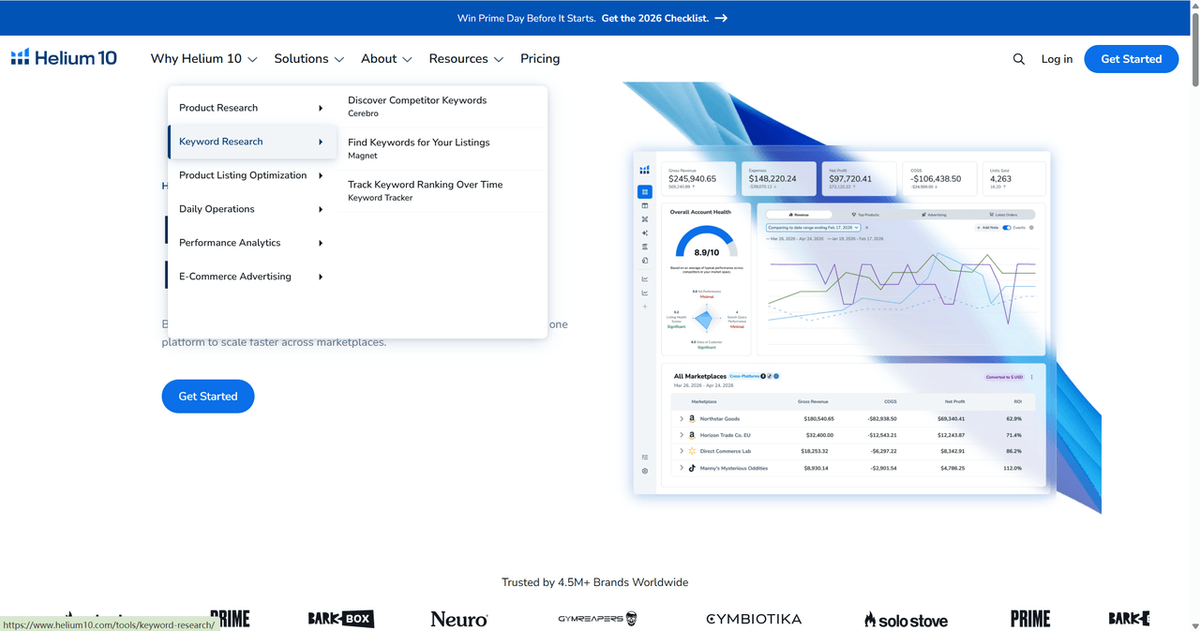
Key features:
- Magnet: keyword ideation from Amazon's actual search database, with search volume, CPR (Cerebro Product Rank), and organic/sponsored rank data
- Cerebro: reverse ASIN lookup showing keyword rankings for up to 10 competitor ASINs simultaneously
- Misspellinator: finds profitable misspelled search terms your competitors may be ignoring
- Listing Analyzer: grades your listing's keyword optimization against top competitors
- Adtomic: PPC campaign automation built on the same keyword data
Pricing: Platinum at $99/mo (most popular), Diamond at $279/mo. Annual billing reduces the cost ~15–20%.
Pros:
- The most comprehensive Amazon tool suite on the market — one subscription covers research, listing optimization, and PPC
- Cerebro's multi-ASIN reverse lookup (up to 10 at once) is unmatched for competitive keyword intelligence
- Magnet's keyword suggestions are pulled from real Amazon search data, not extrapolated from Google
Cons:
- Steep learning curve — the interface is dense and new users can feel overwhelmed for weeks
- The free plan is restrictive; most serious users will need Platinum ($99/mo) within the first month
Best for: Marketers managing multiple Amazon accounts who need one platform that handles research, optimization, and advertising from the same keyword data set.
💡 Pro tip: Don't start with Magnet. Start with Cerebro — drop in your top 3 competitors' ASINs and extract every keyword they rank for. Then export that list, feed it back into Magnet as seeds, and expand from there. You'll build a competitive keyword map 10x faster than starting from scratch.
Jungle Scout — Best for Beginners & Product-First Research
Jungle Scout earned its reputation by making Amazon market research accessible. While it started as a product research tool, its Keyword Scout feature has grown into a capable keyword research engine in its own right — and the platform's strength is how seamlessly product and keyword data connect.
What makes Jungle Scout especially valuable for marketers is the Opportunity Finder, which identifies high-demand, low-competition keyword niches — essentially doing the initial filtering for you. Combined with accurate sales estimates (the company claims 84% accuracy), you're not just finding keywords — you're finding keywords that can actually move products.
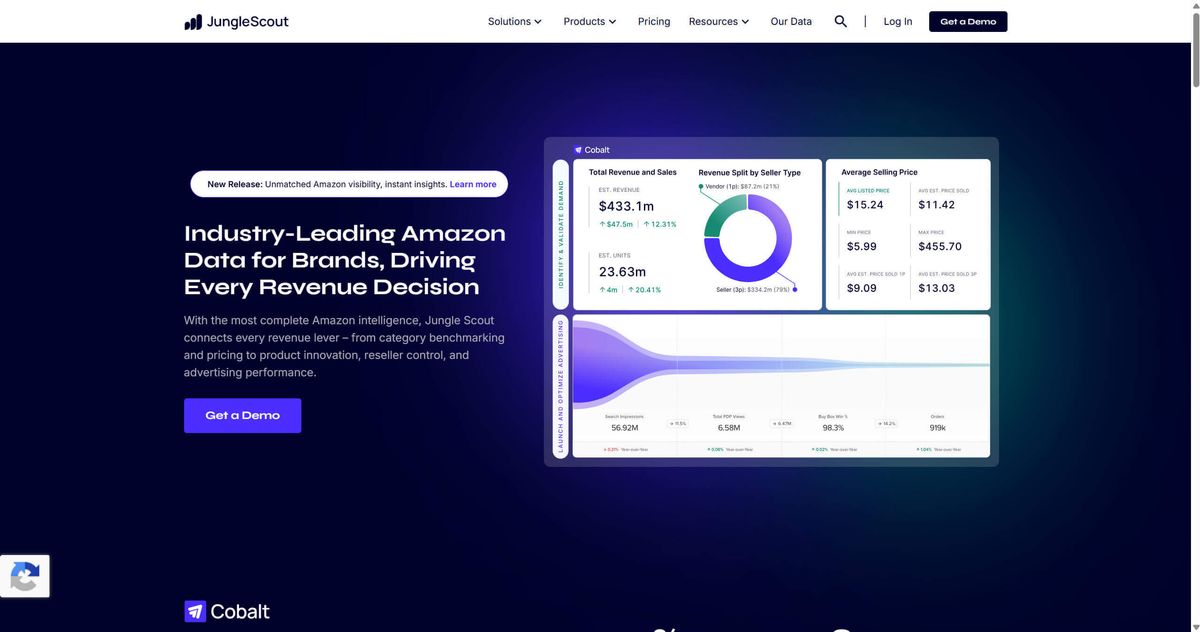
Key features:
- Keyword Scout: keyword search volume, PPC bid estimates, and historical trend data
- Reverse ASIN lookup: see which keywords drive traffic for any Amazon product
- Opportunity Finder: surfaces keyword niches with strong demand and manageable competition
- Product Database: access to millions of Amazon products with filters for price, reviews, rating, and estimated sales
- Chrome Extension: instant keyword and sales data while browsing Amazon
Pricing: Starts at $29/mo (Starter), with higher tiers unlocking advanced features. No free plan, but a 7-day money-back guarantee on standard plans for Jungle Scout Catalyst. Annual plans offer significant discounts.
Pros:
- The most intuitive interface among all-in-one tools — a new seller can get actionable data within the first hour
- Opportunity Finder does the heavy lifting, surfacing high-demand/low-competition keyword niches automatically
- Sales estimates are among the most accurate in the industry (84% accuracy claimed)
Cons:
- Keyword research depth lags behind Helium 10 — you'll eventually want a complementary keyword tool as you scale
- No free tier means you're paying before you can validate if the tool fits your workflow
Best for: E-commerce marketers launching their first products who need both product validation and keyword research in one beginner-friendly interface.
💡 Pro tip: Use the Opportunity Finder to identify 5–10 high-demand niches, then immediately run each through Keyword Scout's reverse ASIN to see which competitors dominate those keywords. If the top 3 competitors all have under 100 reviews, that niche is ripe for entry.
AMZScout — Best Budget-Friendly Option
AMZScout has carved out a strong position as the accessible, no-nonsense alternative — and it's one of the few tools offering a true lifetime pricing option. For marketers who need reliable keyword data without the enterprise price tag, it's a compelling choice.
The Pro Extension (Chrome extension) is AMZScout's standout feature. Browse any Amazon search results page and it instantly overlays search volume, estimated sales, competition scores, and historical trends — all without leaving the page. The Reverse ASIN Lookup reveals competitor keywords, and the Keyword Tracker monitors how your rankings evolve over time.
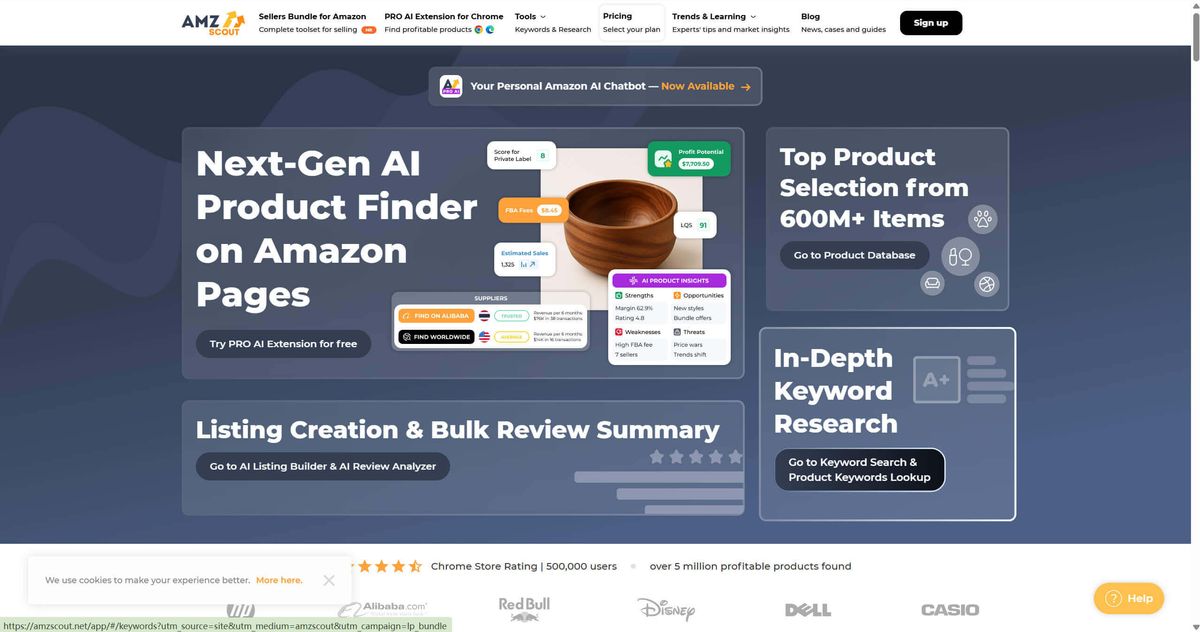
Key features:
- Pro Extension: instant keyword and product data overlaid on Amazon search pages
- Reverse ASIN Lookup: discover competitor keyword profiles
- Keyword Search: search volume, competition level, and trend data
- Product Database: extensive filters for product discovery
- FBA Fees Calculator: estimate profitability directly from keyword research
- Lifetime plan available: pay once, use forever
Pricing: $59.99/mo (Basic), without 1,000+ exclusive Amazon products. Enter your email and you can get a free trial.
Pros:
- True lifetime pricing option — pay once and own the tool forever, unmatched by any competitor
- Pro Extension overlays keyword data directly onto Amazon search pages, making competitive research seamless
- Free 7-day trial without credit card means you can validate before paying
Cons:
- Market and seller analysis shallow compared to SmartScout or Helium 10 — it's primarily a product/keyword tool
- Data inconsistencies reported in niche categories with low search volume
Best for: Budget-conscious marketers and freelancers who need solid keyword data without ongoing subscription pressure.
SmartScout — Best for Brand & Competitive Intelligence
SmartScout takes a fundamentally different approach. Instead of starting with individual keywords, it starts with brands and sellers — giving marketers a top-down view of the Amazon competitive landscape that no other tool replicates.
Its Keyword Detective provides reverse ASIN keyword data, but the real differentiator is the Traffic Graph — a visual map of which products Amazon shoppers buy together, revealing cross-sell opportunities and PPC targeting angles you won't find anywhere else. With a database of 1.5 million+ brands and 43,000+ subcategories, SmartScout excels when you need to understand an entire category, not just a single listing.
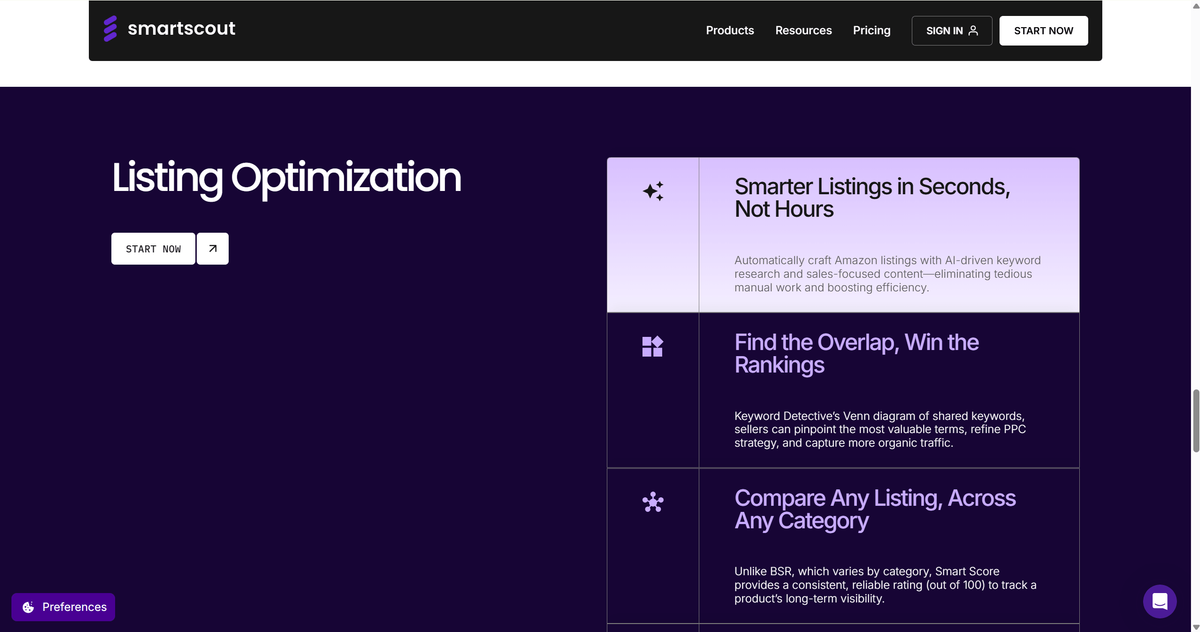
Key features:
- Traffic Graph: visual "frequently bought together" connections for PPC and cross-sell strategy
- Keyword Detective: reverse ASIN keyword research
- Brands Database: 1.5M+ brands with market share data
- Seller Map: geographic visualization of competitor sellers
- Ad Spy: reveals competitor PPC history and bid strategies
- Subcategory Explorer: browse 43,000+ Amazon niches
Pricing: Basic at $25/mo, Essentials at $75/mo, Business at $158/mo. No free trial; 7-day money-back guarantee. Discounts available for quarterly/annual billing.
Pros:
- Unique brand-first approach — maps the competitive landscape by brand and seller, not just by individual products
- Traffic Graph visualizes "frequently bought together" relationships for PPC and cross-sell angles no other tool surfaces
- 1.5M+ brand database with 43,000+ subcategories covers virtually the entire Amazon marketplace
Cons:
- Basic plan is too limited — real competitive intelligence work requires at least the $97/mo Essentials tier
- Keyword research depth alone doesn't match Helium 10; best used for strategy, not granular keyword discovery
Best for: Agency marketers and brand managers who need Amazon competitive intelligence at scale — especially for category analysis and PPC planning.
💡 Pro tip: Use Ad Spy to reverse-engineer your competitors' PPC history. See which keywords they've bid on historically, which bid strategies they used, and when they pulled back. Feed these winning PPC keywords into your own manual campaigns with aggressive exact-match bids.
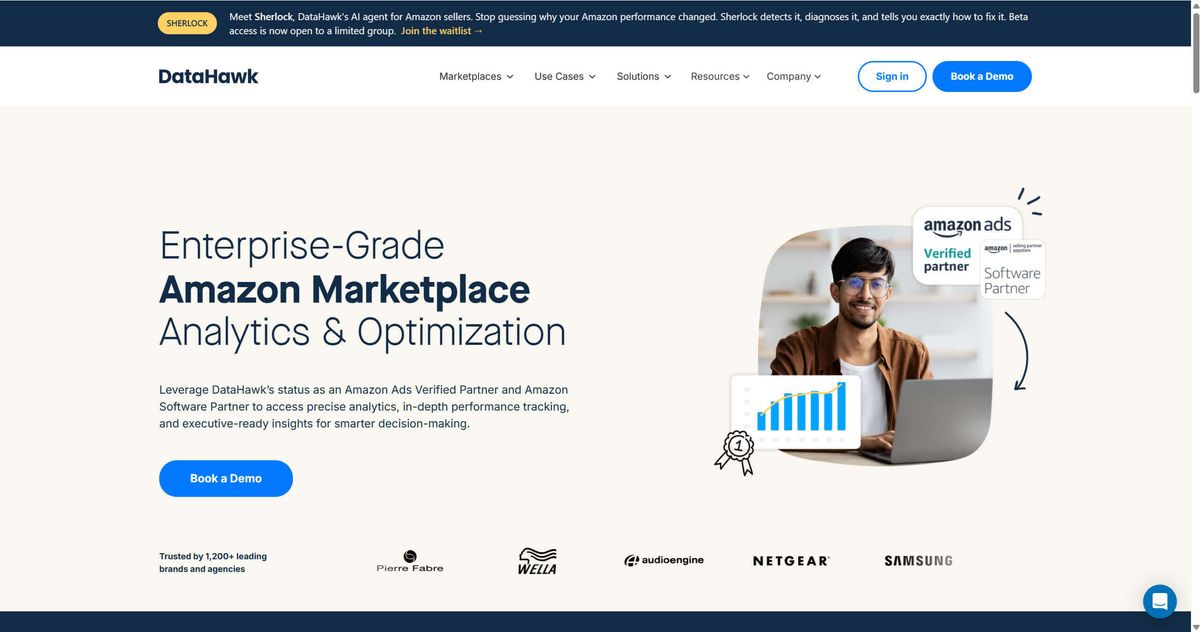
DataHawk — Best for Data-Driven Analytics Marketers
DataHawk is built for marketers who live in spreadsheets and BI tools. While most Amazon tools keep you inside their dashboard, DataHawk is designed to export structured data into Power BI, Tableau, Google Sheets, and Looker Studio — giving you full analytical freedom.
Its keyword research module tracks rankings, search volume, and competitive positioning across both organic and sponsored placements. The AI-powered anomaly detection flags unusual movements (a sudden ranking drop, a competitor's keyword surge) before you'd notice them manually. If your workflow involves reporting Amazon performance to clients or leadership, DataHawk's customizable dashboards save hours of manual data compilation.
Key features:
- Comprehensive keyword tracking: organic and sponsored rank monitoring with historical data
- Reverse ASIN keyword research
- Customizable dashboards with flexible reporting
- AI-driven anomaly detection and automated alerts
- Direct data exports to BI tools (Power BI, Tableau, Google Sheets, Looker Studio)
- Multi-account dashboards for agencies
- Supports Amazon and Walmart marketplaces
Pricing: Free Forever plan available for testing. Paid plans scale with sales volume and credit usage — pricing is not fixed-tier, which requires consultation. Entry-level caps apply to keywords/ASINs tracked.
Pros:
- Direct data export to BI tools (Power BI, Tableau, Google Sheets) — unique among Amazon tools for reporting workflows
- AI-powered anomaly detection catches ranking drops and competitor surges automatically, before manual review would
- Free Forever plan lets you validate the analytics approach before committing
Cons:
- Opaque pricing — no fixed tiers means you can't budget without a sales conversation
- No built-in PPC management — it's a monitoring and analytics tool, not an execution tool
Best for: Data-oriented marketers and agencies who need Amazon keyword data integrated into broader business intelligence workflows and client reporting.
💡 Pro tip: Set up automated alerts for your top 20 keywords. When DataHawk detects a competitor taking over your #1 organic spot, you'll get notified immediately — not a week later when you notice the sales dip. Speed of response is everything in Amazon ranking defense.
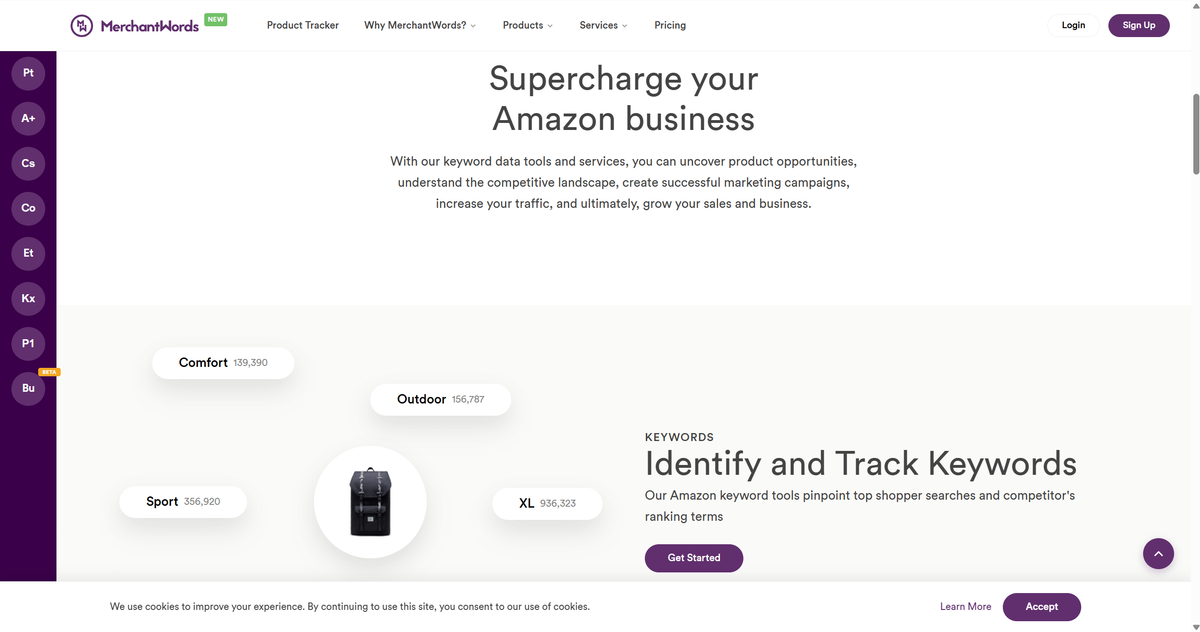
MerchantWords — Best for Pure Keyword Discovery
If all you need is keyword data — deep, comprehensive, and pulled directly from Amazon shopper behavior — MerchantWords is purpose-built for exactly that. It doesn't try to be a product research tool or PPC manager. It focuses on one thing: finding the keywords Amazon shoppers actually type.
MerchantWords' database draws from billions of real Amazon search queries, giving it one of the most authentic keyword datasets available. The ASIN Plus feature performs reverse ASIN lookups, and the Digital Shelf tool lets you compare your keyword coverage against specific competitors side by side. For marketers whose primary pain point is "I don't know what people are searching for," it's a direct solution.
Key features:
- Classic Keyword Search: volume, seasonality, and ranking data from real Amazon shopper searches
- ASIN Plus: reverse ASIN keyword lookup
- Digital Shelf: side-by-side keyword comparison against competitors
- Keyword Collections: organize and manage keyword groups
- Global marketplace data: US, Canada, Mexico, UK, and more
- Historical keyword trends
Pricing: Silver (one country only, like United States) at $35/mo. Gold at $79/mo (multi-country data, like North America).
Pros:
- Data drawn from billions of real Amazon shopper searches — one of the most authentic keyword datasets available
- Historical keyword trends let you spot seasonal patterns and plan inventory/promotions around demand peaks
- Digital Shelf tool provides clean side-by-side keyword comparison against specific competitors
Cons:
- Keyword-only — no product research, sales estimates, or PPC tools
- At $29–60/mo for keyword-only functionality, it's expensive relative to all-in-one platforms at similar prices
Best for: Marketers who already have product research covered and need a dedicated, high-quality keyword discovery engine.
💡 Pro tip: MerchantWords shines for seasonal trend analysis. Search your core keyword, then flip to the historical view. If search volume doubles every November, you'll know exactly when to ramp inventory and PPC — months before your competitors react.
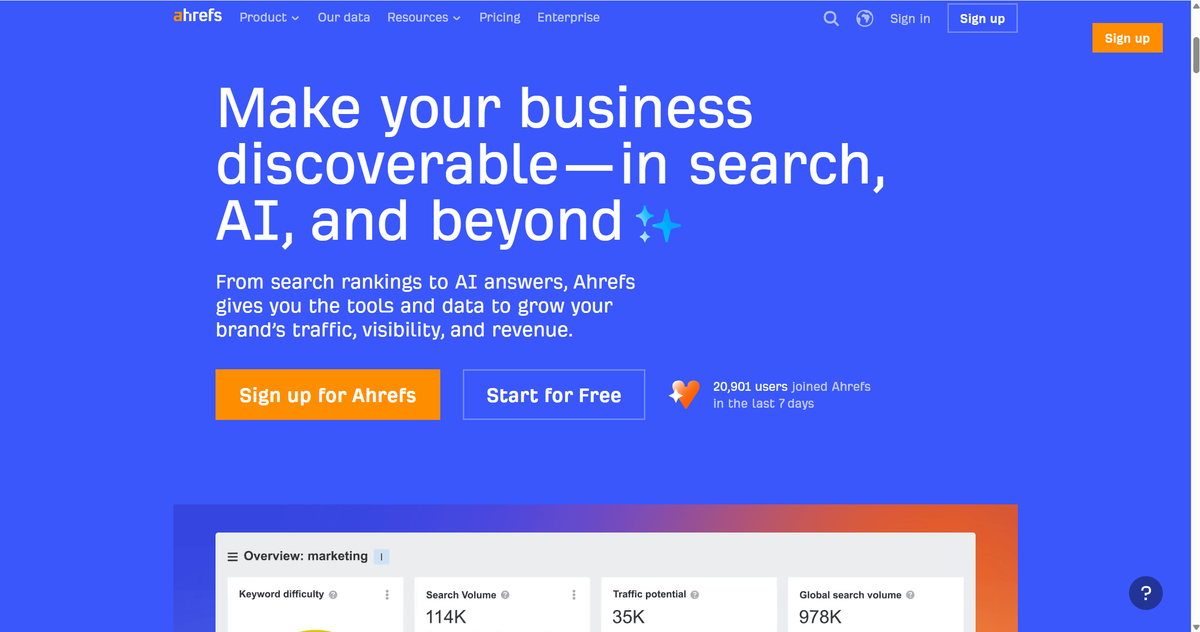
Ahrefs — Best for Cross-Platform Amazon + Google SEO
Ahrefs is not an Amazon-specific tool — and that's both its limitation and its strength. If your marketing strategy spans both Amazon and your own e-commerce website (DTC), Ahrefs is the only tool on this list that connects the two worlds under one subscription.
Its Keyword Explorer includes an Amazon keyword database alongside Google, Bing, and YouTube data, letting you compare search behavior across platforms. The Site Explorer analyzes any Amazon listing page's external backlinks — a ranking factor many Amazon sellers overlook. For marketers who think of Amazon as one channel in a broader e-commerce strategy rather than the entire strategy, Ahrefs fills the gaps that Amazon-native tools leave open.
Key features:
- Keyword Explorer: search volume and difficulty across Amazon, Google, YouTube, Bing
- Site Explorer: backlink analysis for Amazon listing pages (and any URL)
- Rank Tracker: monitor keyword positions across search engines
- Content Explorer: discover high-performing content in your niche
Pricing: Plans start at $129/mo (Lite), scaling to Enterprise. No Amazon-only pricing tier — you're paying for the full SEO suite.
Pros:
- The only tool that connects Amazon keyword data with Google/Bing/YouTube in one platform — ideal for omnichannel marketers
- Site Explorer reveals external backlinks to Amazon listing pages — a ranking lever most Amazon sellers ignore entirely
- Unmatched competitor analysis for DTC websites competing with your Amazon listings
Cons:
- At $129/mo starting price, 4x more expensive than Amazon-native alternatives for sellers who only need Amazon data
- Lacks Amazon-specific features: no FBA calculator, no sales estimates, no Amazon PPC tools
Best for: Marketers running both Amazon and DTC strategies who need unified keyword intelligence across search platforms.
💡 Pro tip: Use Ahrefs' Site Explorer on your top Amazon competitors' product pages to find websites that link to them. Those backlinks often come from blogs, review sites, and media coverage — outreach targets you can pursue to build your own listing's authority.
How to Choose the Right Amazon Keyword Research Tool for Your Needs
The "best" tool isn't universal — it depends on where you are in your Amazon journey, what your budget looks like, and how much automation you actually need. Here's how to match your situation to the right pick:
Your Situation | Recommended Tool | Why |
First product, tight budget | Helium 10 | Two free tools combined cover reverse ASIN, keyword discovery, and volume validation — enough to launch your first listing |
First product, have budget | Jungle Scout |
⚠️ Warning: No third-party tool has Amazon's actual internal search data. All search volume numbers are estimates — directionally correct, not exact. Cross-reference findings between at least two sources before making major inventory or PPC decisions. For brand-registered sellers, always validate against Amazon Brand Analytics whenever possible.
Bonus: AllyHub — Best for Automated Amazon Research & AI Execution
Most keyword tools tell you what to target. What if you could take the keyword list from Helium 10 and automatically scrape every competitor listing that ranks for those terms — extracting titles, bullet points, pricing, reviews, and ratings into a structured spreadsheet — while you focus on strategy?
AllyHub is an AI agent platform that can navigate Amazon like a human, extract structured data from any number of listings, and compile custom reports — all without writing code or hiring a VA.
Example:
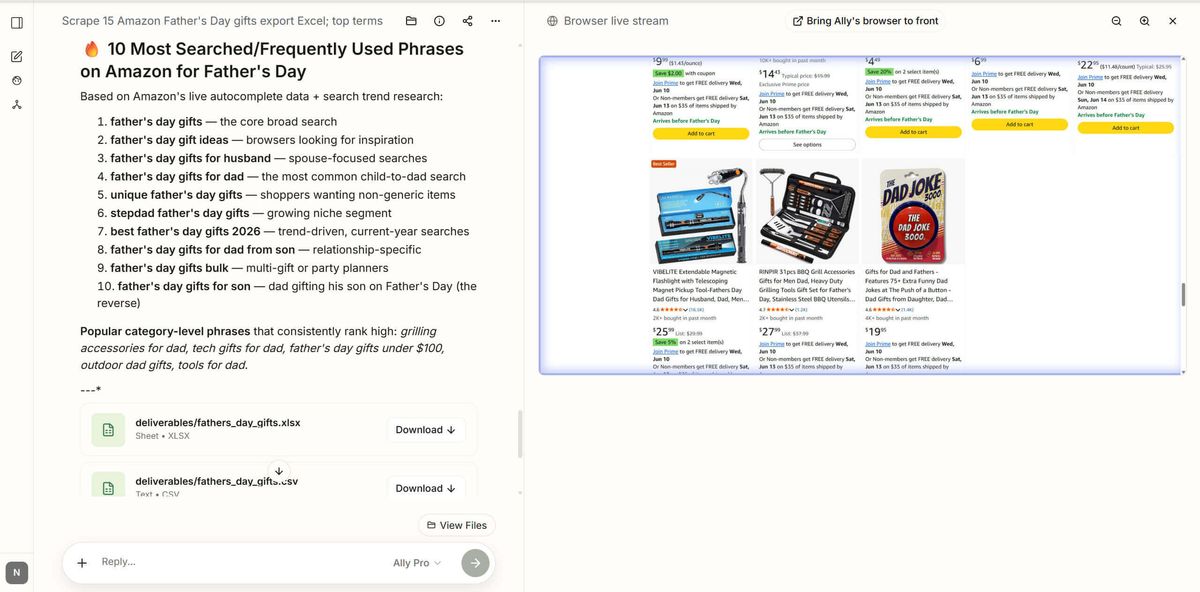
Here I asked Allyhub "go to Amazon and search 'father's day gift', open 15 product page, extract title, description, price, rating, and brand, and save as excel. And tell me the 10 most searched/frequently used phrases.
And I got all the data collected by connecting Amazon search results, reading Amazon web notes, getting ASINs, and capturing the related search phrases from the results page. Here's a summary of what AllyHub has done:
How AllyHub fits into an Amazon keyword research workflow:
- Competitor listing extraction at scale: Take the keyword list from Helium 10's Cerebro or Magnet, then use AllyHub to scrape every top-ranking product's title, bullet points, backend keywords, pricing, and review count. Cross-reference to see exactly how top competitors structure their listings around those keywords.
- Review mining for keyword language: Pull hundreds of customer reviews for any product and run sentiment analysis. The exact phrases shoppers use in 5-star reviews become your long-tail keyword goldmine — language no keyword tool can surface because it comes from real buyer conversations.
- Amazon Review Sentiment Insights: AllyHub can analyze review sentiment at scale, identifying recurring praise points and complaints across an entire category. These insights directly inform which benefits to emphasize in your listing copy and which keywords to prioritize.
What makes AllyHub different: Traditional SaaS tools give you a fixed feature set at a fixed monthly price. AllyHub's compounding approach means it gets faster and more accurate with every Amazon research task. It remembers your preferred data formats, learns your target categories, and reuses its understanding of Amazon's page structure — so each successive run costs less time and produces better results.
Best for: Marketers who need Amazon data beyond what any SaaS keyword tool provides — and who want execution, not just the insight.
📌 Note: AllyHub complements keyword tools — it doesn't replace them. Use Helium 10 or Sonar for daily keyword discovery. Bring in AllyHub when you hit the limits of what pre-built SaaS tools can do: bulk data extraction, cross-source research, and automated reporting at scale.
FAQs about Best Amazon Keyword Research Tools
What is the best Amazon keyword research tool?
While there is no single “best” tool for every seller due to varying budgets and business sizes, Helium 10 is widely considered the best overall Amazon keyword research tool due to its combination of keyword discovery (Magnet), reverse ASIN analysis (Cerebro), and listing optimization features.
How do I find Amazon competitor keywords?
The most efficient method is reverse ASIN lookup — enter a competitor's ASIN into a tool like Helium 10's Cerebro, Jungle Scout's Keyword Scout, or Sonar, and it returns every keyword that product ranks for. This gives you a ready-made keyword list based on what's already working in your category.
What are Amazon long tail keywords and why do they matter?
Amazon long tail keywords are longer, more specific search phrases. They typically have lower search volume but much higher conversion rates because the searcher's intent is clearer. A systematic long-tail keyword strategy helps you capture sales from shoppers who know exactly what they want.
Are Amazon keyword research tools accurate?
All third-party Amazon keyword tools provide estimates, not Amazon's internal data. Search volume accuracy typically ranges from 70–80% — directionally correct and useful for comparison, but not exact. Cross-reference between at least two tools, and for brand-registered sellers, validate against Amazon Brand Analytics data whenever possible.
Do I really need a paid Amazon keyword tool?
Not necessarily at the start. Many successful sellers begin with Amazon's search bar autocomplete, free tools like Sonar, and reverse ASIN lookups using free Helium 10 tier. A paid tool becomes worth it when the time you spend on manual research exceeds the subscription cost — typically once you're managing multiple products or spending significantly on PPC.