You’re trying to figure out why a competitor keeps outselling you — same product, same niche, but they rank higher, price better, and get more reviews.
So you start digging: checking ASINs, copying prices into spreadsheets, switching between tools — but still can’t see the full picture.
On Amazon, if you’re not ranking, your competitor is getting the sale. What matters is understanding why they win — keywords, pricing strategy, review velocity, and listing gaps you can exploit.
This guide breaks down the 10 best Amazon competitor analysis tools in 2026 — so you can quickly see what competitors are doing and how to beat them.
Key Takeaways
- Top pick: AllyHub for structured, ready-to-use competitor intelligence (best sellers, ASIN data, pricing matrices) with no code required.
- Best free tool: SellerSprite Chrome extension for basic competitor insights at zero cost.
- Best for keywords: Jungle Scout for reliable keyword and search volume data.
- Best for pricing: Keepa for historical price and sales rank tracking.
- Best for PPC: SellerApp for combining Amazon SEO and advertising competitor insights.
- What matters most: Data accuracy, keyword depth, pricing history, and workflow fit.
- Bottom line: Use AllyHub for full competitor reports and pair with Jungle Scout for keyword strategy.
How We Selected These Amazon Competitor Analysis Tools
We evaluated 20+ Amazon competitor analysis tools based on the following criteria:
- Data accuracy: How reliable are the sales estimates, keyword volumes, and pricing data?
- Competitor tracking depth: Can you monitor multiple ASINs, sellers, and categories simultaneously?
- Keyword intelligence: Does the tool surface competitor keyword strategies, not just your own?
- Free tier availability: Is there a meaningful free option for marketers testing the waters?
- Ease of use: Can a marketer (not just a developer) get actionable insights without a steep learning curve?
- Pricing value: Does the paid plan deliver ROI proportional to its cost?
Only tools that deliver actionable competitor intelligence — not just raw data dumps — made this list.
Best Amazon Competitor Analysis Tools: Quick Comparison Table
Tool | Best For | Free Option | Starting Price | Standout Feature |
AllyHub | Best Seller analysis + price matrix | ✅ Available | Custom |
10 Best Amazon Competitor Analysis Tools
AllyHub — Best AI-Powered Amazon Competitor Research Assistant
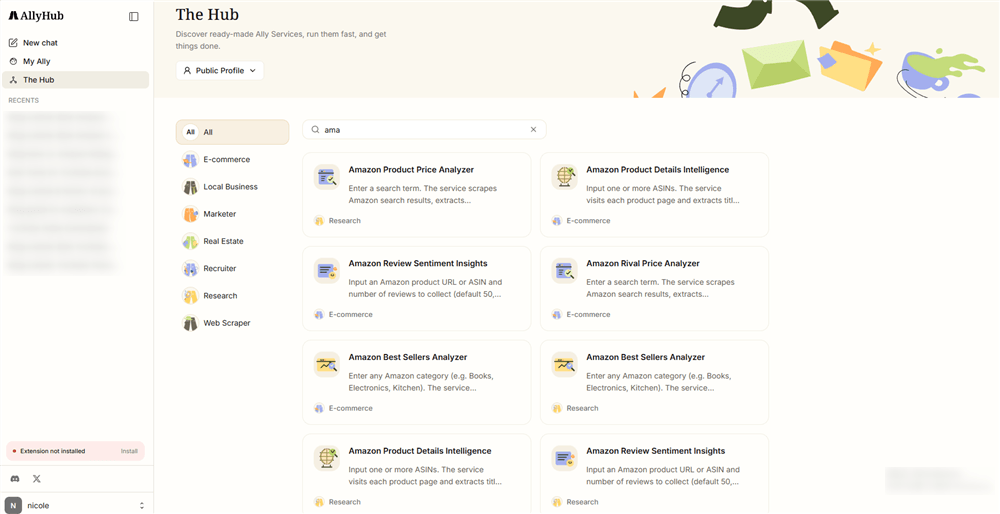
AllyHub is a flexible AI agent platform that can automate Amazon competitor research end-to-end. Instead of relying on fixed dashboards, it navigates Amazon like a human, extracts competitive data, generates structured reports, and continuously improves through reusable Skills, Recipes, and Playbooks. Each research task compounds over time, helping users maximize ROTI (Return on Token Investment) while eliminating repetitive manual analysis.
Unlike traditional tools built specifically for Amazon competitor analysis, AllyHub functions as a general-purpose AI agent that can be adapted to different research workflows. It doesn't just surface data — it executes the entire research process and delivers ready-to-use outputs.
Key Features:
- Amazon Best Sellers Analyzer: Enter any Amazon category — Books, Electronics, Kitchen, or any other. AllyHub navigates directly to the Best Sellers page, extracts up to 30 top-ranked products with rank, title, price, star rating, review count, and ASIN, and delivers a ranked XLSX + HTML report. In one run, you have a complete picture of who's dominating your category and at what price points.
- Amazon Product Details Intelligence: Input one or more ASINs. AllyHub visits each product page and extracts title, brand, price, star rating, review count, availability, feature bullets, technical specs, and category breadcrumb — then outputs a structured XLSX + HTML report. Use this to do a deep-dive on specific competitors' listings: what they're saying, how they're positioning, and where their specs leave gaps you can exploit.
- Amazon Rival Price Analyzer: Enter a search term. AllyHub scrapes Amazon search results, extracts competitor prices, ratings, badges (Best Seller, Amazon's Choice), and purchase velocity, then delivers a competitor price matrix in XLSX + HTML. This is the fastest way to map the competitive pricing landscape for any keyword before you set or adjust your own price.
Pricing: A free version is available.
Best for: Digital and e-commerce marketers who need structured Amazon competitor reports fast — whether for category research, listing benchmarking, or pricing strategy — without building their own data pipelines.
Limitations:
- Less focused on ongoing keyword rank tracking compared to dedicated SEO tools like Jungle Scout
- Best Sellers Analyzer captures a point-in-time snapshot; for trend tracking over weeks, pair with a tool like Keepa
- Keyword gap analysis (reverse ASIN lookup) is better handled by Jungle Scout or SellerSprite
💡 Pro tip: Run the Amazon Rival Price Analyzer before any pricing decision or promotional campaign. The competitor price matrix — including Best Seller and Amazon's Choice badges — gives you the full competitive context in one report, not a dashboard you have to interpret yourself.
Jungle Scout — Best for Keyword-Driven Competitor Research
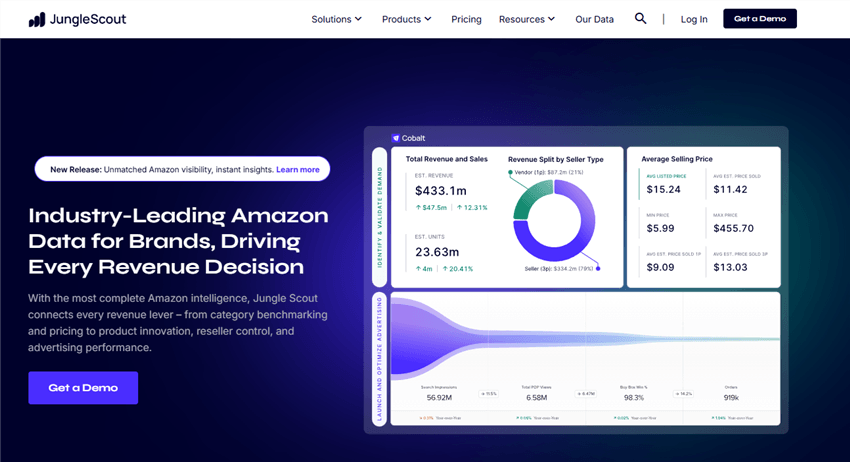
Jungle Scout has built its reputation on data accuracy, and for keyword-focused competitor analysis, it remains one of the strongest options on the market. Its Keyword Scout tool lets you enter a competitor's ASIN and surface every keyword they rank for — along with search volume, trend data, and PPC bid estimates.
The Product Tracker feature lets you monitor competitor ASINs over time, tracking daily sales estimates, price changes, and inventory levels. For marketers running category analysis, the Market Intelligence module gives you a macro view of how competitors are positioned across a niche.
Key features:
- Keyword Scout for competitor keyword gap analysis (reverse ASIN lookup)
- Product Tracker for ongoing ASIN-level competitor monitoring
- Sales estimator with industry-recognized accuracy benchmarks
- Supplier Database for understanding competitor sourcing (useful for private label)
- Cobalt module for enterprise brands needing deeper market intelligence
Pricing: Starts at $49/month. No permanent free plan, but a limited free trial (typically 7 days) may be available depending on promotions.
Best for: E-commerce marketers who prioritize keyword strategy and want reliable search volume data to identify competitor keyword gaps and PPC opportunities.
Limitations:
- The Basic plan limits the number of tracked products — you'll need Suite for serious competitor monitoring
- Less strong on pricing history compared to dedicated tools like Keepa
- Some users report that sales estimates can skew high in competitive categories
💡 Pro tip: Run Keyword Scout on your top competitor's ASIN, then filter for keywords where they rank in positions 4–15. These are the gaps where you can realistically outrank them with a focused listing and PPC push.
SmartScout — Best for Market Share & Seller Intelligence
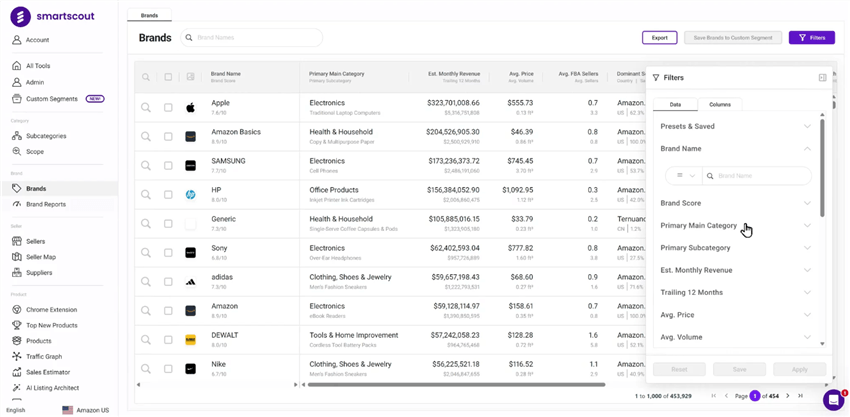
SmartScout takes a different angle on Amazon competitor analysis: instead of focusing purely on keywords and ASINs, it maps the entire Amazon marketplace ecosystem. You can see which sellers dominate a category, how market share is distributed, and which brands are growing fastest.
For marketers doing category-level competitive research — especially those in wholesale, private label, or brand management — SmartScout's Seller Discovery and Category Intelligence features are genuinely differentiated. You can identify which sellers are carrying your competitors' products, track brand market share over time, and find white-space opportunities in crowded categories.
Key features:
- Category Intelligence for market share distribution across any Amazon category
- Seller Discovery to identify who's selling competitor products and at what volume
- Brand Analytics integration for deeper competitive benchmarking
- Free Amazon Search Trends tool (no account required)
- Chrome extension for quick competitive data on any Amazon page
Pricing: Pricing: Free tools available (including Search Trends and limited Chrome extension access). Paid plans start at approximately $29–$49/month, with higher-tier plans ($99–$199+/month) offering advanced seller, brand, and category analytics. Enterprise plans are custom-priced.
Best for: Brand managers, wholesale buyers, and category managers who need a macro view of competitive market share and seller dynamics, not just keyword-level data.
Limitations:
- Custom pricing makes it harder to evaluate cost without a sales conversation
- Less focused on individual listing optimization compared to AllyHub or Jungle Scout
- The depth of data can be overkill for solo sellers or small teams
AMZScout — Best for Budget-Conscious Sellers Getting Started
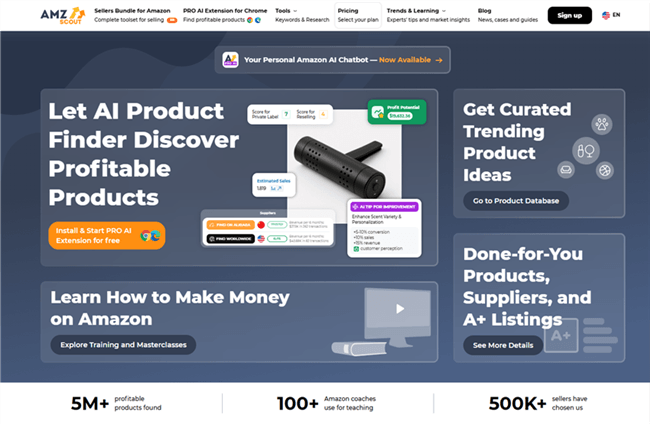
AMZScout is the most accessible entry point for e-commerce marketers who are new to Amazon competitor analysis. Its interface is clean, its data is easy to interpret, and its pricing is among the most competitive in the category.
The Product Database and Product Tracker tools let you monitor competitor ASINs for sales volume, revenue estimates, price changes, and stock levels. The Keyword Tracker surfaces which keywords competitors are ranking for and how those rankings shift over time. For sellers just building their competitive intelligence workflow, AMZScout covers the essentials without overwhelming complexity.
Key features:
- Product Tracker for monitoring competitor ASIN performance over time
- Keyword Tracker for competitor keyword ranking surveillance
- Sales estimator with monthly revenue projections
- Real-time stock level monitoring for competitor inventory
- Chrome extension for quick competitive data on Amazon search pages
Pricing: Starts at $59.99/month. 3-month plan at $169.99, or $399.99/year (includes 3 extra months). AI Review Analyzer and AI Listing Builder are included in the AI Bundle. No clearly advertised free plan.
Best for: New Amazon sellers and budget-conscious e-commerce marketers who need reliable competitor data without the complexity or cost of enterprise-tier tools.
Limitations:
- Data depth is shallower than AllyHub or Jungle Scout for advanced use cases
- The keyword database is smaller than the top-tier competitors
- Limited PPC competitor analysis compared to tools like SellerApp
SellerSprite — Best Free Amazon Competitor Analysis Tool
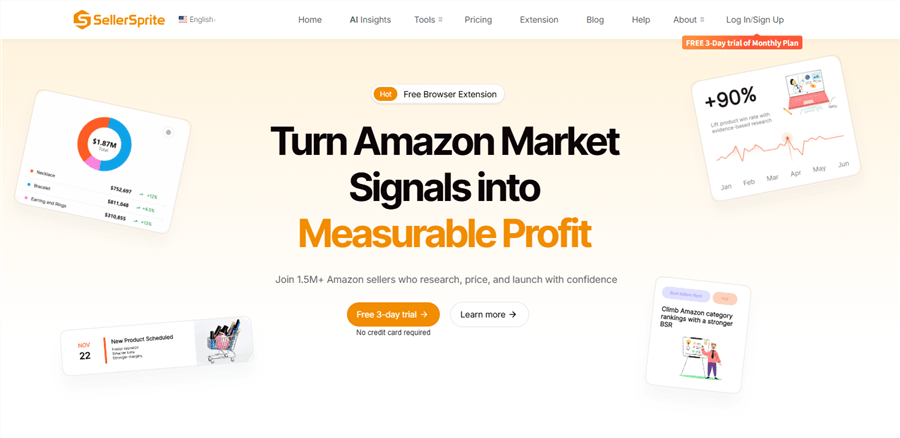
If you're looking for the best Amazon competitor analysis tool free option that actually delivers, SellerSprite is the answer. Its free Chrome extension gives you real-time competitor data — sales estimates, keyword rankings, review counts, and pricing — directly on Amazon search pages and product listings.
Beyond the extension, SellerSprite offers a suite of free utilities including a Listing Builder, Sales Estimator, and Profitability Calculator. For marketers who need to run competitor analysis without a budget commitment, this is the most capable free toolkit available.
Key features:
- Free Chrome extension with live competitor data on Amazon pages
- Keyword Intelligence for competitor keyword gap analysis
- Product Research with sales and revenue estimates
- Free Listing Builder and Sales Estimator tools
- Market Research module for category-level competitive trends
Pricing: Free plan available. Paid plans start at $39/month.
Best for: E-commerce marketers who want meaningful competitor intelligence without paying for a full platform subscription — especially useful for initial market research before committing to a niche.
Limitations:
- Free tier has usage limits; heavy users will hit caps quickly
- The paid platform is less polished than AllyHub or Jungle Scout
- Customer support response times can be slower than those of premium competitors
✅ Recommended: Start with SellerSprite's free Chrome extension for your first 30 days of competitor research. It's the fastest way to validate whether a niche is worth pursuing before investing in a paid tool.
Keepa — Best for Competitor Pricing History & Sales Rank Tracking
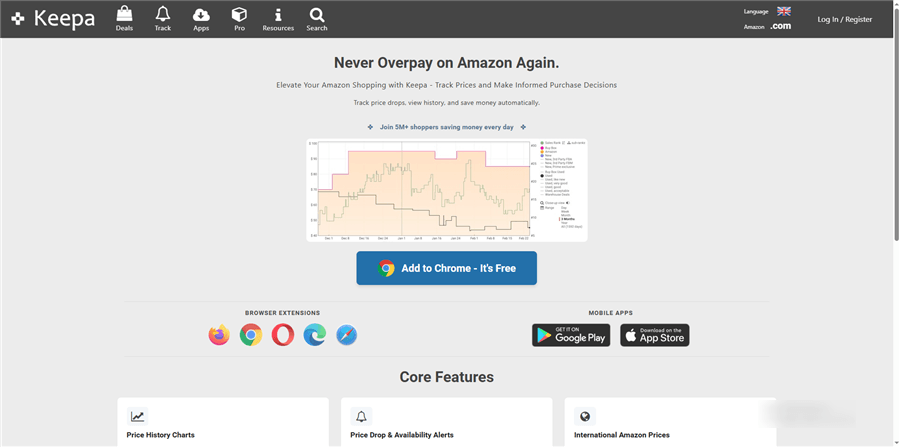
Keepa does one thing exceptionally well: it tracks the full price and sales rank history of any Amazon product. For e-commerce marketers who need to understand competitor pricing behavior over time — seasonal discounts, promotional patterns, Buy Box competition — Keepa is indispensable.
Every product page on Amazon gets a Keepa chart overlay showing price history across all sellers, sales rank trends, and stock availability. You can set price drop alerts for competitor products and export historical data for deeper analysis. It's not a full competitor analysis suite, but as a pricing intelligence layer, nothing beats it.
Key features:
- Complete price history charts for any Amazon ASIN (all sellers, all conditions)
- Sales rank history tracking to identify competitor sales velocity trends
- Price drop alerts for competitor products
- Data export for custom analysis in Excel or Google Sheets
- Browser extension that overlays data directly on Amazon product pages
Pricing: Free browser extension with limited history.
Best for: E-commerce marketers and pricing strategists who need to understand competitor pricing patterns, seasonal discount behavior, and Buy Box dynamics over time.
Limitations:
- Not a full competitor analysis platform — no keyword research or listing analysis
- The data visualization can be dense and takes time to interpret effectively
- Best used as a complement to a full-suite tool, not as a standalone solution
💡 Pro tip: Use Keepa to identify when your top competitors historically drop prices (usually 2–3 weeks before Prime Day and Black Friday). Time your own promotions to either match or slightly undercut them during peak traffic windows.
SellerApp — Best for PPC Competitor Analysis
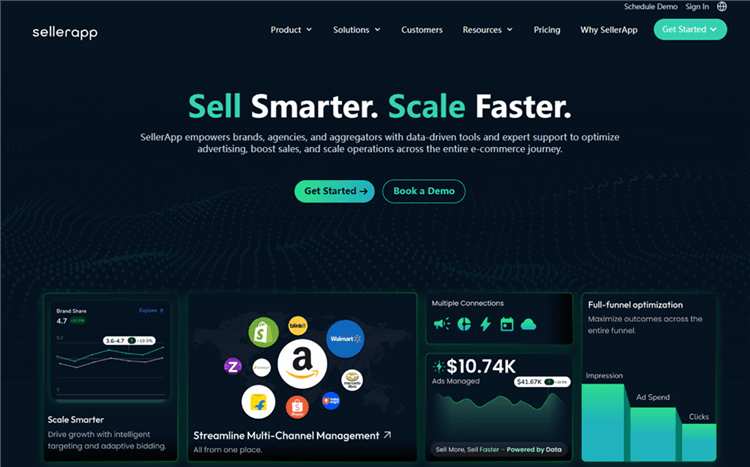
SellerApp is built for Amazon sellers who want to understand not just organic competitor rankings, but also their paid advertising strategies. Its PPC Competitor Analysis module lets you see which keywords competitors are bidding on, estimated ad spend, and how their sponsored placements shift over time.
For digital marketers managing Amazon advertising alongside organic optimization, SellerApp bridges the gap between SEO and PPC competitor intelligence in a single platform.
Key features:
- PPC competitor analysis — keyword bidding patterns and estimated ad spend
- Keyword Tracker for organic and sponsored ranking surveillance
- Product Trends for identifying competitor sales momentum
- Listing SEO analyzer for benchmarking listing quality against competitors
- Automated alerts for competitor listing changes
Pricing: Free tools available. Paid plans start at approximately $99/month, with higher-tier plans for advanced features.
Best for: E-commerce marketers running Amazon PPC campaigns who want to align their paid strategy with competitor advertising intelligence.
Limitations:
- The interface is less intuitive than AllyHub or Jungle Scout
- PPC data is estimated, not pulled directly from Amazon's ad platform
- Some advanced features require higher-tier plans that push the price up significantly
DataHawk — Best for Enterprise-Level Amazon Competitor Analytics
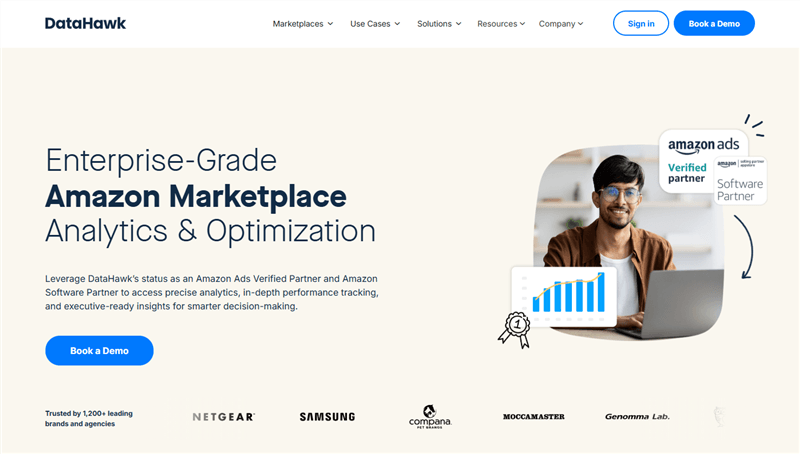
DataHawk is built for brands and agencies managing large Amazon catalogs across multiple marketplaces. Its competitor analysis capabilities go deep: you can track hundreds of ASINs, monitor market share shifts at the category level, and build custom dashboards that surface the competitive signals that matter most to your business.
For enterprise marketing teams that need to report on competitive positioning across regions and product lines, DataHawk's multi-marketplace tracking and custom reporting features are genuinely differentiated.
Key features:
- Multi-marketplace competitor tracking (US, EU, and more)
- Market share analytics at the category and subcategory level
- Custom dashboard builder for competitive KPI reporting
- SEO and keyword rank tracking with competitor benchmarking
- Integration with BI tools for enterprise reporting workflows
Pricing: Custom pricing based on catalog size and feature requirements. Contact DataHawk for a quote.
Best for: Enterprise brands and marketing agencies managing large Amazon catalogs who need scalable, multi-marketplace competitor intelligence with custom reporting.
Limitations:
- Custom pricing and enterprise focus make it inaccessible for small sellers
- Requires more setup and configuration than plug-and-play tools
- Overkill for sellers with fewer than 50 ASINs or a single marketplace
Trellis — Best Free PPC Competitor Analysis Tool
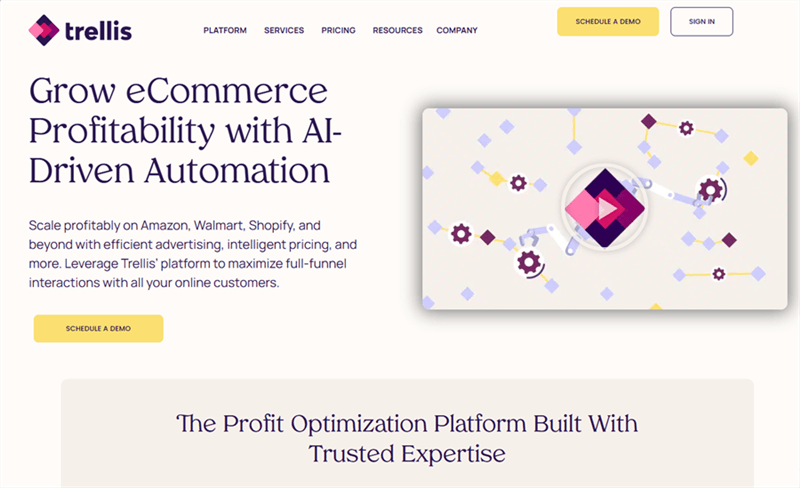
Trellis offers a free Amazon PPC Competitor Analysis Tool that's worth bookmarking even if you never upgrade to a paid plan. It surfaces competitor-sponsored keyword data, estimated bid ranges, and ad placement patterns — giving PPC-focused marketers a free window into competitor advertising strategy.
The paid Trellis platform goes further with dynamic pricing and full campaign automation, but the free competitor analysis tool alone makes it worth including on this list.
Key features:
- Free PPC Competitor Analysis Tool (no account required for basic use)
- Competitor keyword bidding pattern analysis
- Dynamic pricing recommendations based on competitive positioning
- Campaign automation for scaling PPC based on competitor activity
- Performance analytics with competitor benchmarking
Pricing: Free PPC competitor analysis tool available. Paid plans are custom-priced — contact Trellis for details.
Best for: E-commerce marketers focused on Amazon PPC who want a free starting point for competitor advertising intelligence before investing in a full platform.
Limitations:
- The free tool is limited in scope — serious PPC analysis requires the paid platform
- Less comprehensive than SellerApp for full PPC + SEO competitor analysis
- Pricing transparency could be better; requires a sales conversation for paid tiers
CamelCamelCamel — Best Fully Free Price Tracking Tool
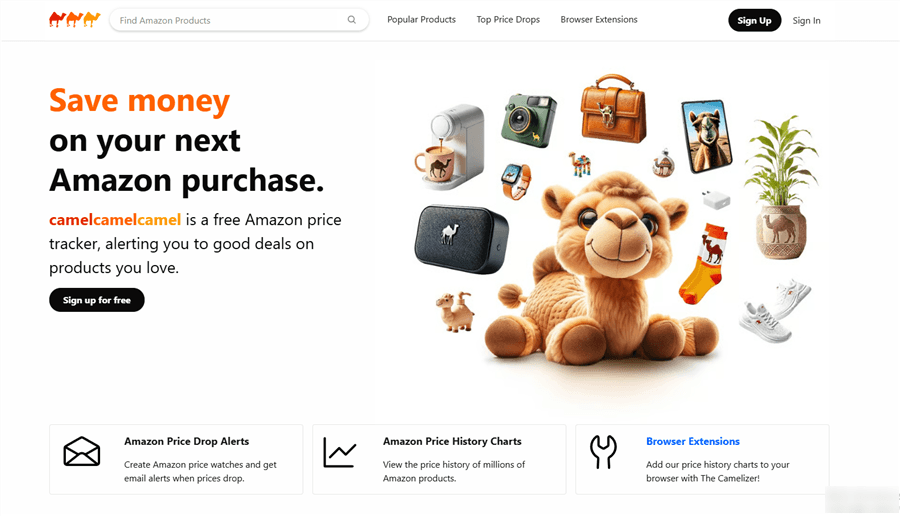
CamelCamelCamel is the original Amazon price tracker, and it remains the best fully free option for monitoring competitor pricing. Enter any ASIN and get a complete price history chart going back years. Set up price drop alerts for competitor products and get notified when they discount.
It's not a full competitor analysis platform — there's no keyword research, no sales estimates, no listing analysis. But for marketers who need a free, reliable way to track competitor pricing behavior, CamelCamelCamel is a staple tool.
Key features:
- Complete price history for any Amazon ASIN (all sellers)
- Price drop alerts via email
- Browser extension for quick price history on Amazon pages
- Wishlist import for bulk price tracking
- Fully free — no paid tiers
Pricing: Completely free.
Best for: Budget-conscious e-commerce marketers who need a reliable, zero-cost way to monitor competitor pricing history and set up price drop alerts.
Limitations:
- No keyword research, sales estimates, or listing analysis
- Data is limited to pricing and availability — not a full competitive intelligence tool
- Interface is dated compared to modern SaaS platforms
How to Choose the Right Amazon Competitor Analysis Tool for Your Needs
With 10+ options on the table, here's a practical decision framework:
If you need structured competitor reports fast: AllyHub is the strongest choice. Its three Amazon intelligence services — Best Sellers Analyzer, Product Details Intelligence, and Rival Price Analyzer — deliver finished XLSX + HTML reports without any manual data work.
If you're just starting out: Begin with SellerSprite's free Chrome extension or CamelCamelCamel. Get comfortable with the data before committing to a paid plan.
If keyword strategy is your priority: Jungle Scout's Keyword Scout is the most accurate keyword competitor tool on the market. Pair it with AllyHub's Product Details Intelligence for a complete picture of how top-ranking competitors structure their listings.
If pricing intelligence is your focus: Keepa is non-negotiable for historical pricing trends. Use AllyHub's Rival Price Analyzer for a current-state competitor price matrix on any search term.
If you run Amazon PPC: SellerApp or Trellis's free PPC tool should be in your stack alongside your primary platform.
If you're at the enterprise level: DataHawk or SmartScout for category-level market share intelligence. Both require a conversation with their sales teams.
⚠️ Warning: No Amazon competitor analysis tool gives you exact sales figures — all sales estimates are modeled approximations. Use them for directional decisions, not precise forecasting. Cross-reference data from two tools before making major inventory or pricing decisions.
FAQ: Best Amazon Competitor Analysis Tools
What is Amazon competitor analysis?
Amazon competitor analysis is the process of studying competing sellers to understand their keyword strategy, pricing, listing quality, review trends, and market performance. The goal is to find gaps you can use to improve rankings and sales.
How do I find my competitors on Amazon?
Search your main keywords and identify the top 5–10 organic results. These are your main competitors. You can also use tools like Jungle Scout or AllyHub to extract ASIN-level competitor data or category-level best sellers.
Is there a free Amazon competitor analysis tool?
Yes. SellerSprite offers a strong free Chrome extension for basic keyword and sales insights. Keepa is best for price history tracking, and CamelCamelCamel is a fully free price tracking tool. These tools cover basic competitor monitoring without cost.
What makes AllyHub different from Jungle Scout?
Jungle Scout focuses on keyword research and ongoing tracking. AllyHub focuses on structured competitor reports, such as best seller lists, ASIN-level product data, and pricing matrices. Many sellers use both for a complete view.
How often should I run competitor analysis?
At least once a month. For fast-moving or seasonal products, weekly checks are recommended. Tools like Keepa can also help you track competitor price changes automatically.
Can I track competitor reviews?
Yes. Most tools show review count and rating. Some platforms (like AllyHub) also extract review data and can analyze review patterns to identify product weaknesses.
What data matters most in competitor analysis?
Focus on: keywords, pricing behavior, review growth speed, listing quality, and overall category trends.