The real bottleneck in market research isn’t accessing data—it’s the hours spent manually finding, extracting, and organizing it. Specialized AI research agents fix this by autonomously browsing the web, pulling structured data, and turning raw sources into actionable insights. Here are the top 10 AI agent tools built specifically for research, data extraction, and data analysis.
💡 How We Selected These Tools: We evaluated 20+ AI agents based on real-web extraction depth, output quality, ease of use for non-technical marketers, and task reusability—selecting only tools with genuine, autonomous data-gathering capabilities.
Key Takeaways
- Top pick for recurring data workflows: AllyHub. It operates natively in your browser, learns your specific workflows, and gets cheaper/faster every time you run it.
- Best for deep autonomous research: Manus AI handles complex, multi-step research tasks end-to-end with minimal supervision.
- Best for structured research outputs: Genspark synthesizes research into polished, presentation-ready Sparkpages and documents, not just raw text.
- Best for no-code web scraping: Browse AI lets non-technical marketers build data extraction robots by clicking — no code required.
- Best for large-scale data pipelines: Apify offers 36,000+ pre-built scrapers for virtually every major platform, built for high-volume extraction.
- What to look for: The most important factors when choosing an AI agent for research and data work are execution depth (does it actually extract data or just summarize?), data structure quality (does it return clean, usable output?), and learning capability (does it improve with repeated use?).
- Bottom line: For most content creators and marketers, start with AllyHub or Manus AI — both handle the full research-to-analysis pipeline and offer meaningful free tiers.
Quick Comparison Table of AI Agent Tools
Tool | Best For | Starting Price | Web Data Access | Structured Output | Learning / Self-Evolution |
AllyHub | Recurring research & extraction workflows | Free / $15.99/mo |
10 Best AI Agent Tools in 2026
AllyHub — The AI Research Agent That Gets Smarter Every Run
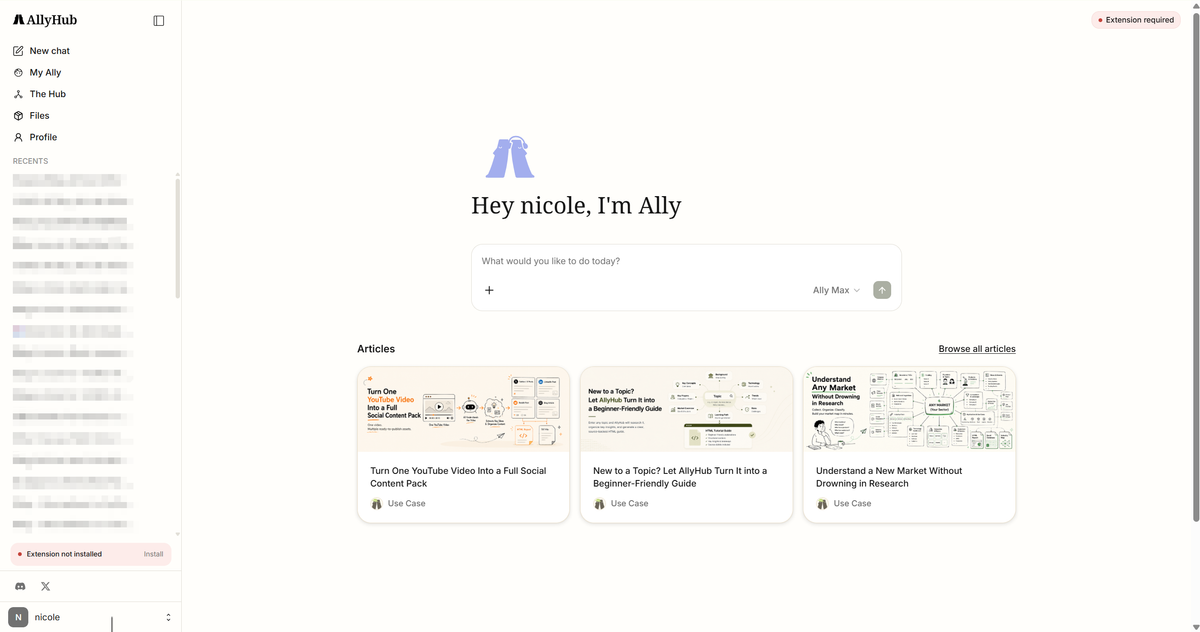
AllyHub is a browser-native AI copilot that treats every task as an investment than a blank slate, specifically for knowledge workers, marketers, and e-commerce teams. What sets it apart from every other tool on this list is its self-evolving architecture: every research or data extraction task you complete builds reusable Skills, Web Notes, and Service assets.
This matters enormously for research and data work. If you use an agent to scrape competitor pricing today, AllyHub learns the site structure. The next time you run it, the agent skips the learning phase, executing the task faster and costing you fewer credits. This compounding efficiency is what they call ROTI (Return on Token Investment).
For e-commerce marketers, AllyHub's Amazon Review Sentiment Insights feature reads thousands of reviews in a single run, extracts complaint themes, and delivers a structured analysis report. For content creators, it can research dozens of sources, extract key data points, and generate structured briefs — all through its Chrome extension, using your real browser sessions (no cloud VM, no login headaches).
Key features:
- Chrome extension — operates your real browser, uses your existing login sessions for authenticated sites
- Self-evolving Skills system — every completed task builds reusable knowledge that reduces future task cost
- 50+ pre-built one-click Services in The Hub covering research, review analysis, competitor monitoring, and more
- Multi-step automation: web scraping, competitor research, social media listening, data extraction, report generation
- Three agent modes (Lite / Pro / Max) to match task complexity to cost
Pricing: Free / Start at $19.99/month (2,000 credits + daily bonus; 20% off annual)
Best for: Content creators, digital marketers, and e-commerce marketers who run the same research or data extraction workflows repeatedly and want an AI agent that compounds in value — getting faster, smarter, and cheaper over time.
Limitations: No mobile app; no scheduled/background tasks (on roadmap); requires staying online during execution; no enterprise security certifications (SOC2/HIPAA); max 3 concurrent tasks on paid plans; no open API/SDK yet.
💡 Pro tip: Start with one of AllyHub's 50+ pre-built Services in The Hub — they're ready to run immediately and cover common research workflows like Amazon review analysis, competitor research, and social media monitoring.
Manus AI — Best for Deep Autonomous Research
Manus AI is a fully autonomous AI agent designed for complex, multi-step research tasks. Give it a research brief — a competitive landscape analysis, a market sizing report, a deep-dive content brief — and it browses the web, writes and executes code, analyzes data, and delivers a structured report with minimal supervision.
For content creators and digital marketers who need comprehensive one-off research, Manus is one of the most capable tools available. It handles the entire research pipeline from query to structured output, including cross-referencing multiple sources, running data analysis, and generating citations.
Key features:
- Fully autonomous multi-step research execution — browses, codes, analyzes, and reports
- Web browsing, code writing, and data analysis in a single unified workflow
- Structured report generation with citations and source attribution
- Manus Collab for team-based research workflows (up to 49 people)
Pricing: Free (300 daily credits) / Standard 20/month(4,000 credits)/ Customizable 40/month (8,000 credits) / Extended $200/month (40,000 credits); annual billing saves ~17%
Best for: Content strategists, researchers, and digital marketers who need deep, autonomous research on complex topics and want a complete report delivered — not just raw data.
Limitations: Credit consumption is unpredictable — complex research tasks can deplete allowances quickly, and even failed tasks consume credits. Every task starts from zero with no accumulated learning. Cloud-based execution means it can't access sites requiring your personal login.
ChatGPT Agent Mode — Best for General Research & File Analysis
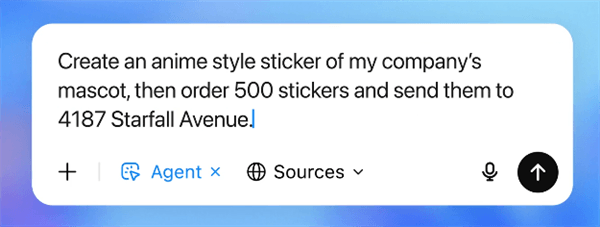
ChatGPT Agent Mode turns the world's most widely used AI into a task executor. It operates a virtual computer, browses websites, works with uploaded files, fills forms, and connects to email and document sources. For marketers already in the OpenAI ecosystem, it's the most frictionless entry point into AI-driven research workflows.
Where ChatGPT Agent Mode particularly shines for research is in its ability to combine web browsing with file analysis — pulling data from the web and cross-referencing it against your own documents, spreadsheets, or reports in a single workflow.
Key features:
- Virtual computer control — browses, clicks, fills forms, edits spreadsheets
- Deep Research mode for comprehensive multi-source topic analysis with citations
- File upload and analysis — cross-reference web data with your own documents
- Connects to email, calendar, and document sources for integrated research workflows
Pricing: Free (limited); Plus 20/month; Pro $200/month (~400 agent messages/month); Business $25/user/month
Best for: Marketers and content creators who need a capable general-purpose research agent without switching tools, especially those who frequently combine web research with analysis of their own files and data.
Limitations: Monthly usage caps require rationing on lower plans; operates on a virtual computer rather than your real browser, so it can't access sites requiring your personal login; limited memory across sessions; agent message limits make it impractical for high-volume research workflows.
Genspark — Best for Structured Research Synthesis
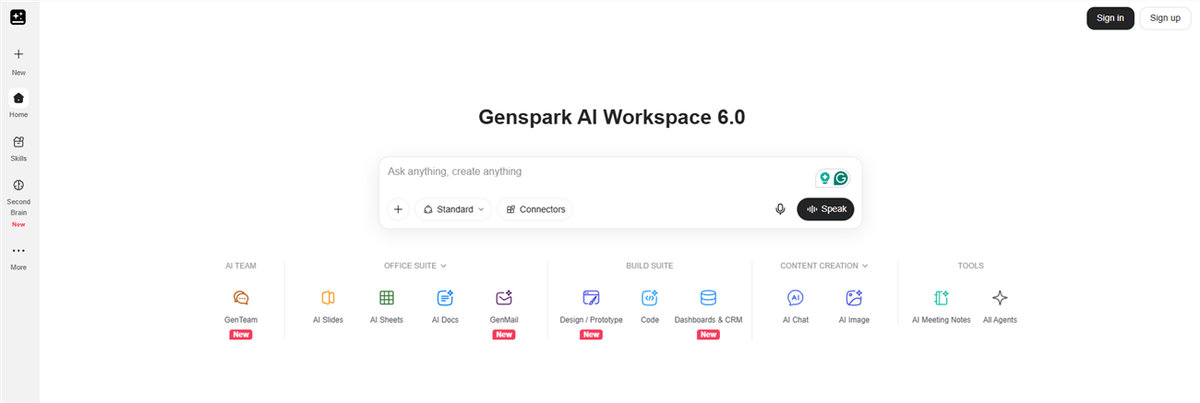
Genspark is a multi-agent AI workspace that routes research prompts through specialized agents to produce polished, structured outputs: Sparkpages, slides, documents, and spreadsheets. It's the strongest option for content creators and marketers who need research delivered in a format that's ready to share or publish — not just a wall of text.
Where most research agents return raw information, Genspark returns finished artifacts. Ask it to research a topic, and it delivers a structured Sparkpage with organized sections, visual formatting, and citations — the kind of output you'd normally spend hours formatting yourself.
Key features:
- Multi-agent routing for specialized research task handling
- Structured output formats: Sparkpages, slides, spreadsheets, documents
- Super Agent multi-model fact-checking for research accuracy and source verification
- Real-time web access for up-to-date research synthesis
Pricing: Free; Plus $24.99/month; Pro $249.99/month; annual billing saves ~20%
Best for: Content creators and marketers who need research delivered in polished, structured formats — competitive analyses, market overviews, topic briefs — ready for immediate use or publication.
Limitations: Complex tasks consume credits rapidly; every task starts from zero with no accumulated learning; costs can be unpredictable for heavy research users; less suited for raw data extraction than for research synthesis.
Perplexity — Best for Fast, Cited Research
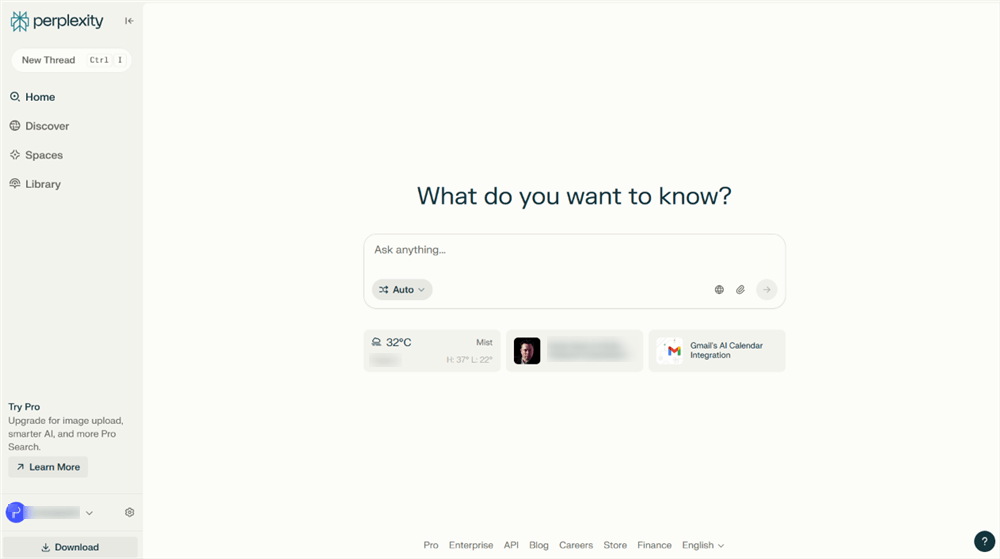
Perplexity is an AI-powered research engine that delivers real-time, cited answers by searching the web and synthesizing results. For content creators and digital marketers who need quick, reliable research with source attribution — without the hallucination risk of standard LLMs — Perplexity is the fastest tool on this list.
It's not a full autonomous agent in the same sense as Manus or AllyHub, but for the specific job of rapid research synthesis with verifiable citations, nothing is faster or more reliable. Its Deep Research mode handles multi-step research tasks and delivers structured reports with full source lists.
Key features:
- Real-time web search with automatic source citation
- Deep Research mode for multi-step, comprehensive topic analysis
- Perplexity Pages for publishing structured research as shareable documents
- Pro Search for more thorough, multi-query research workflows
Pricing: Free (limited Pro searches/day); Pro $20/month (unlimited Pro searches, Deep Research, file uploads)
Best for: Content creators and digital marketers who need fast, reliable, cited research for content briefs, fact-checking, trend monitoring, and competitive intelligence — without the risk of AI hallucinations.
Limitations: Not a full autonomous agent — it researches and synthesizes but doesn't extract structured data from websites or execute multi-step browser tasks; no data extraction or scraping capability; no learning or self-evolution between sessions.
Skyvern — Best for Complex Browser-Based Data Extraction
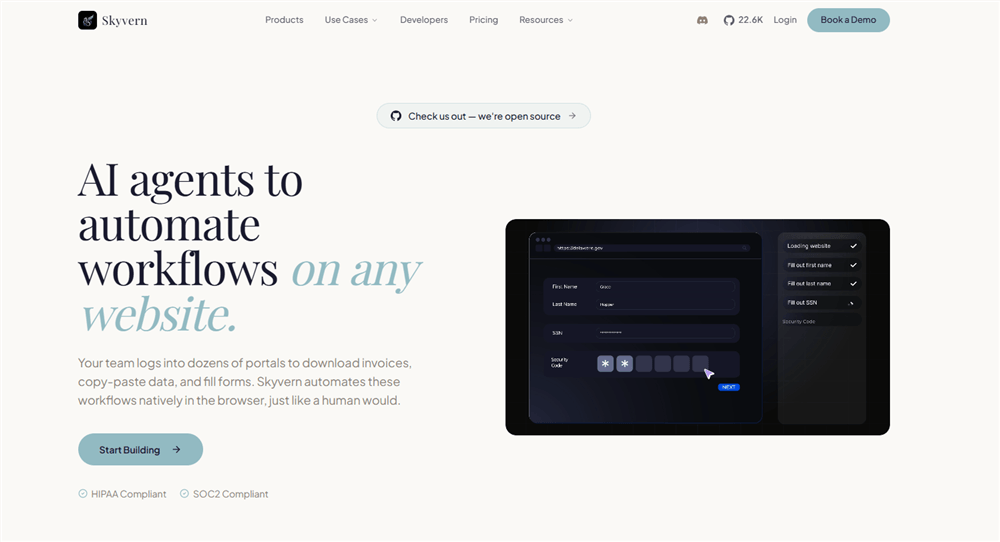
Skyvern uses computer vision and large language models to read and interact with web pages — making it resilient to UI changes that break traditional scrapers. Unlike CSS-selector-based tools, Skyvern understands page layouts visually, so it keeps working even when websites update their design.
For e-commerce marketers and data teams that need to automate complex, multi-step browser workflows — price monitoring across dynamic sites, form-based data retrieval, invoice extraction from authenticated portals — Skyvern is one of the most robust options available.
Key features:
- Computer vision + LLM for UI-agnostic browser automation — no CSS selectors to maintain
- Handles CAPTCHA solving and 2FA authentication (higher tiers)
- Resilient to website UI changes — continues working after site redesigns
- Open source (AGPL-3.0) with managed cloud option for teams
Pricing: Free (5,000 credits/month) / Hobby $29/month (30,000 credits/month); Pro $149/month (150,000 credits/month); Enterprise (custom)
Best for: E-commerce marketers and operations teams that need reliable, automated data extraction from dynamic, authenticated websites where traditional scrapers break due to UI changes.
Limitations: Credit-based pricing consumes credits per automation step, making costs hard to predict for complex workflows; CAPTCHA handling and residential proxies are gated to higher tiers; no learning or self-evolution between runs; requires more setup than no-code alternatives.
Browse AI — Best No-Code Web Scraping & Monitoring Tool
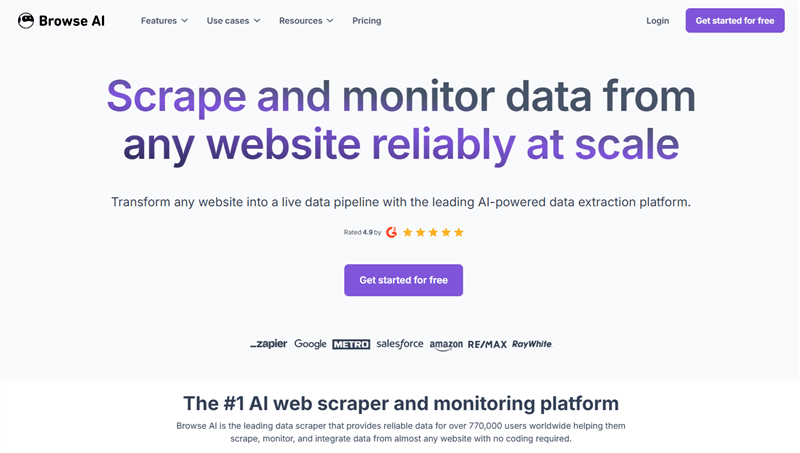
Browse AI lets non-technical users build web scrapers by clicking on the data they want — no code required. You simply point and click on the data you want, and it trains a robot to monitor that page and push data to your Google Sheets.
For e-commerce marketers tracking competitor pricing, content creators monitoring industry news sources, or digital marketers pulling social proof data, Browse AI is the most accessible entry point into automated data extraction.
Key features:
- No-code robot training by clicking on target data points — no technical knowledge required
- Automated monitoring with change detection alerts for price, content, or availability changes
- 7,000+ integrations for data delivery (Google Sheets, Airtable, Zapier, Slack, and more)
- Scheduled scraping with customizable frequency (hourly, daily, weekly)
Pricing: Free (50 credits/month); Personal $48/month; Professional $87/month; Premium from $500/year (600,000+ credits)
Best for: Non-technical marketers, freelancers, and e-commerce businesses that need simple, scheduled data extraction and change monitoring from stable websites — without writing a single line of code.
Limitations: Credits deplete quickly on premium or JavaScript-heavy sites; credits don't roll over on standard plans; less capable than developer-focused tools for complex, authenticated, or heavily dynamic sites; no AI reasoning or autonomous research capability.
Apify — Best for Large-Scale Data Extraction Pipelines
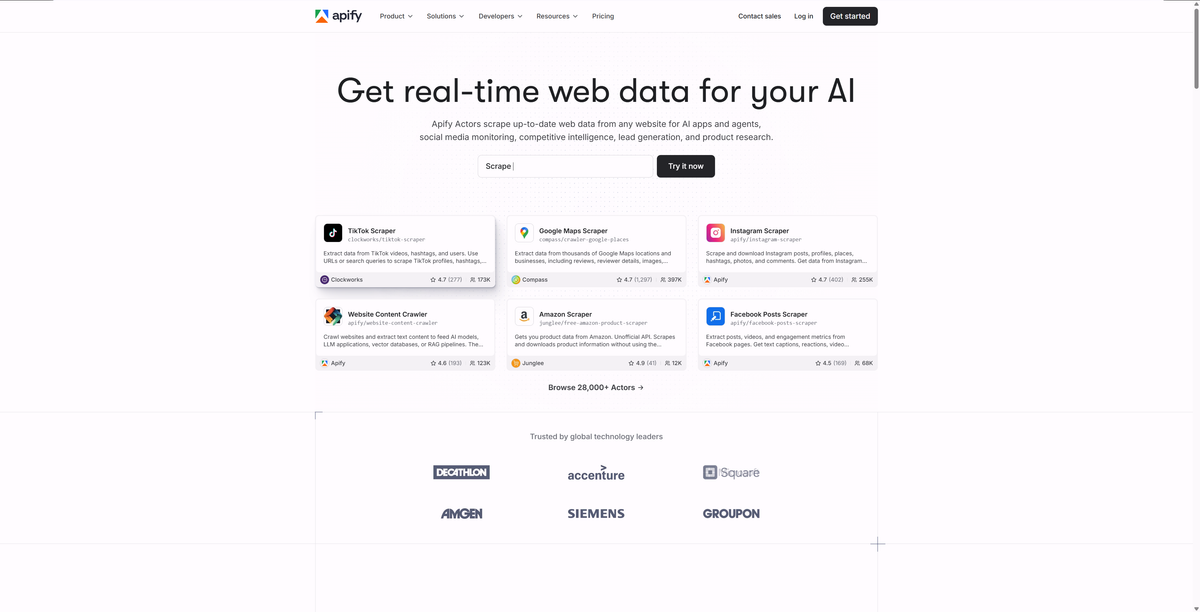
Apify is a cloud-based web scraping and automation platform with a marketplace of over 36,000 pre-built scrapers (called Actors) covering virtually every major website. For data-driven marketers and content teams that need large-scale, structured data extraction from specific platforms, Apify's ecosystem is unmatched.
Content creators can use pre-built Actors to pull data from Instagram, YouTube, LinkedIn, Amazon, TikTok, and hundreds of other platforms. E-commerce marketers can extract product data, pricing, and reviews at scale. The platform handles proxy rotation, JavaScript rendering, and anti-bot bypass automatically — and its MCP Server lets you pipe scraped data directly into AI models for analysis.
Key features:
- 36,000+ pre-built Actors (scrapers) in the marketplace — covering virtually every major platform
- Handles proxy rotation, JavaScript rendering, and anti-bot bypass automatically
- MCP Server for connecting scraped data directly to AI models and analysis pipelines
- Scalable cloud infrastructure for high-volume, scheduled extraction jobs
Pricing: Free; Starter $29/month; Scale $199/month; Business $999/month; consumption-based billing on top of subscription
Best for: Data-driven marketers, content teams, and e-commerce businesses that need large-scale, structured data extraction from specific platforms and are comfortable with a developer-oriented tool.
Limitations: Actual costs are unpredictable — compute units, proxies, and storage are billed on top of the subscription; overkill for simple or occasional scraping tasks; steeper learning curve for non-technical users; requires technical knowledge to build custom Actors.
Firecrawl — Best for Feeding Web Data Into AI Analysis
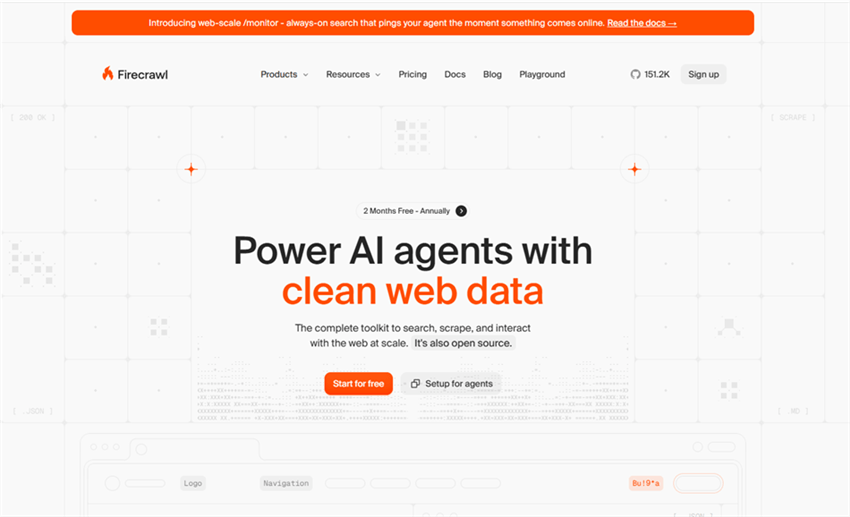
Firecrawl is an API-first web crawler that converts any website into clean, LLM-ready Markdown or structured JSON. It's purpose-built for one specific job: taking messy web content and turning it into structured data that AI models can actually analyze — handling JavaScript rendering, proxy rotation, anti-bot bypass, and content cleaning automatically.
For digital marketers and content teams building AI-powered research pipelines — competitive intelligence feeds, content monitoring systems, or automated market analysis workflows — Firecrawl is the cleanest bridge between raw web data and AI analysis.
Key features:
- Converts any website to clean Markdown or structured JSON — LLM-ready output
- Full-site crawling with automatic JavaScript rendering and anti-bot bypass
- MCP Server for direct integration with AI models and agent frameworks
- Structured data extraction with custom schemas for targeted data points
Pricing: Free (1,000 credits/month); Hobby $19/month; Standard $99/month; Growth $399/month
Best for: Digital marketers and content teams building AI-powered research or analysis pipelines who need a reliable, clean data feed from the web into their AI models or analysis tools.
Limitations: API-first tool — requires technical integration to use effectively; not a standalone research agent (it extracts data but doesn't analyze or synthesize it); dual pricing for AI extraction features and scraping credits can lead to unexpected costs; lower tiers have strict rate caps.
n8n — Best for Custom Research & Data Analysis Workflows
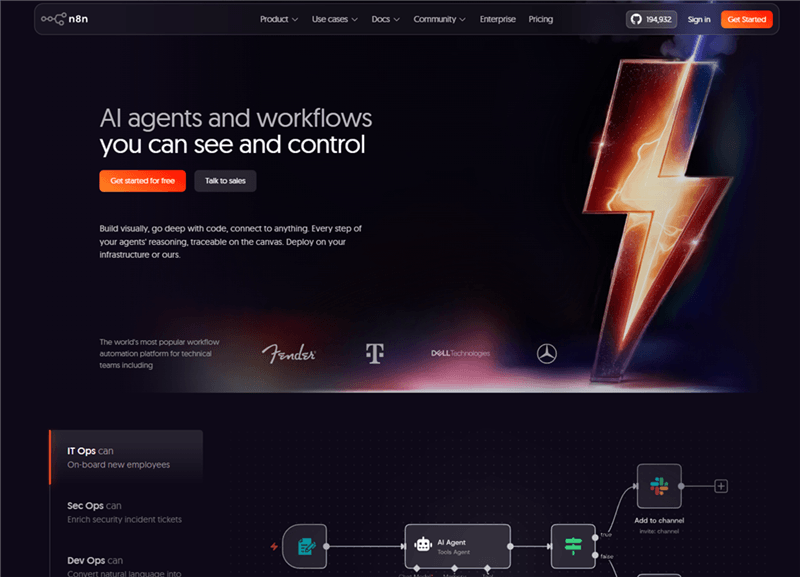
n8n is an open-source workflow automation platform that gives technical teams full control over their research and data infrastructure. Its self-hosted Community edition is free with unlimited executions, and its AI Agent nodes support tasks like multi-source data aggregation, knowledge base Q&A, and automated data transformation using any LLM.
For marketing teams with technical resources who need fully customized research pipelines — pulling data from multiple APIs, processing it through AI models, and delivering structured analysis to specific destinations — n8n offers unmatched flexibility at the lowest possible cost.
Key features:
- Open source (Apache 2.0) — self-host for free with unlimited executions and no per-task fees
- 400+ integrations with APIs, databases, SaaS apps, and AI models
- AI Agent nodes for LLM-powered data processing, research synthesis, and analysis
- Code + visual hybrid builder for maximum workflow flexibility
Pricing: Free (self-hosted, unlimited); Starter €24/month (2,500 executions); Pro €60/month (10,000 executions); Business €800/month (40,000 executions); annual billing saves ~17%
Best for: Technical marketing teams or agencies that need fully customizable, automated research and data analysis pipelines and are comfortable managing their own infrastructure.
Limitations: Requires technical setup and server management for self-hosted deployment; steeper learning curve than no-code alternatives; AI agent capabilities require configuration rather than out-of-the-box use; not suitable for non-technical users.
✅ Recommended starting point: If you're new to AI agents for research, start with AllyHub's free tier or Manus AI's free plan. Both handle the full research-to-analysis pipeline, require no technical setup, and offer meaningful free usage to test with real workflows.
FAQs When Comparing AI Agent Tools
Which AI agent tools are best for data extraction specifically?
For no-code data extraction, Browse AI is the most accessible option. For large-scale extraction from specific platforms, Apify leads with its 36,000+ pre-built scrapers. For dynamic or authenticated sites that break traditional scrapers, Skyvern is the most resilient. For feeding clean web data into AI analysis pipelines, Firecrawl is purpose-built for that job.
Which AI agent tools are best for competitive research and market analysis?
Manus AI and AllyHub are the strongest for comprehensive competitive research. Manus handles deep one-off analyses; AllyHub is better for recurring competitive monitoring workflows that improve over time. Perplexity is the fastest option for quick, cited competitive snapshots.
Can AI agents replace manual research for e-commerce marketers?
For structured, repeatable research tasks — product review analysis, competitor pricing monitoring, market trend tracking — AI agents can handle the execution layer almost entirely. The judgment layer (interpreting findings, making strategic decisions) remains human. Tools like AllyHub's Amazon Review Sentiment Insights can process thousands of reviews in a single run, a task that would take a human analyst days.
Are there free AI agent tools for research and data extraction?
Yes. AllyHub, Manus AI, ChatGPT Agent, Genspark, Perplexity, Skyvern, Browse AI, and Apify all offer free tiers. For most occasional research use cases, free tiers are sufficient to get started and evaluate fit.
What should e-commerce marketers look for in an AI research agent?
Prioritize: (1) real browser access — can it reach actual product pages and review sites using your login? (2) structured data output — does it return clean, analysis-ready data? (3) learning capability — does it improve with repeated use, reducing cost over time? (4) pricing predictability — can you estimate monthly costs before committing? AllyHub's ROTI model is particularly valuable for e-commerce teams running the same product research workflows repeatedly.