You spent hours setting up your lighting, filming, and editing — only to watch your video stall at 200 views. Meanwhile, the same concept from another account blows past a million.
Most of the time, the difference isn't the idea — it's the script.
TikTok's recommendation system considers signals such as watch time, completion, likes, shares, comments, and video information. Stronger viewing signals can indicate that a viewer found a video interesting.
A strong script can help improve retention by getting to the point faster, creating a clear payoff, and giving the edit a tighter structure. This guide walks you through a 6-step formula for writing a TikTok video script that stops the scroll, five templates you can adapt to your format, and a shortcut for mining TikTok transcripts of viral videos so you never script blind again.
Key Takeaways
- The opening seconds matter most: Give viewers a clear reason to keep watching before they scroll. Write 5–10 hook options, then choose the strongest one.
- Hook → Body → CTA: A useful starting structure for many TikTok scripts is a hook, a focused body, and an optional CTA.
- Write to a word budget: A 30-second TikTok is roughly 75–85 words; a 60-second video is about 150. Write to the clock, not the page.
- Script for sound-off viewers: Use on-screen text and, as a practical editing guideline, introduce a visual change every 2–3 seconds when the format allows it.
- Study before you write: Pulling TikTok transcripts from viral videos in your niche reveals the exact hook lines and structures your audience already responds to.
- One goal per script: Decide whether the video teaches, entertains, or sells — a script that tries to do all three does none of them well.
Why a TikTok Script Beats Winging It
Plenty of creators treat scripts as optional. Here's what skipping the script actually costs you:
- Weak openings. Winging it makes it easier to waste the opening seconds before getting to the point.
- Poor pacing. A script keeps the delivery tight and gets to the payoff faster.
- Messy editing. Stage directions show where to cut, add b-roll, or place text overlays.
- Inconsistent output. Repeatable templates make it easier for creators, UGC teams, and MCNs to produce content at scale.
A script doesn't make you robotic. It removes the guesswork so your personality can come through.
Also Read: Best Times to Post on TikTok >
The 3-Part Structure Every TikTok Script Follows
A TikTok script typically follows a hook → body → CTA structure. The hook gives viewers a reason to keep watching, often by creating a curiosity gap, calling out a pain point, or making a bold claim. The body delivers the promised value in short, one-idea-per-sentence beats, with visual changes added as a practical pacing guideline. The CTA asks for one specific action — a follow, save, comment, or link-in-bio click.
Part | Timing | Job | Word budget (30s video) |
Hook | 0–3 seconds | Stop the scroll | 10–20 words |
💡 Pro tip: If a script has no clear break between these three parts, the CTA will feel tacked on and viewers will bounce before it lands. Write the hook and CTA first, then fill the body — they're the two hardest-working lines in the video.
How to Write a Script for a TikTok Video [The 6-Step Formula]
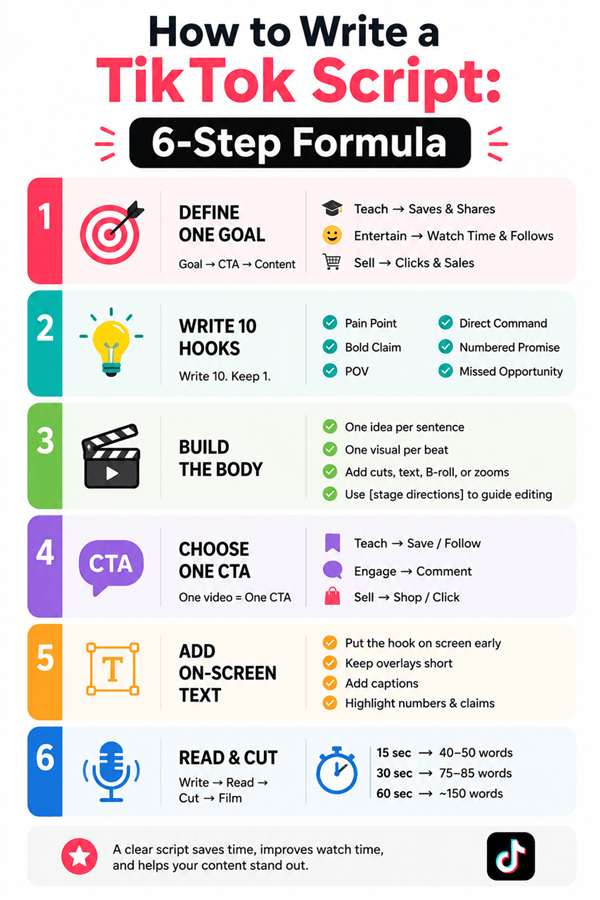
Step 1: Define One Goal Before You Write a Word
Pick the job before the words. Every script needs a single job. Choose it before you write anything:
- Teach → the goal is saves and shares ("Save this for your next drop")
- Entertain → the goal is watch time and follows
- Sell → the goal is clicks, product discovery, or checkout
The goal decides the CTA, the tone, and what counts as "value" in the body. E-commerce sellers scripting for TikTok Shop write a different video than UGC creators scripting a brand testimonial — but both start from this same question.
Step 2: Write 10 Hooks, Keep One
Treat hooks as a test, not a guess. The hook is the highest-leverage sentence in the script. Don't gamble on your first idea — draft ten and read them out loud. The best one usually comes around option six.
Hook formulas that consistently stop the scroll:
- Pain-point callout: "If your TikToks keep getting zero views, this is why."
- The table-turning claim: "Unpopular opinion: posting more often is actually hurting your reach."
- POV scenario: "POV: you just got your first viral comment and have no idea how to reply."
- Direct command: "Stop scrolling if you're about to film your first product video."
- Numbered promise: "Three changes that took my hook rate from 4% to 11%."
- Missed-opportunity framing: "If you're still writing TikToks without a script, you're leaving views on the table."
Step 3: Script the Body in Single-Idea Beats
One idea per sentence, one visual per beat. The body's job is to deliver on the hook's promise as clearly and efficiently as possible. Three rules:
- One idea per sentence. If a sentence has two commas and a "which means," cut it in half.
- Use visual changes as a pacing guideline. When the format allows it, aim to introduce a new cut, zoom, text overlay, b-roll shot, or gesture every 2–3 seconds. This can help maintain visual variety without treating the timing as a fixed rule.
- Write stage directions in brackets. [CUT to close-up of the result] tells you — or your editor — where the visuals should change. Faceless creators especially benefit from this extra layer.
Here's what a body beat looks like in practice:
Hook (text overlay): "3 changes that saved my TikTok reach"
If your reach dropped this month, it's probably not the algorithm. (CUT: screenshot of declining analytics)
First, I stopped posting daily and started posting when the idea was actually good. (ZOOM on calendar with 3 uploads)
Second, I rewrote every hook before filming. (SPLIT SCREEN: old hook vs new hook)
Third, I cut my scripts to under 90 words. (CUT: word counter)
Step 4: Write One CTA — and Only One
Ask for one action, earned by the body. A script with "like, comment, follow, and check the link in my bio" asks for everything and gets nothing. Pick the action that matches the goal from Step 1:
- Educational video → "Save this for your next shoot" or "Follow for more TikTok scripts"
- Engagement play → a low-effort comment prompt ("Which hook would you click on?")
- Seller or product video → "Tap the link in my bio" or a TikTok Shop prompt
The CTA works best when the body earned it. Ask after you've delivered value, not before.
Step 5: Write the On-Screen Text Layer
Script the silent layer too. Text isn't decoration on TikTok — it's a primary content layer. Some viewers watch without sound, so:
- Reinforce the hook as on-screen text in second one
- Keep each text overlay to 5–10 words
- Use TikTok's auto-captions so your spoken words are readable with sound off
- Highlight numbers, results, and claims in text even when you say them out loud
Write this layer into the script as bracketed directions, not as an afterthought in editing.
Step 6: Read It Out Loud, Then Cut
Edit with your voice, not your eyes. Scripts are written for ears, not eyes. Read the draft aloud at your natural on-camera pace with a timer:
- 15 seconds → aim for 40–50 words
- 30 seconds → 75–85 words
- 60 seconds → about 150 words
Cut before filming, not in the edit. If a sentence sounds unnatural when spoken, rewrite it — over-scripted language is the fastest way to sound like a brand reading a teleprompter instead of a person.
Best for: Any creator, MCN, or seller who wants a repeatable scripting process instead of staring at a blank page. The six steps take about 20 minutes once the structure becomes habit.
5 TikTok Script Templates You Can Adapt
Template 1: How-To / Educational
Best for: Creators building authority, coaches, service providers.
Hook: "If you're still doing [common mistake], you're leaving [result] on the table."
Body: "Here's the fix: [one clear step]." (CUT: demo)
"[Second step]." (ZOOM: result)
"[Third step] — this is the one nobody talks about." (TEXT: key phrase)
CTA: "Save this for your next [context], and follow for more [niche] tips."
Template 2: Product Showcase (E-commerce Sellers)
Best for: TikTok Shop sellers, DTC brands, drop-shippers.
Hook: "POV: you finally found a [product] that doesn't [common complaint]."
Body: "I tested it for [timeframe] — here's what surprised me: [benefit 1]." (CUT: close-up demo)
"[Benefit 2] — you can literally [use case]." (TEXT: price or key spec)
Social proof: "This is the one [customer type] keep reordering."
CTA: "Tap the link to grab it before the next restock. / Tap the link to learn more."
Template 3: UGC Testimonial
Best for: UGC creators filming brand content — the format brands actually approve.
Hook: "I was skeptical about [product], so I used it for [X days]."
Body: "[Specific result with number]." (CUT: before/after)
"The thing nobody mentions: [unexpected detail]." (ZOOM: detail)
"It's now part of my [routine/context]."
CTA: "If you've been on the fence, this is your sign."
Template 4: Faceless Voiceover + B-Roll
Best for: Faceless creators in finance, productivity, and niche-explainer channels.
Hook (VO over bold text): "The real reason [common belief] is wrong."
Body: "[Claim 1] — [2 seconds of supporting b-roll]." (CUT)
"[Claim 2] — [stock footage or screen recording]." (CUT)
"[Claim 3] — [animated text emphasizing the number]."
CTA: "Follow for one [niche] breakdown every day."
Template 5: Storytime / Trend-Jack
Best for: Solo creators and niche accounts riding trending sounds or formats.
Hook: "Last week, [relatable event] completely changed how I think about [topic]."
Body: "It started when [setup in one sentence]." (CUT: reenactment or footage)
"Then [the turn]." (ZOOM: reaction)
"Which taught me [the lesson]."
CTA: "Have you ever had this happen? Tell me in the comments."
Your scenario | Start with | Why |
New creator building authority | Template 1 | Educational content earns saves, which the algorithm rewards |
TikTok Shop or DTC seller | Template 2 | Demo + social proof in under 30 seconds |
Common TikTok Script Mistakes to Avoid
- Opening with a greeting. "Hey guys, welcome back" burns your 3 seconds. Start mid-thought.
- Stacking multiple CTAs. Every extra ask dilutes the one that matters.
- Writing for readers, not listeners. Long sentences read fine in a doc and die out loud. Read every draft aloud.
- Zero visual direction. 20 seconds of the same framing is a scroll trigger, even with a great script.
- Ignoring the sound-off audience. No text layer means roughly half your potential viewers see a silent video.
- Over-scripting the humanity out. Scripts control pace — they shouldn't erase your natural speech. If it reads like an ad, rewrite it like a text message.
How to Analyze Viral TikTok Scripts for New Ideas
Studying viral TikToks is more useful when you break down how the script works, not just what the creator says.
Instead of studying one viral video at a time, you can turn the process into a repeatable research workflow: collect videos, analyze them, compare patterns, and save the resulting workflow for future research. AllyHub, an AI copilot, allows you to do that — its TikTok Script Analyzer helps break each script into its opening hook, hook type, key turns, closing CTA, and overall structure. It can also compare several videos to identify patterns that repeat across them.
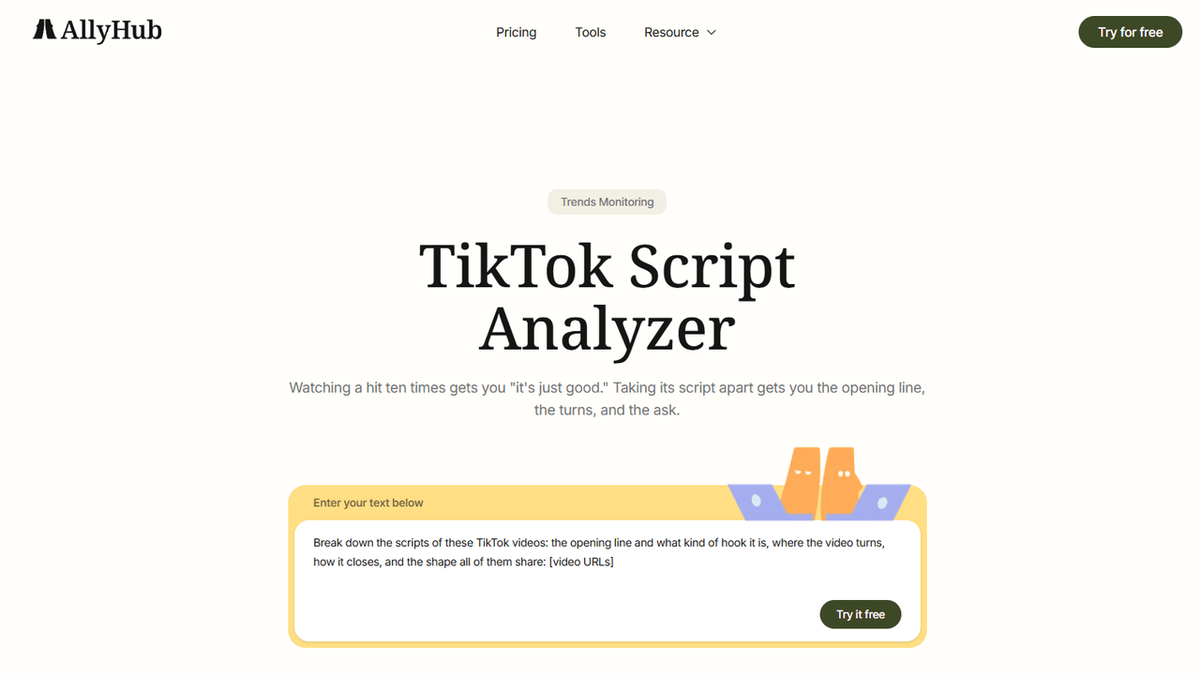
That gives you a practical research workflow:
- Find: Collect several high-performing TikToks in your niche.
- Analyze: Identify the hook, beats, transitions, and CTA in each script.
- Compare: Look for structures that appear across multiple successful videos.
- Adapt: Use the resulting script skeleton as a starting point for your own topic and voice.
Study what works, then make it your own. A script structure that worked for another creator isn't a guarantee of performance; the edit, visuals, sound, account, and timing all matter too. AllyHub itself describes the analyzer as a way to understand the structure behind a video, not as a predictor of whether copying that structure will go viral.
If the goal is to go from “What made this TikTok work?” to “How can I build my own version?”, script analysis is more useful than simply collecting transcripts.
FAQ
How do you write a good TikTok script?
Start with one clear goal, write the hook and CTA first, then script the body in single-idea beats with visual changes every 2–3 seconds. Read it out loud, cut to your word budget, and add the on-screen text layer last.
How important are the first few seconds of a TikTok?
The opening seconds are critical because viewers can scroll away at any time. Start with a clear hook that creates curiosity, highlights a pain point, or promises a useful payoff. The goal is to give viewers a reason to keep watching—not to meet a fixed 3-second algorithm threshold.
How long should a TikTok script be?
Budget roughly 2.5 words per second: 40–50 words for a 15-second video, 75–85 words for 30 seconds, and about 150 words for 60 seconds. TikTok delivery runs faster than YouTube, so shorter is safer.
Do you need a script for TikTok?
Casual, off-the-cuff posts don't need one. But if you're posting for growth — creators, MCN rosters, sellers with a product calendar — yes. Even a bullet-point outline keeps pacing tight, makes editing faster, and gives you hooks you can test and reuse.
What are the best hooks for TikTok?
Pain-point callouts ("if your reach dropped, this is why"), unpopular-opinion statements, POV scenarios, "stop scrolling if..." commands, and numbered promises. Write 5–10 options per video and let performance data pick the winner.
How do I get a TikTok transcript to study viral videos?
TikTok's auto-captions are viewable but not exportable, so paste the video URL into an AI transcription tool for a copyable transcript. For research at scale — dozens of videos across your niche — a browser AI agent like AllyHub can batch-extract TikTok transcripts and summarize the recurring hooks and CTAs into one document.
Can AI tools write my TikTok script for me?
AI can draft scripts, remix hook formulas, and speed up research, but the best-performing scripts still carry a human voice. Use AI for the tedious parts — research, first drafts, hook variations — then edit so it sounds like you. TikTok's Creative Center also includes Script Generator, which can generate TikTok-style scripts from basic product or brand inputs.