You post consistently, reply often, and still sit at 400 followers. The problem usually isn't one bad hook — it's that the pieces are not working together yet.
This playbook is for X accounts under 5,000 followers. It covers how to choose a niche, set up your profile, build a posting cadence, use replies for discovery, review your analytics, and avoid the growth mistakes that make an account look busy but stay flat.
Key Takeaways
- Own a narrow niche first. Pick something you can plausibly be the go-to account for, then hold it for 90 days before judging results.
- Cadence beats bursts. For small accounts, three to five posts a day is a useful starting range — but the real rule is to publish consistently enough that you can learn from the data.
- Replies are the lever. Five to ten sharp replies a day off your own timeline bring more profile visits than extra posts.
- Review weekly, repeat outliers. Each week, find your top three posts and write two or three more in the same format.
- Monetise at 500–1,000 followers, not 10,000 — waiting is the expensive mistake.
How to Grow on Twitter - 8 Steps
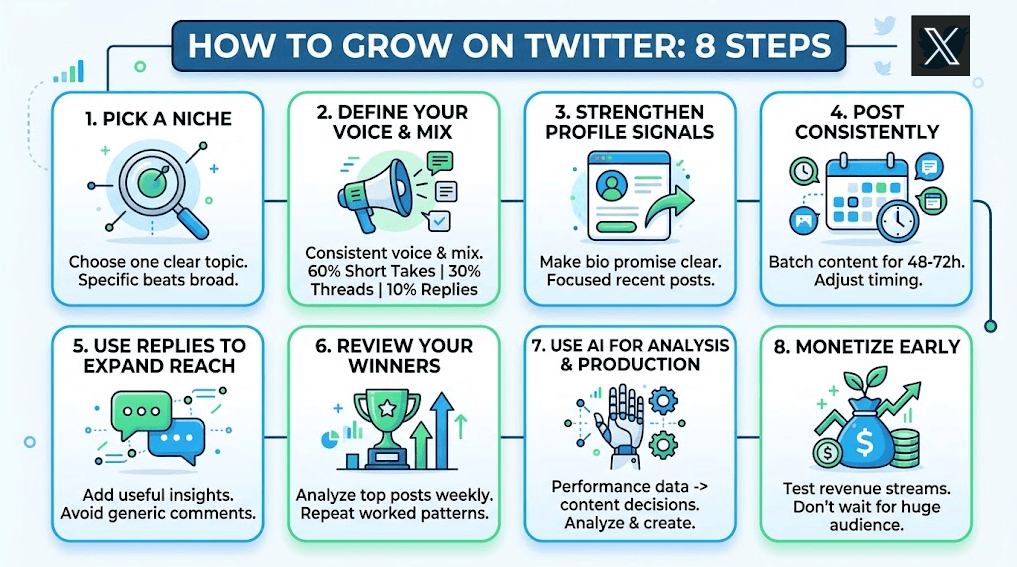
Step 1: Pick a niche you can plausibly own
Narrow beats broad. “SaaS pricing for bootstrapped founders” gives both X and your readers a clearer signal than “business advice.”
Hold the lane for 90 days before judging it. If you cover two related subjects, connect them with one clear spine — for example, “using AI in e-commerce operations” — and make sure your posts and replies both reinforce that frame.
Step 2: Set your voice and your format mix
Pick one register and keep it: analytical, blunt, contrarian, or warm. Trying to be all four reads as no voice at all.
A mix that works for solo creators:
- 60% short takes — one-to-three-sentence opinions, reactions, observations.
- 30% threads — five to fifteen posts teaching one thing, or walking through one case.
- 10% replies and quote posts — daily engagement outside your own timeline.
Short takes travel, threads build trust, replies bring strangers. The percentages are a starting point to test, not a rule.
Step 3: Make your profile easy to follow
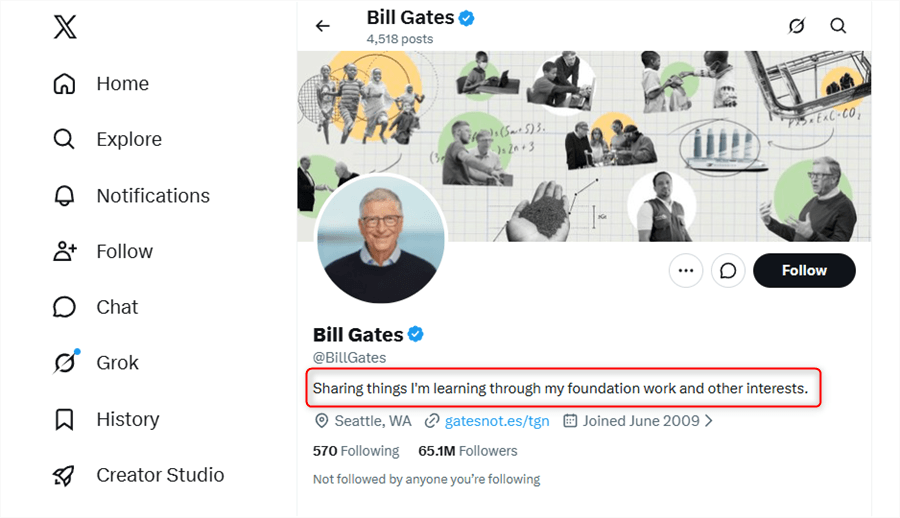
Your profile can help the right person decide, in a few seconds, whether this account is for them.
A simple structure example:
- Bio line 1: who you help and what outcome you talk about
- Bio line 2: proof, experience, or posting promise
- Bio line 3: one human detail or clear next step
- Pinned post: your best value post, not necessarily your latest offer
Step 4: Post three to five times a day, batched
Consistency matters more than volume: three posts a day for a month does more than ten posts in one afternoon. The practical version is batching — schedule 48–72 hours of posts in one sitting, then spend the rest of the week replying instead of writing.
Timing: start with your audience's working hours rather than generic charts. B2B readers skew 7–9am and 12–1pm in their time zone; creator and consumer audiences often skew 8–10pm. Then check your own analytics and adjust.
📌 A quick note on views: X views are closer to impressions than confirmed readers. A low-view week doesn't always mean the content was bad, and a high-view post doesn't always mean people cared. Pair views with replies, reposts, profile visits, and follows before drawing conclusions.
Step 5: Work the reply lever harder than your own feed
Replies put your name in front of someone else's audience. For small accounts under the first 5,000 followers, that often creates more discovery than publishing more posts into an empty feed. Budget 20–30 minutes a day for five to ten replies — specific additions, not applause:
- Add what the post didn't say — a number from your own experience, a counter-example, an edge case.
- Skip "great post." It is invisible to the author and to everyone else.
- Split your targets. Big viral threads give raw reach; small threads get read. Three replies on the bigger threads in your niche, five on posts young enough that the author reads every reply.
Step 6: Review weekly and double down on outliers
Once a week, pull your top three posts by engagement and note three things about each: the format, the topic, and the shape of the first line. Then write two or three more posts in the winning format on adjacent topics.
Most accounts have one or two formats that carry everything; you can't see them without a weekly pass. Copying your own outlier is the cheapest content strategy that exists.
Step 7: Use AI to speed up review, research, and content planning
AllyHub’s Social module connects your X account and syncs account- and post-level performance. Depending on the platform and post type, that can include views or plays, likes, replies or comments, reposts or shares. Its built-in AI turns that data into performance briefs, winning content patterns, content gaps, and next-topic opportunities, giving you a faster way to run the weekly review in Step 6.
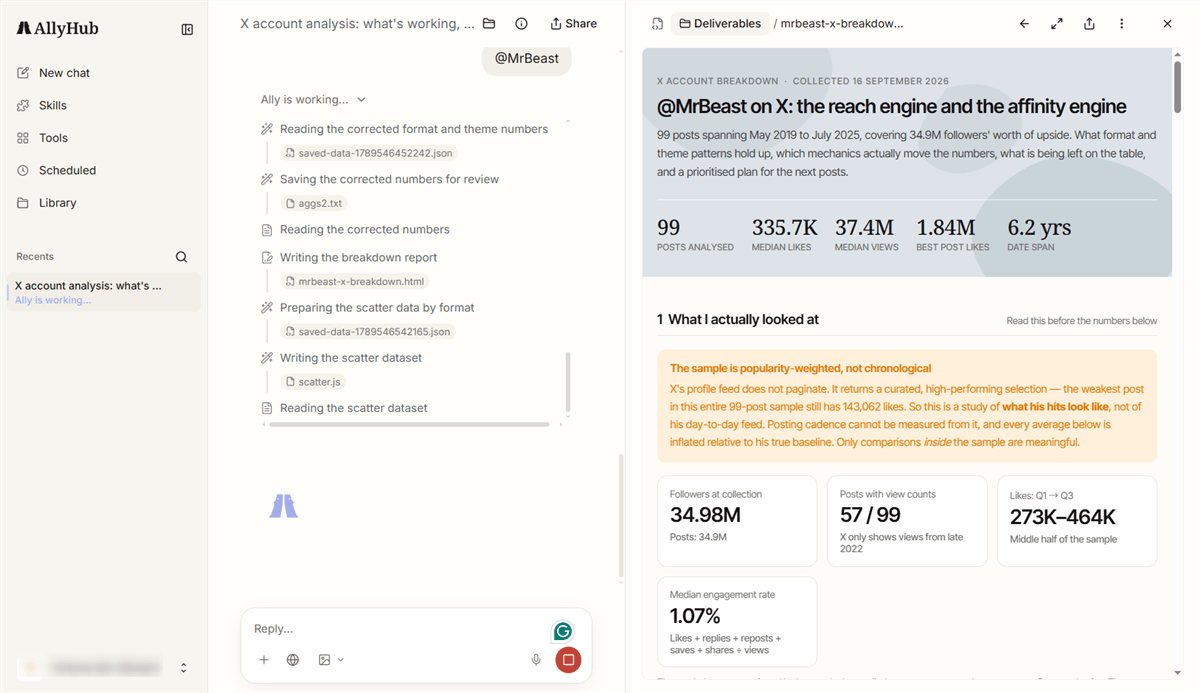
For ongoing research, Radars can track niche keywords, selected X accounts, and TikTok/X creators through manual or scheduled scans. Profiles keeps your positioning and target audience consistent, while Studio turns research and insights into long-form content. AllyHub doesn't replace your judgment or guarantee growth, but it connects performance analysis, research, and content creation in one workflow. Plans include a free tier with daily credits and Pro at $15.99/month.
Step 8: Start monetising at 500–1,000 followers
Don't wait for 10,000. Realistic first revenue at 500–1,000 engaged followers:
- Affiliate links for tools you already use — typically 10–30% commission.
- A low-ticket product — a $19–49 template, checklist or mini-course.
- A paid newsletter at $5–10/month, sold to the people who reply to you most.
- One consulting or freelance client from a DM conversation.
X's own ad revenue sharing is a later milestone: it requires 5,000,000 organic impressions in three months, among other criteria (X's monetization standards). Treat it as a bonus, not the plan.
Your first 30 days: A Simple Starting Plan
Use this as a starting plan. The point of the first month is to build enough consistent activity to learn what your audience responds to.
Days | What you do |
1–3 | Pick the niche. Audit 20 accounts in it and note their voice and format mix. |
4–7 | Write and queue your first 14 posts (2/day). Start replying 5×/day. |
8–14 | Step up to 3 posts/day. Keep replying. Watch for your first outlier. |
What Not to Do If You Want Organic Growth on X
- Follow-for-follow and follow churn. Named in X's authenticity policy as manipulation, and capped by X's follow limits and ratios. Low-quality followers rarely read or reply, which makes your engagement rate look weaker when brands, clients, or collaborators check the account.
- Buying followers. Same arithmetic, faster, and it permanently corrupts your own data.
- Engagement pods and growth services. Team engagement can lift a post above its natural level once, then trains the algorithm and your audience to expect a response you can't keep producing.
- Generic replies at volume. Automation tools will happily post "insightful!" five hundred times; that is a reputation you cannot undo.
rganic growth is slower, but the inputs are more durable: a clear niche, repeatable formats, useful posts, genuine replies, and regular review of what actually earns attention.
FAQ
How long does it take to grow on Twitter in 2026?
For many small accounts, 1,000 real followers can take three to six months of consistent posting and daily replies. Some niches move faster, but the first 500 usually feel slower because you're still building recognition.
Is there a way to get a lot of followers on Twitter fast?
Only in one direction. Giveaways, follow trains and growth services move counts quickly and leave you with an audience that doesn't read. Paid promotion buys attention faster than anything organic — buy it for a launch, not for the account.
Do I need to pay for X Premium to grow?
It changes mechanics, not fundamentals: longer posts and additional posting formats help if you publish long-form analysis. It won't fix a vague niche, an inconsistent cadence, or a lack of real replies.
Should I cross-post the same content to Instagram or TikTok?
Rewrite, don't repost. X rewards a strong first line and native formatting. An Instagram caption can work as a starting point, but rewrite it for X: shorter opening, tighter structure, and a clearer reason for someone to reply or repost.
Can AI tell me why one of my posts performed?
Partly, and it depends on what you feed it. Against your own post-level data, a model can compare a winner to your baseline and flag differences in format, topic and timing far faster than you'd spot them by hand — that's the job AllyHub's Social analysis does for X and TikTok accounts. It connects your X and TikTok accounts, analyzes performance, identifies winning content patterns and content gaps, and suggests next-topic opportunities.