Firecrawl’s billing dashboard is a brutal wake-up call: credits evaporate three times faster than expected.
Between a 5× credit multiplier for AI extraction, extra charges for Stealth Mode, and a self-hosted version stripped of proxy rotation, the costs are unsustainable. For growth marketers feeding AI pipelines or tracking competitors, a developer-first tool with unpredictable pricing is a constant bottleneck.
If web scraping shouldn't require an engineering degree or an infinite budget, here are the 7 best Firecrawl alternatives in 2026—categorized by the exact problem they solve.
Key Takeaways
- Best overall alternative: Apify offers the most complete platform for marketers who need both pre-built scrapers and custom automation, with a generous free tier.
- Best no-code alternative: Octoparse is the top pick for non-technical marketers — point-and-click scraping with 100+ templates, no coding required.
- Best self-hosted alternative to Firecrawl: Crawl4AI is the strongest open-source, self-hosted option with Apache 2.0 licensing and LLM-ready output.
- Best for enterprise scale: Bright Data handles the most heavily protected sites with unmatched proxy infrastructure.
- Firecrawl is still worth it if: You're a developer building LLM pipelines who needs a single managed API for AI-ready Markdown output and you're comfortable with credit-based pricing.
- Bottom line: For marketers who want data without writing code, Octoparse or Apify will serve you better than Firecrawl in 2026.
Quick Comparison: Firecrawl Alternatives at a Glance
Alternative | Best For | Pricing vs. Firecrawl | Free Plan? | No-Code? |
Apify | Pre-built scrapers + custom automation | Comparable | ✅ $5/mo credits |
7 Best Firecrawl Alternatives
Apify — Best for Marketers Who Need Pre-Built Scrapers
Apify is one of the most complete web scraping and automation platforms available, and it's the closest like-for-like alternative to Firecrawl for teams that need both managed infrastructure and flexibility. Where FireCrawl gives you a single API, Apify gives you a marketplace of thousands of pre-built "Actors" — ready-to-run scrapers for Amazon, Google, LinkedIn, Instagram, and hundreds of other sites — plus the ability to build custom scrapers when you need them.
Why it beats Firecrawl for marketers who need pre-built scrapers: Instead of writing code to extract data from a specific site, you can find a pre-built Actor in Apify's marketplace, configure it with a few clicks, and run it immediately. For common marketing use cases — competitor price monitoring, Google SERP tracking, social media data collection — this saves hours of development time.
Key features:
- Marketplace of 1,500+ pre-built Actors for popular websites
- Full API for custom scrapers and automation pipelines
- Proxy management, CAPTCHA solving, and anti-bot bypass built in
- Scheduling, webhooks, and integrations with Google Sheets, Zapier, and Make
- LLM-ready output formats including JSON and Markdown
Pricing vs. Firecrawl: Apify's free plan includes $5 in monthly platform credits — enough for light usage. Paid plans start at $29/month (Starter) up to $999/month (Business), with pay-as-you-go for additional usage. Pricing is more predictable than Firecrawl's credit multiplier system because you pay for compute time and data transferred, not per-feature credit multipliers.
Best for: Digital marketers and e-commerce teams who need to scrape specific platforms (Amazon, Google, social media) without writing code from scratch, and who want a managed platform with scheduling and integrations.
Limitations vs. Firecrawl: Apify's free tier is more limited than Firecrawl's for pure API usage. If you're building a custom LLM pipeline and want a single clean API endpoint, Firecrawl's developer experience is more streamlined. Apify's breadth can also feel overwhelming if you only need one specific scraping task.
Octoparse — Best No-Code Alternative to Firecrawl
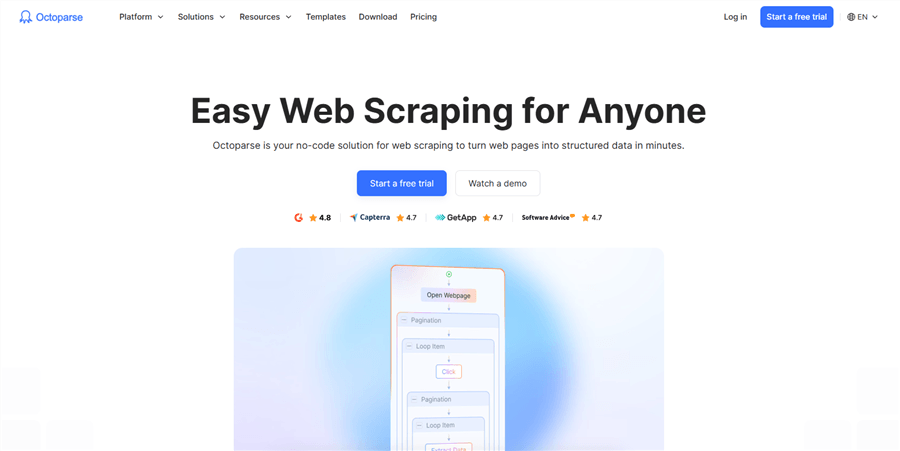
If Firecrawl's biggest problem for you is that it requires coding, Octoparse is the answer. It's a fully visual, point-and-click web scraper designed specifically for non-technical users. You highlight the data you want on a webpage, Octoparse figures out the extraction pattern, and you run it — no API calls, no selectors, no code.
Why it beats Firecrawl for non-technical marketers: Octoparse has an AI assistant that auto-detects data points on a page, plus 100+ pre-built templates for popular sites like Amazon, eBay, LinkedIn, and Yelp. A marketer can go from zero to extracted data in under 10 minutes without touching a line of code. Firecrawl requires API integration at minimum.
Key features:
- Visual point-and-click interface with AI-assisted data detection
- 100+ pre-built templates for popular websites
- Cloud-based extraction with scheduled scraping
- IP rotation and CAPTCHA solving
- Export to Excel, CSV, Google Sheets, or databases
- Handles JavaScript, AJAX, and dynamic content
Pricing vs. Firecrawl: Octoparse offers a free plan with limited features. Paid plans start at $83/month (Standard) or $229/month billed monthly. This is more expensive than Firecrawl's entry-level tiers, but the no-code interface eliminates the developer time cost that Firecrawl implicitly requires.
Best for: E-commerce marketers monitoring competitor pricing, content marketers collecting research data, and any marketer who needs structured web data without engineering support.
Limitations vs. Firecrawl: Octoparse is not an API — it's a desktop/cloud application. If you need to integrate web scraping into a programmatic pipeline or LLM workflow, Firecrawl's API approach is more suitable. Octoparse also has less flexibility for highly custom extraction logic.
Bright Data — Best for Enterprise-Scale Data Extraction
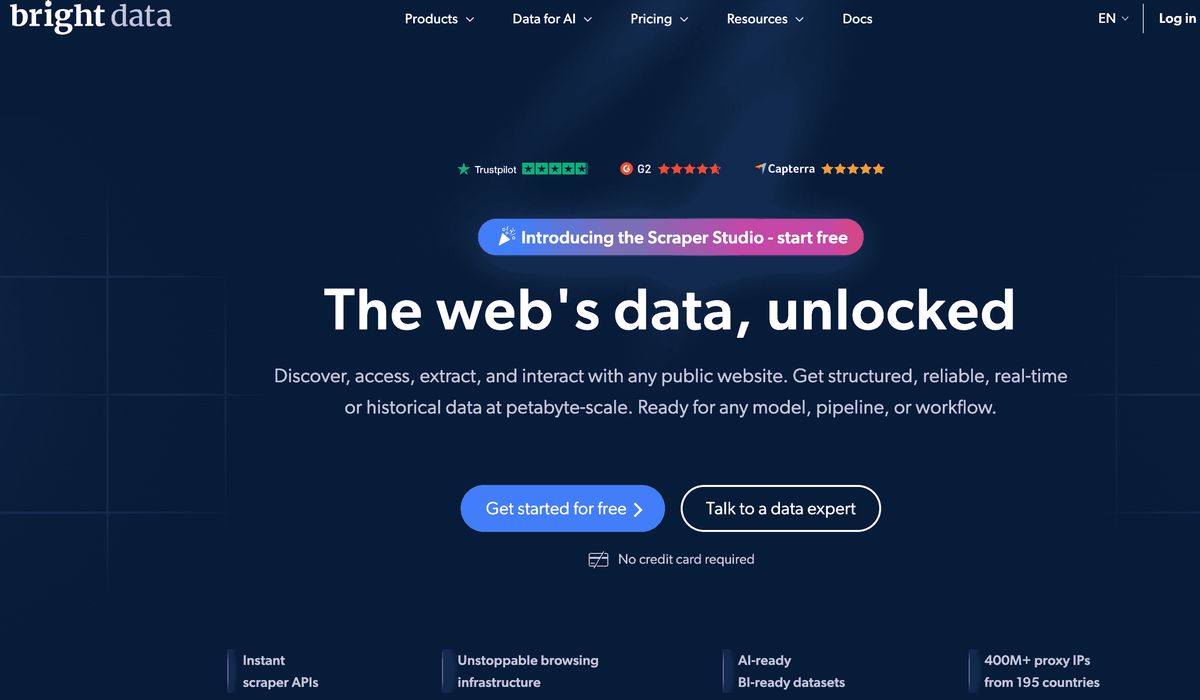
Bright Data is the enterprise-grade choice when you need to scrape at massive scale or extract data from heavily protected websites that block most other tools. Its proxy network — spanning residential, datacenter, ISP, and mobile IPs — is the largest in the industry, and its Web Unlocker technology handles anti-bot measures that trip up Firecrawl and most alternatives.
Why it beats Firecrawl for enterprise-scale needs: Firecrawl can struggle with highly protected sites even with Stealth Mode enabled. Bright Data's infrastructure is purpose-built for exactly these scenarios. It also offers ready-made datasets for common use cases (e-commerce pricing, social media, financial data), so you don't have to scrape at all for many standard marketing data needs.
Key features:
- Largest proxy network globally (residential, datacenter, ISP, mobile)
- Web Unlocker for automatic anti-bot bypass
- Browser API for full JavaScript rendering
- Ready-made datasets for e-commerce, social media, and more
- Scraping Browser for complex multi-step interactions
- Enterprise SLAs and compliance support
Pricing vs. Firecrawl: Bright Data’s Crawl API includes a free tier of 5,000 requests per month, with pay-as-you-go rates starting at $1.50 per 1,000 successful results and monthly scale plans starting at $499. While it remains pricier than Firecrawl for mid-sized volumes, it eliminates complex proxy bandwidth fees by billing you strictly for successfully delivered records.
Best for: Enterprise marketing teams, large e-commerce operations, and data-intensive agencies that need reliable extraction from protected sites at scale and can justify the higher cost.
Limitations vs. Firecrawl: Bright Data is significantly more expensive for small or medium-scale use cases. The platform has a steeper learning curve than Firecrawl, and its breadth of products can be confusing to navigate. For simple LLM pipeline use cases, FireCrawl is more straightforward.
ScrapingBee — Best for Developers Who Want Simpler Pricing
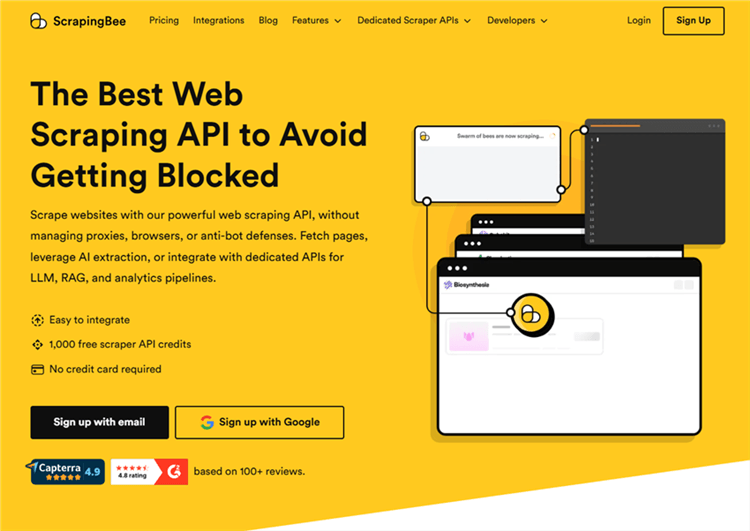
ScrapingBee is an API-first web scraping tool that handles proxies, headless browser rendering, and anti-bot bypass — similar to Firecrawl — but with a more transparent credit model and a cleaner developer experience for straightforward extraction tasks.
Why it beats Firecrawl for simpler pricing: ScrapingBee's credit consumption is more predictable. Basic requests cost 1 credit, JavaScript rendering costs 5 credits, and premium proxies cost 10–25 credits. While there are still multipliers, the tiers are clearer and easier to budget than Firecrawl's layered credit system. ScrapingBee also has dedicated APIs for specific high-value use cases like Google SERP scraping and Amazon data extraction.
Key features:
- REST API for HTML extraction and JavaScript rendering
- Dedicated Google SERP API and Amazon scraping API
- Rotating proxies with residential and premium options
- Screenshot capture and PDF generation
- Integrations with Zapier, Make, and major programming languages
Pricing vs. Firecrawl: ScrapingBee offers a free trial with 1,000 credits. Paid plans start at approximately $49/month for 250,000 credits. Comparable to Firecrawl's Standard tier but with more predictable per-request costs for most use cases.
Best for: Developers and technically-comfortable marketers who want a clean REST API for content extraction, SERP monitoring, or Amazon data collection, with more predictable billing than Firecrawl.
Limitations vs. Firecrawl: ScrapingBee doesn't have Firecrawl's AI-powered natural language extraction endpoint. If your use case requires describing what data you want in plain English rather than specifying selectors, Firecrawl's /extract endpoint is more capable. ScrapingBee also lacks Firecrawl's native LLM framework integrations.
Crawl4AI — Best Self-Hosted Alternative to Firecrawl
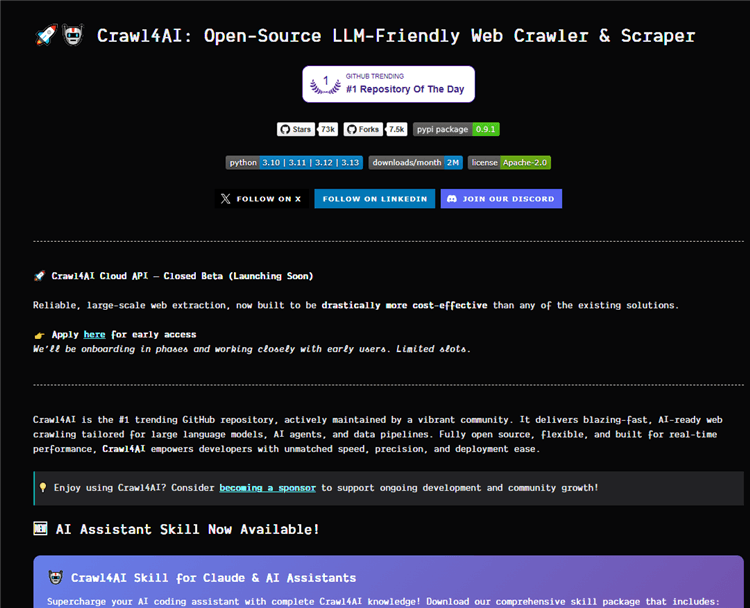
If you're specifically looking for self-hosted alternatives to Firecrawl, Crawl4AI is the strongest option available. It's an open-source Python library for AI-powered web scraping with Apache 2.0 licensing — meaning you can use it commercially without the AGPL-3.0 friction that Firecrawl's open-source version carries.
Why it beats Firecrawl's self-hosted version: Firecrawl's self-hosted version is widely considered bare-bones — it lacks bot bypass, proxy rotation, and dashboards. Crawl4AI, by contrast, is designed from the ground up to be self-hosted and production-ready. It supports CSS selectors, XPath, and AI-driven schema extraction, integrates with multiple LLMs, and produces clean LLM-ready output without requiring the cloud service.
Key features:
- Apache 2.0 license — fully open for commercial use
- Python-native with full pipeline control
- LLM-ready Markdown and structured JSON output
- CSS selector, XPath, and AI-driven extraction
- Integrates with OpenAI, Anthropic, and other LLM providers
- Lightweight footprint compared to Firecrawl's self-hosted stack
- Active open-source community and regular updates
Pricing vs. Firecrawl: Free and self-hosted. Your only costs are infrastructure (server/cloud compute) and LLM API calls for AI extraction. For teams with existing cloud infrastructure, this can be dramatically cheaper than Firecrawl's paid tiers at scale.
Best for: Technical marketers and marketing engineers who want full control over their scraping infrastructure, need commercial-use open-source licensing, and are building LLM pipelines or RAG systems in-house.
Limitations vs. Firecrawl: Crawl4AI requires Python knowledge and infrastructure management. You're responsible for proxy rotation, anti-bot measures, and scaling — none of which are handled for you. Firecrawl's managed cloud service is significantly easier to get started with if you don't want to manage infrastructure.
💡 Pro tip: Crawl4AI pairs well with a self-managed proxy service like Bright Data's proxy network if you need bot bypass on top of the open-source scraping layer.
ParseHub — Best for Marketers Scraping Dynamic Sites
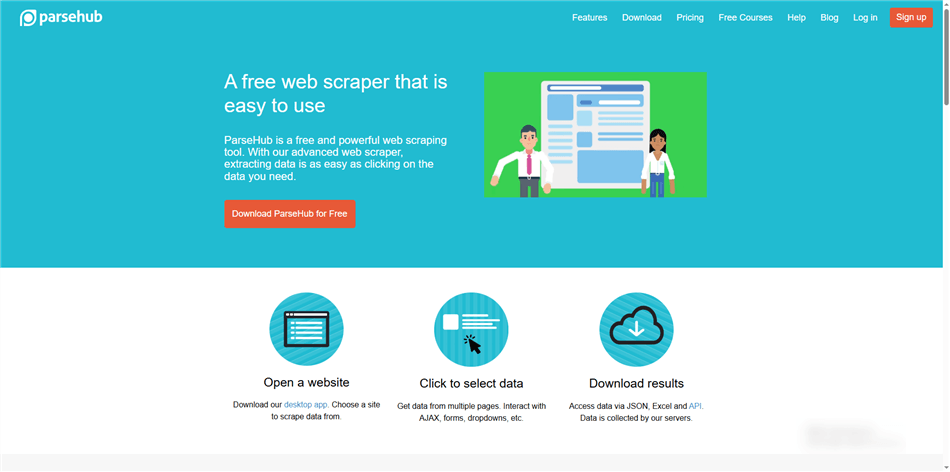
ParseHub is a no-code visual web scraper with a particular strength in handling complex, dynamic websites — including those with infinite scroll, login walls, dropdown menus, and multi-page navigation. For marketers who need to extract data from sites that simpler tools can't handle, ParseHub is a reliable choice.
Why it beats Firecrawl for non-technical users on dynamic sites: ParseHub's visual interface lets you click through a website's actual navigation flow to define your extraction — including clicking dropdowns, navigating pagination, and handling login-required pages. Firecrawl handles dynamic content well, but requires API calls and code to do so. ParseHub does it visually.
Key features:
- Visual point-and-click interface for complex site navigation
- Handles JavaScript, AJAX, infinite scroll, and login-required pages
- Cloud-based processing with IP rotation
- Scheduled scraping and project management
- Export to JSON, CSV, Excel, or Google Sheets
- API access for programmatic triggering
Pricing vs. Firecrawl: ParseHub offers a free plan with 5 public projects and 200 pages per run. Paid plans start at $189/month (Standard), making it one of the more expensive no-code options. However, for complex dynamic sites, the visual interface can save significant engineering time.
Best for: E-commerce marketers tracking competitor product pages with complex navigation, content researchers extracting data from login-required sites, and marketers who need to scrape sites with multi-step interactions.
Limitations vs. Firecrawl: ParseHub's paid plans are expensive relative to Firecrawl for the volume of data you can extract. It's also not an API-first tool, so integrating it into automated pipelines requires more setup. For pure API use cases, Firecrawl remains more developer-friendly.
Clay — Best for Marketers Combining Data and Outbound Workflows
Clay is a fundamentally different kind of tool — it's not just a web scraper, it's a no-code platform that combines AI-powered data collection with outbound workflow automation. If you're a B2B marketer or growth professional who wants to collect web data and act on it (enrich leads, build prospect lists, trigger outreach), Clay does both in one place.
Why it beats Firecrawl for marketing workflows: Firecrawl extracts data and stops there. Clay's "Claygent" AI can retrieve relevant information from the web using natural language prompts, enrich it with data from 50+ sources, and feed it directly into outbound sequences — all without code. For marketers, this end-to-end workflow is far more valuable than raw data extraction alone.
Key features:
- "Claygent" AI for natural language web research
- Chrome extension for manual data capture
- 50+ data source integrations (LinkedIn, Apollo, Clearbit, and more)
- Pre-built templates for common marketing workflows
- Native integration with outbound tools (Instantly, Smartlead, HubSpot)
- No-code workflow builder
Pricing vs. Firecrawl: Following its 2026 pricing overhaul, Clay features a free tier (100 Data Credits / 500 Actions), a Launch plan ($185/month for 2,500 Data Credits), and a Growth plan ($495/month for 6,000 Data Credits and CRM sync). Unlike Firecrawl's simple credit model, Clay splits usage into Data Credits (for data enrichment) and Actions (for workflow execution). While much pricier for raw scraping, you are paying for an end-to-end GTM orchestration platform rather than a developer-focused extraction API.
Best for: B2B digital marketers, growth hackers, and demand generation teams who need to collect web data and immediately use it for lead enrichment, prospecting, or outbound campaigns.
Limitations vs. Firecrawl: Clay is not a general-purpose web scraper. It's optimized for B2B marketing data workflows and doesn't replace Firecrawl for large-scale content extraction, LLM pipeline feeding, or technical scraping use cases. Its credit model can also become expensive at high volumes.
AllyHub: The Firecrawl Alternative Built to Maximize ROTI and Automate Web Workflows
AllyHub is not a direct Firecrawl replacement. Firecrawl is an API for turning web pages into clean, LLM-ready data. AllyHub is better understood as a browser-native AI copilot for marketers who need to execute repeatable research workflows, not just extract raw page content.
For example, a marketer might use AllyHub to open competitor pages, collect visible pricing or product details, summarize findings, compare changes, and package the workflow into a reusable Service card. Because AllyHub operates in the browser, it is useful for tasks that involve clicking, scrolling, checking pages, extracting visible information, and organizing the result into a report.
Its main advantage is reuse. Repeatable workflows can be turned into Skills, Web Notes, and Service assets, so similar future tasks do not have to start from scratch. That makes AllyHub a better fit for recurring competitor research, product review analysis, lead research, and content workflows than for high-volume API scraping.
Limitations vs. Firecrawl: AllyHub is not a developer API for feeding millions of pages into an LLM pipeline. If you need clean Markdown or JSON at scale through a programmable API, Firecrawl, Apify, ScrapingBee, or Crawl4AI may be more appropriate. AllyHub fits best when the task is browser-based, repeatable, and benefits from human direction.
Why Marketers Look for Firecrawl Alternatives
Firecrawl is genuinely impressive for what it does: it converts messy, JavaScript-heavy websites into clean, structured, LLM-ready data. Its AI-powered extraction endpoint, smart wait technology, and built-in CAPTCHA handling make it a strong choice for developers building RAG systems and AI agents.
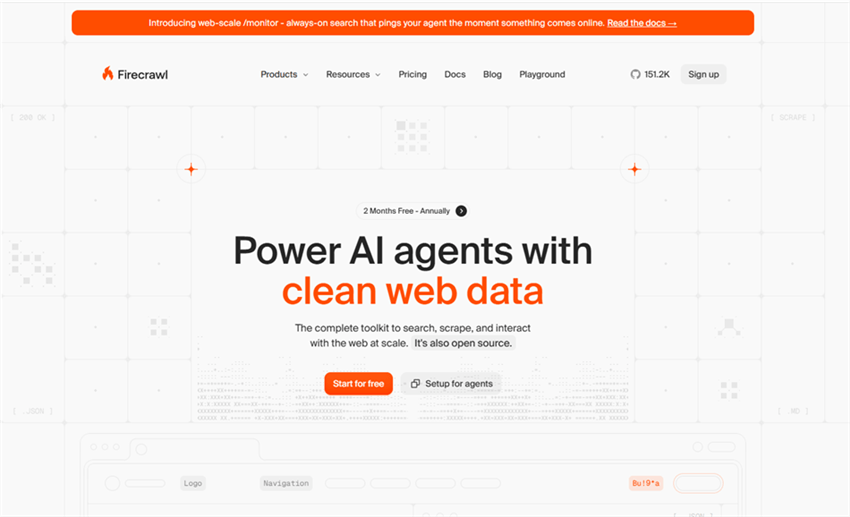
However, marketers commonly switch because:
- Unpredictable credit costs: Firecrawl's credit multiplier system can be hard to forecast for recurring or advanced workflows. Basic scrapes cost 1 credit, but AI extraction costs 5 credits per call, Stealth Mode adds more, and a crawl with extraction can run 7 credits per page. Credits don't roll over. Many users report burning through their monthly allocation far faster than expected.
- Developer-only setup: Firecrawl is an API-first tool. There's no visual interface, no point-and-click workflow, and no pre-built templates. For marketers without engineering support, getting value out of Firecrawl requires writing and maintaining code.
- Self-hosted version is bare-bones: The open-source version lacks bot bypass, proxy rotation, and dashboards — the features that make the cloud version useful. If you want to self-host, you're essentially building those capabilities yourself.
- No workflow automation: Firecrawl scrapes and extracts. It doesn't help you do anything with that data — no built-in scheduling tied to marketing workflows, no CRM integration, no outbound automation.
- Not built around marketer-friendly workflows: Such as templates, dashboards, CRM enrichment, or no-code scheduling.
If you need Firecrawl specifically for LLM pipeline development and you have engineering resources, it remains a solid choice. But if you're a marketer trying to extract competitive intelligence, monitor pricing, or automate research workflows without writing code, one of the alternatives below will serve you better.
How to Choose the Right Firecrawl Alternative
Use this decision framework to find the best fit for your situation:
Your Core Need | Recommended Tool | Why It Fits |
No-Code Visual Scraping | Octoparse or ParseHub | Best for simple templates (Octoparse) or complex dynamic sites (ParseHub) without writing code. |
Predictable Developer API | ScrapingBee |
FAQ: Firecrawl Alternatives
Is Firecrawl still worth it in 2026?
Yes, but strictly for developers who need a quick API-first solution to feed clean Markdown or JSON directly into LLM and RAG pipelines. For non-technical marketers requiring native workflow automation, out-of-the-box integrations, or predictable scaling costs, its developer-centric design falls short.
Why do Firecrawl credits disappear so quickly?
The platform relies on a steep feature-multiplier system that heavily penalizes advanced requests. While a basic page scrape costs just one credit, adding JSON schema extraction or Enhanced Mode can add four credits each, and activating Stealth Mode triggers a 5× multiplier per call, making high-volume budgets highly volatile.
Can non-technical marketers use Firecrawl?
Firecrawl is primarily API-first. Non-technical marketers can use it with engineering support or through wrappers, but it is not a point-and-click visual scraper like Octoparse or ParseHub.
What is the best free or self-hosted alternative?
Crawl4AI is the leading open-source choice for teams that can manage their own Python infrastructure. Unlike Firecrawl’s self-hosted version—which strips out critical cloud features like proxy rotation and bot bypass—Crawl4AI is production-ready out of the box. It operates under a commercial-friendly Apache 2.0 license.
What is the best option for e-commerce and B2B marketing?
Apify dominates standard e-commerce tasks through its massive marketplace of pre-built platform scrapers, whereas Clay is ideal for direct B2B lead enrichment pipelines. If your goal is repeatable browser-based research rather than raw API scraping, AllyHub is worth considering because it can turn recurring workflows into reusable assets.