If you are a business owner or a GTM (Go-to-Market) leader, you already know that chat-based AI is no longer enough. You don't need another tool to help you brainstorm marketing ideas. You need a system that actually executes them.
The transition from AI chatbots to autonomous AI agents is the biggest productivity shift of 2026. Instead of answering questions, these business agents take over the operational grunt work: prospecting leads, generating brand-consistent content, monitoring competitors across the web, and updating your CRM.
But with every SaaS tool suddenly claiming to have an "AI Agent," which ones actually drive ROI and save headcount? We tested over 30 platforms. Here are the 8 best AI agents built for real business, marketing, and sales workflows.
Key Takeaways
- Best for web operations & e-commerce: AllyHub acts like a digital employee in your browser, automating manual web tasks — and it gets faster with every task you run.
- Best for workflow automation: Zapier Agents connects 9,000+ apps without code, making it the go-to for teams already using multiple SaaS tools.
- Best for marketing content scale: Jasper is purpose-built for brand-consistent marketing content at scale.
- Best for sales outreach: Artisan fully automates your B2B lead generation and email sequencing.
- Best free option: ChatGPT Agent offers a capable free tier for general-purpose task automation.
- What to look for: Focus on 4 core metrics: execution depth (does it do the work or just suggest it?), self-learning capability, integration range, and long-term TCO.
- Bottom line: Don't settle for text generators. The best ROI comes from agents that natively execute real-world tasks in your workflows.
Why AI Agents Matter for Marketers and E-Commerce Teams
For marketers and e-commerce teams, the value of AI agents isn't just better answers—it's autonomous execution. The best AI agents for business can research competitors, generate publish-ready content, browse websites, extract structured data, and trigger downstream actions without constant supervision. Teams adopting these tools are reporting faster research cycles, reduced manual work, and the ability to scale campaigns with far fewer resources.
How We Selected These AI Agents
We evaluated 30+ AI agent platforms based on the following criteria:
- Execution depth: Does the agent actually complete tasks, or does it just generate suggestions?
- Relevance to marketers: Does it handle real marketing, e-commerce, or content workflows?
- Ease of use: Can a non-technical marketer get value without engineering support?
- Pricing transparency: Are costs predictable and proportional to value delivered?
- Self-improvement: Does the agent get smarter or more efficient with repeated use?
- Honest limitations: We only included tools we could also honestly critique.
Only tools that deliver measurable execution value for marketing, e-commerce, or content use cases made this list.
Best AI Agents - Quick Comparison Table
Tool | Best For | Pricing | Key Capability | Rating |
AllyHub | Browser automation, research, e-commerce workflows | Free / Pro $19.99/mo | Self-evolving, Chrome extension, 50+ pre-built services |
8 Best AI Agents for Business, Marketing & Sales
AllyHub — The AI Agent That Compounds With Every Task
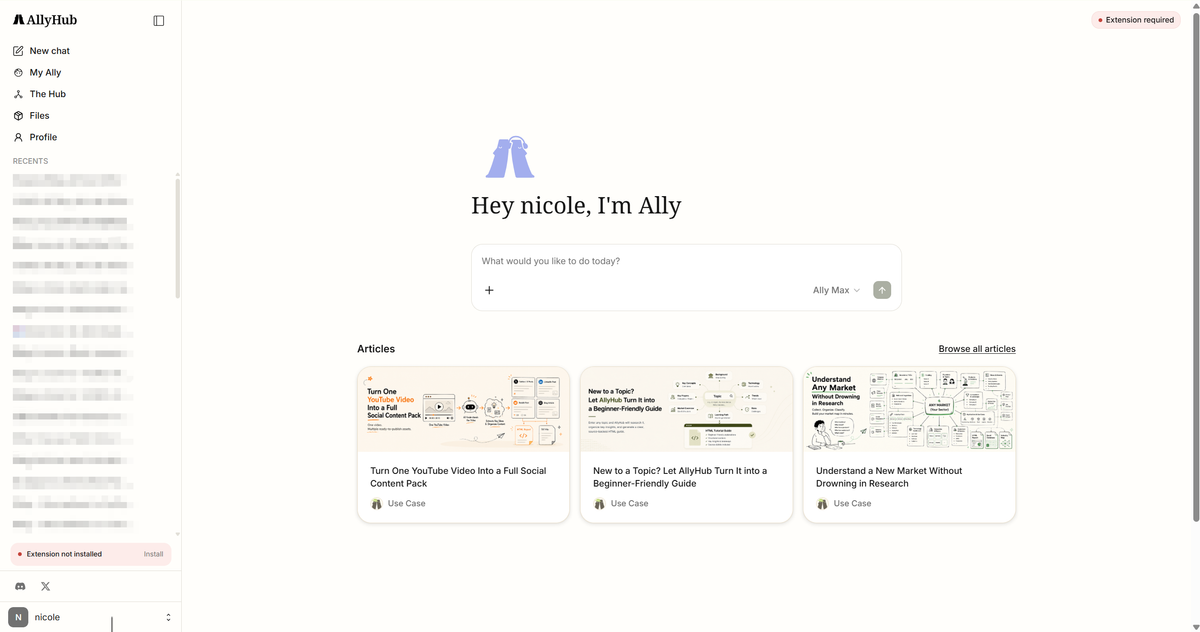
AllyHub is a browser-native AI copilot built specifically for knowledge workers, marketers, and e-commerce teams. While traditional AI agents require complex API setups or expensive cloud infrastructure, AllyHub operates directly inside your active browser, executing operational tasks like a digital employee.
- Direct Business Value: Marketing and e-commerce teams spend thousands of hours manually tracking competitor prices, auditing Amazon listings, or scraping B2B leads. AllyHub converts these painful manual workflows into one-click "Service cards." You hit run, and the agent handles the repetitive clicking, scrolling, and data entry.
- Compounding ROI: Traditional AI tools cost the exact same amount of time and compute every time you run them. AllyHub is built to compound value: every completed workflow builds reusable "Skills." By the 10th time you run your weekly competitor audit, AllyHub completes it in a fraction of the time with higher accuracy.
- Zero IT Friction: Because AllyHub operates natively through your active browser sessions, you don't need developers to configure API keys or OAuth for gated platforms (like your Amazon Seller Central or Shopify backend). It just works where you already work.
Pricing: Free tier with daily credits. Pro plan at $19.99/month (includes 2,000 monthly credits plus daily bonus credits; 20% discount on annual billing).
Best for: Marketers and e-commerce sellers who run recurring data or research workflows and need an agent that retains contextual knowledge across tasks rather than resetting to zero every session.
Limitations: Browser extension/web only (no mobile app); requires the browser to remain active (no offline background scheduling); lacks enterprise security compliance certifications (SOC2/HIPAA).
Zapier Agents — Best for Multi-App Workflow Automation
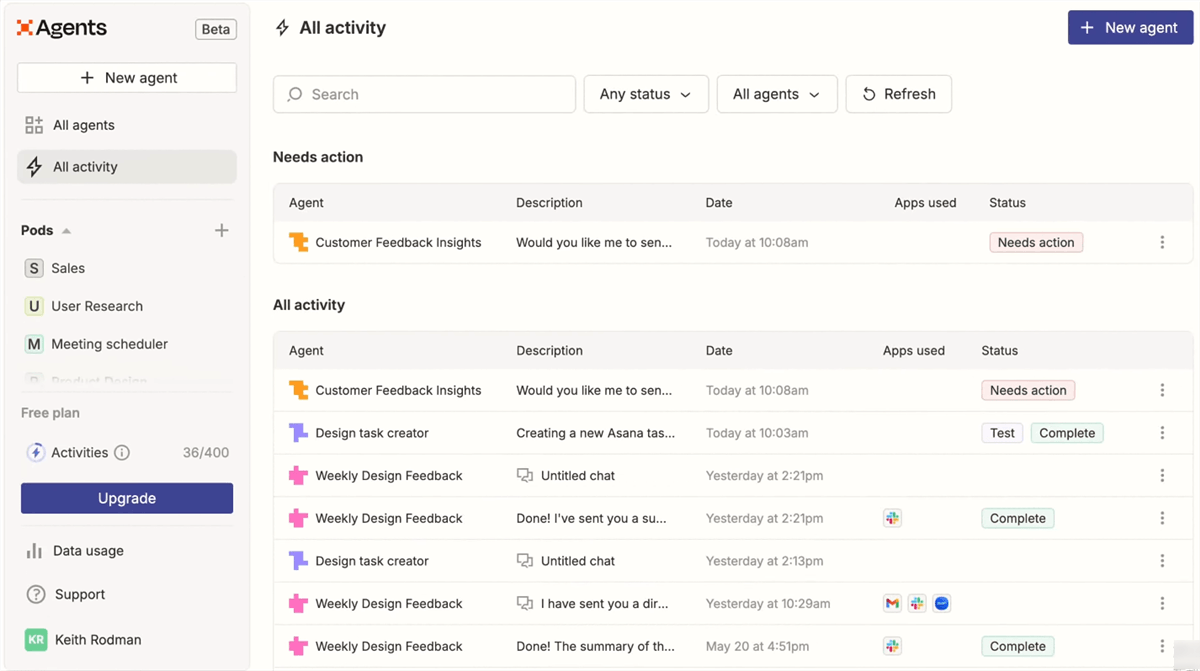
Zapier Agents brings AI decision-making to the world's largest app integration platform. With 9,000+ connected apps, Zapier lets you build AI agents that trigger actions across your entire marketing stack — from CRM updates to social media posts to Slack notifications — without writing a single line of code.
For digital marketers managing multiple tools, Zapier Agents is the connective tissue that makes everything work together. Set up an agent to monitor new leads, enrich them with data from Clay, add them to HubSpot, and send a personalized Slack alert — all automatically.
Key features:
- 9,000+ app integrations (largest in the market)
- AI-powered decision nodes within Zap workflows
- Natural language workflow builder
- MCP integration for advanced AI connectivity
Pricing: Free tier available. Zapier Agents starts at $29.99/month.
Best for: Marketing operations teams managing 5+ tools who need reliable, no-code automation across their entire stack.
Limitations: AI agent capabilities are newer and less mature than core Zap automation. Complex multi-step AI reasoning can be brittle. Costs scale quickly with high task volumes.
ChatGPT Agent — Best General-Purpose AI Agent
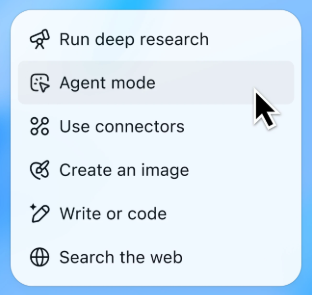
ChatGPT Agent by OpenAI gives the world's most-used AI model the ability to take actions — browsing the web, filling forms, completing purchases, and executing multi-step computer tasks. For marketers already living in the ChatGPT ecosystem, it's the most accessible entry point into agentic AI.
The GPT Store adds another layer: thousands of pre-built custom GPTs for specific marketing tasks, from SEO analysis to ad copy generation to social media scheduling.
Key features:
- Computer control: browses real websites, fills forms, executes tasks
- GPT Store: thousands of specialized marketing and content GPTs
- Deep Research mode for comprehensive topic analysis
- Integration with OpenAI's full model suite (GPT-5, o3, etc.)
Pricing: Free plan available. Paid plans include Go ($8/month), Plus ($20/month), and Pro ($200/month).
Best for: Marketers who want a versatile, general-purpose AI agent with the broadest model ecosystem and the lowest learning curve.
Limitations: Computer control operates in a virtual environment, not your real browser — meaning it can't access sites where you're already logged in. Each session starts fresh with no accumulated task knowledge.
Jasper — Best AI Agent for Marketing Copy
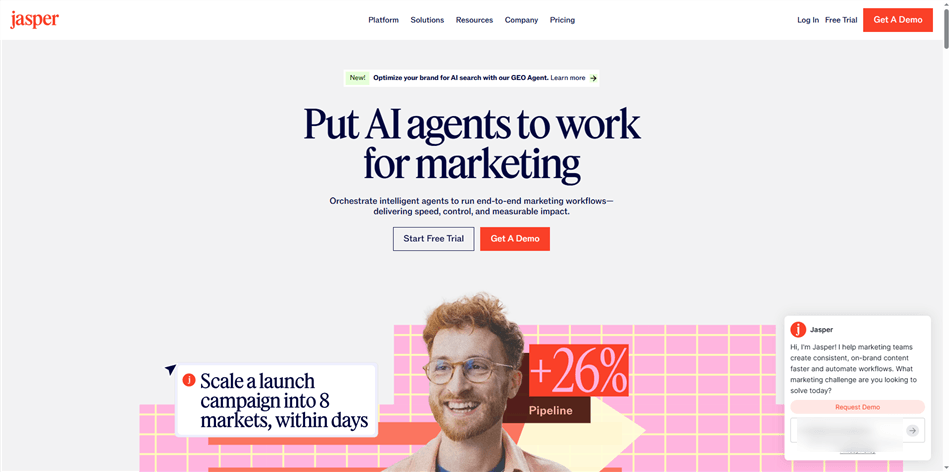
Jasper is purpose-built for marketing teams that need brand-consistent content at scale. Its Brand Voice feature learns your brand's tone, style, and messaging guidelines, then applies them consistently across blog posts, ad copy, email campaigns, social media content, and landing pages.
For content creators and marketing teams managing multiple campaigns, Jasper's workflow-oriented approach — with templates, campaigns, and team collaboration built in — makes it more than just a writing tool.
Key features:
- Brand Voice: learns and applies your brand's tone across all content
- 50+ marketing-specific templates (ads, emails, blog posts, social)
- Team collaboration with shared brand assets
- SEO mode with keyword integration
Pricing: Pro plan at $69/month per seat. Business plan with custom pricing.
Best for: Marketing teams producing high volumes of brand-consistent content across multiple formats and channels.
Limitations: Primarily a content generation tool — not a true multi-step execution agent. Requires significant human editing for nuanced or highly technical content. Pricing adds up quickly for larger teams.
Genspark — Best for Research-Heavy Marketing Tasks
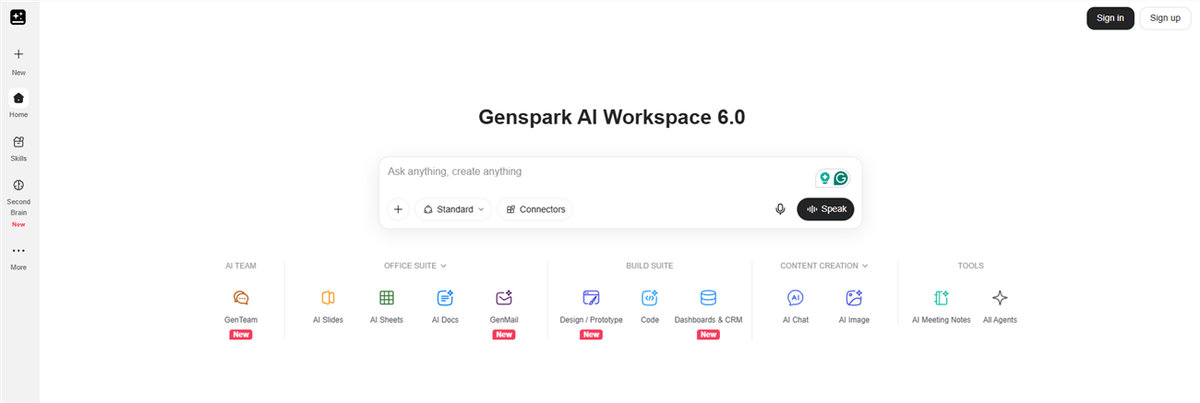
Genspark's Super Agent uses multi-model fact-checking to produce more reliable research outputs than single-model alternatives. For marketers who need competitive intelligence, market research, or content research done quickly and accurately, Genspark's depth-first approach is a strong differentiator.
Its "Call for Me" voice agent feature is a standout for sales and customer research — it can make actual phone calls to gather information on your behalf.
Key features:
- Super Agent: multi-model fact-checking for higher accuracy
- Deep Research mode for comprehensive topic analysis
- Call for Me: AI voice agent that makes phone calls
- Sparkpages: shareable AI-generated research reports
Pricing: Free tier available. Plus at $24.99/month.
Best for: Marketers and content creators who need thorough, fact-checked research reports and competitive intelligence without spending hours on manual research.
Limitations: Each task starts from zero — no accumulated knowledge or self-improvement across runs. Not suited for repetitive browser automation or data extraction workflows.
Relevance AI — Best for Building Custom Marketing Agents
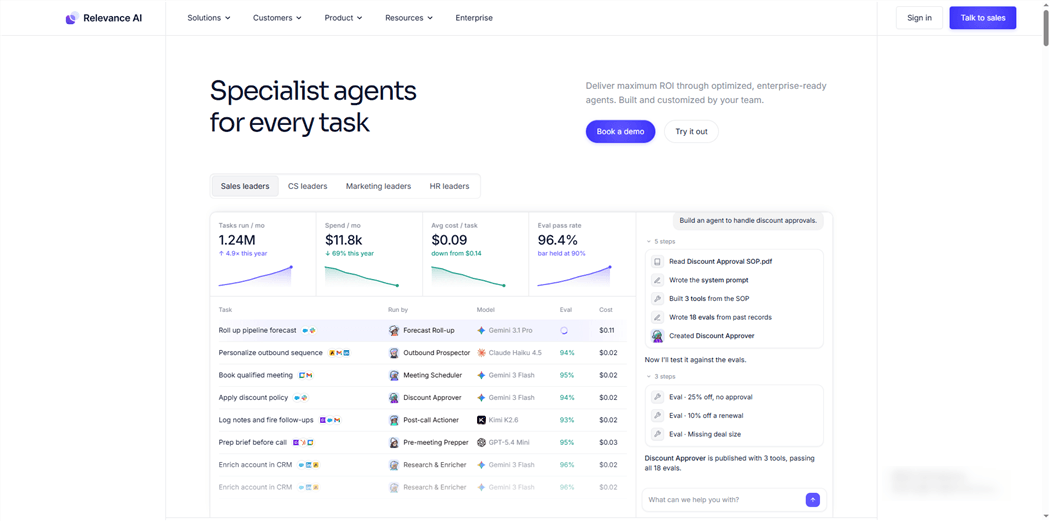
What if you need a specific agent for your unique business process?
Relevance AI lets marketing and GTM teams build custom AI agent workforces without deep engineering resources. With 400+ templates and a visual agent builder, teams can create specialized agents for lead enrichment, content research, competitive monitoring, and customer segmentation.
Key features:
- 400+ pre-built agent templates for GTM and marketing use cases
- Multi-agent collaboration: agents that work together on complex tasks
- SSO and RBAC for enterprise security
- Custom LLM integration
Pricing: Talk to sales.
Best for: Marketing and GTM teams that need custom AI agents tailored to their specific workflows, with enterprise-grade security and team collaboration.
Limitations: Building effective custom agents requires time investment and some technical understanding. Pricing scales significantly for larger agent workforces.
Artisan (Ava) — Best AI Agent for Sales Outreach
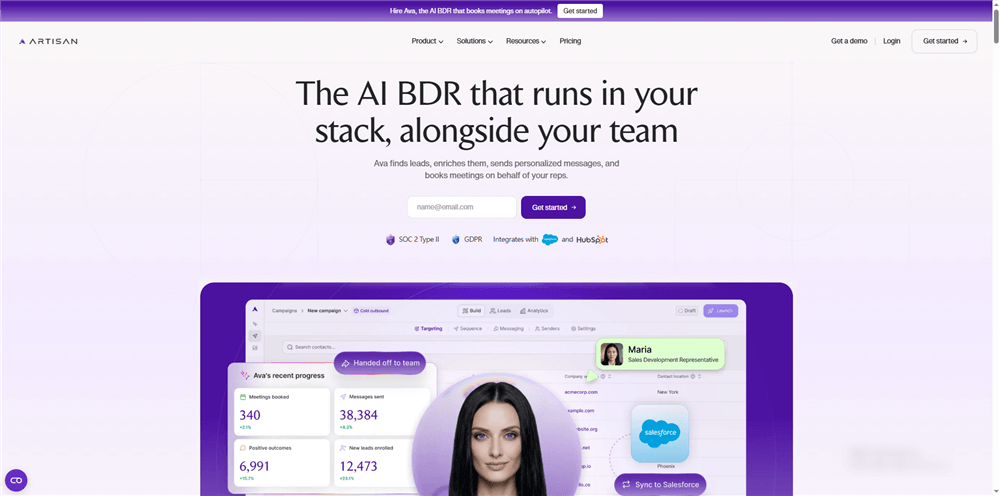
Artisan's Ava is an autonomous AI Sales Development Representative (SDR) that handles the full outbound sales workflow: prospecting, lead enrichment, personalized email sequence creation, and follow-up — without human intervention at each step.
The Business Value: Ava autonomously prospects from a database of millions of B2B contacts, researches the prospect’s company, writes highly personalized cold emails, and manages the follow-up sequences. It integrates directly into your CRM, acting as a relentless, 24/7 sales rep that never gets tired.
Key features:
- Autonomous prospecting from a database of 300M+ contacts
- AI-personalized email sequences based on prospect research
- Automated follow-up and reply handling
- CRM integration and activity logging
Pricing: Custom pricing based on contact volume and features.
Best for: Sales teams and e-commerce brands running outbound campaigns who want to automate the SDR function end-to-end.
Limitations: AI-generated outreach can feel impersonal without careful customization. Requires human oversight for complex objection handling and relationship-building. Custom pricing makes cost comparison difficult.
HubSpot Breeze — Best for HubSpot-Native Teams
HubSpot Breeze (Agent Hub) is the AI layer built directly into HubSpot's marketing, sales, and service hubs. For teams already running their marketing operations on HubSpot, Breeze provides AI-powered content generation, lead scoring, email personalization, and workflow automation without switching platforms.
Key features:
- AI content generation within HubSpot's CMS and email tools
- Breeze Copilot: AI assistant across all HubSpot hubs
- Breeze Agents: specialized agents for social media, content, and prospecting
- Native CRM data integration for personalization
Pricing: Free plan available. Paid plans start at $20/month, with Marketing Hub Professional starting at $800/month for advanced marketing automation and analytics.
Best for: Marketing teams already invested in the HubSpot ecosystem who want AI capabilities without adding another tool to their stack.
Limitations: Full AI agent features require Professional or Enterprise tiers — significant cost jump from free. Limited value for teams not already using HubSpot. AI capabilities are less advanced than dedicated agent platforms.
How to Choose the Right AI Agent for Your Business Strategy
Adding an AI agent to your business isn't about buying new software; it's about scaling your operations without scaling your payroll. Here is your decision matrix:
- To automate manual web operations without APIs: Add the AllyHub extension. It’s the easiest way to give your e-commerce or marketing team a digital intern that learns and gets cheaper with every run.
- To scale B2B revenue: Deploy Artisan (Ava) to handle the grueling work of outbound prospecting.
- To scale brand content: Invest in Jasper to ensure your marketing team stays on-brand across every channel.
- To connect your existing tech stack: Use Zapier to build automated bridges between your CRM, email, and Slack.
💡 Pro tip: Before committing to any AI agent platform, run the same real task you do repeatedly — competitor research, product listing analysis, or content brief creation — on your top 2–3 candidates. The difference in execution depth and output quality will be immediately obvious.
FAQ: Best AI Agents for Business and Marketing
What is an AI agent, and how is it different from an AI assistant?
An AI assistant answers questions and generates text when you ask. An AI agent takes autonomous action — browsing websites, filling forms, executing multi-step workflows, and completing tasks end-to-end without requiring you to guide every step. For marketers, the distinction matters: you want execution, not just advice.
What are the best AI agents for marketing in 2026?
For marketing-specific use cases, the top picks are AllyHub (browser automation, research, e-commerce workflows), Jasper (brand-consistent content at scale), Zapier Agents (multi-app workflow automation), and Genspark (research-heavy tasks). The best choice depends on whether your bottleneck is execution, content, or integration.
What are the best AI agents for e-commerce sellers?
E-commerce sellers benefit most from agents that handle browser-based tasks: competitor price monitoring, Amazon review analysis, product research, and listing optimization. AllyHub is particularly strong here — its Chrome extension operates your real browser with your real login sessions, and its self-evolving architecture means repeated tasks get faster and cheaper over time.
Are AI agents safe to use for business data?
Security varies significantly by platform. Enterprise-grade options like Relevance AI (SSO/RBAC) offer formal compliance certifications. Browser-native tools like AllyHub operate on your local machine, meaning your data never passes through a third-party cloud VM. Always review a platform's data handling policies before connecting sensitive business data.
How much do AI agents cost for small businesses?
Most platforms offer free tiers with meaningful capabilities. Paid plans typically range from
50/month for individual users. Enterprise platforms (HubSpot Breeze Professional, Salesforce Agentforce) can run into hundreds or thousands per month. For small businesses, AllyHub's Pro plan at $19.99/month offers strong value-to-cost ratios.