A faceless TikTok account can grow without showing the creator's face—but the content still needs to be original, useful, and engaging.
The most practical formats include storytelling, tutorials, screen recordings, POV demos, product videos, and text-led explainers. This guide covers 10+ faceless TikTok ideas, low-cost production methods, and monetization options including Creator Rewards, TikTok Shop, affiliate marketing, and dropshipping.
Key Takeaways
- You don't need to show your face: TikTok does not require creators to appear on camera, but faceless content still needs to meet originality, quality, and platform-policy requirements.
- Choose a repeatable format: Storytelling, tutorials, screen recordings, POV demos, product videos, and educational explainers all work without an on-camera host.
- Monetization varies: Depending on your location and eligibility, options include Creator Rewards, TikTok Shop, affiliate marketing, digital products, and e-commerce.
- Low-cost doesn't mean zero-cost: Free editing, stock media, and voice tools can reduce production costs, but running a store or monetizing commercially may still involve fees.
- Originality matters: Don't rely on reposted clips or lightly edited third-party footage. Add meaningful creative value through your own scripting, narration, demonstrations, or analysis.
- Start with one format: Test a focused content format consistently, then use analytics to identify which topics and structures deserve more investment.
What Is a Faceless TikTok Account (and How Does It Work)?
A faceless TikTok account publishes content without showing the creator's face. Instead, it uses formats such as text overlays, voiceovers, screen recordings, POV footage, product demos, and stock or original visuals.
The goal is the same as any TikTok account: create useful or entertaining content, build an audience, and turn that audience into revenue.
How Faceless TikTok Content Works
The production process is similar to any TikTok video, but without an on-camera host:
- Write the script — Start with a story, tip, tutorial, product angle, or other clear idea.
- Choose the visuals — Use original footage, screen recordings, POV shots, graphics, or properly licensed stock media.
- Add narration — Record your own voice or use an appropriate AI voiceover.
- Edit for TikTok — Add captions, graphics, music, and other edits that support the content.
- Publish and analyze — Track performance and refine the topics and formats that resonate with your audience.
A faceless account can still have a strong identity through its visual style, narration, editing, and recurring content format. The creator simply isn't the visual focus.
Why Choose a Faceless TikTok Format?
Faceless content can be useful for creators who want to:
- Skip on-camera filming — No need to appear on screen or set up a camera for every video.
- Protect personal privacy — Keep your face and personal identity out of your public content, although commercial features may still require account or identity verification.
- Start with simple equipment — A phone, editing software, and suitable media can be enough to produce many formats.
- Build repeatable workflows — Scripts, templates, screen recordings, and product footage can make production easier to standardize.
Can You Make Money on TikTok Without Showing Your Face?
Yes. Showing your face is not a requirement for every monetization method, but eligibility, availability, and content rules vary by program and location.
- Creator Rewards Program — Eligible creators can earn rewards from qualified views on original videos that are at least one minute long. TikTok's eligibility requirements include 10,000 followers and 100,000 video views in the past 30 days, along with other conditions. TikTok does not publish a fixed RPM, so earnings estimates should be treated as variable rather than guaranteed.
- TikTok Shop affiliate — In supported markets, eligible creators can promote products in videos or LIVE and earn commissions. Requirements vary by market and account type. Faceless formats such as product demos, hands-only videos, and voiceover reviews can be used where permitted.
- SaaS and digital-product affiliates — Tutorial and educational accounts can recommend relevant software, courses, templates, or other digital products through eligible affiliate programs.
- E-commerce and dropshipping — Product-focused TikTok content can drive organic traffic to an online store. However, revenue is not the same as profit: product, shipping, payment, platform, refund, and other operating costs still apply.
Reality check: Faceless TikTok is a content strategy, not a shortcut to guaranteed income. Start with one niche and a repeatable format, publish consistently, and use your analytics to decide what to make more of.
10+ Best Faceless TikTok Content Ideas for Viral Engagement
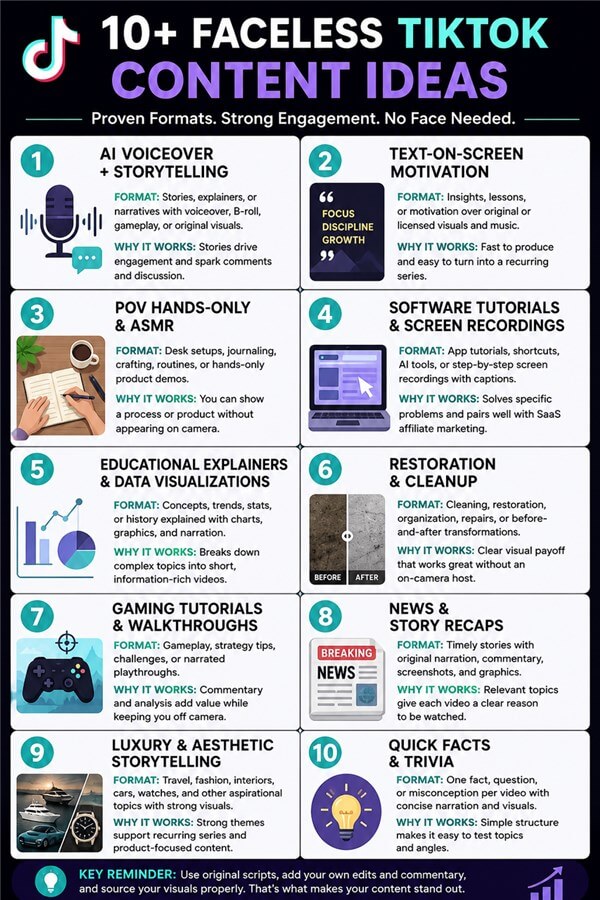
AI Voiceover + Storytelling
Format: Reddit-inspired stories, personal narratives, niche explainers, or fictional scenarios paired with voiceover, B-roll, gameplay, or original visuals.
Why it works: Strong storytelling can keep viewers engaged and encourage comments and discussion. Use original scripts and properly sourced visuals instead of simply reposting other people's content.
Text-on-Screen Motivation
Format: Short insights, lessons, or motivational ideas layered over original or licensed visuals and music.
Why it works: The format is quick to produce and easy to turn into a recurring series. Focus on original perspectives rather than generic quotes and repetitive stock footage.
POV Hands-Only & ASMR
Format: Desk setups, journaling, crafting, routines, or hands-only product demonstrations.
Why it works: You can demonstrate a process or product without appearing on camera. The format works especially well for visual, tactile, and product-focused content.
Software Tutorials & Screen Recordings
Format: App tutorials, workflow tips, AI tools, software shortcuts, or step-by-step screen recordings with captions.
Why it works: Each video can answer a specific question or solve a practical problem. The format also pairs naturally with software and SaaS affiliate marketing.
Educational Explainers & Data Visualizations
Format: Explain concepts, trends, statistics, or historical topics using charts, screen recordings, graphics, and narration.
Why it works: Complex topics can be broken into concise, information-rich videos. The format also lends itself to original content and longer-form explanations.
Restoration & Cleanup
Format: Cleaning, restoration, organization, repairs, or before-and-after transformations with narration or natural sound.
Why it works: The process creates a clear visual payoff and works well without an on-camera host.
Gaming Tutorials & Walkthroughs
Format: Original gameplay, strategy tips, challenges, walkthroughs, or narrated playthroughs.
Why it works: Commentary and analysis add value while keeping the creator off camera. Avoid relying on simple reposts or unedited gameplay clips.
News & Story Recaps
Format: Timely stories explained through original narration, commentary, screenshots, graphics, and properly sourced visuals.
Why it works: Current topics give each video a clear reason to be relevant. Prioritize accuracy and original commentary instead of reposting news footage.
Luxury & Aesthetic Storytelling
Format: Travel, fashion, interiors, cars, watches, or other aspirational topics using original or properly licensed visuals.
Why it works: Strong visual themes can support recurring series and product-focused content. Avoid turning the format into a generic compilation of third-party clips.
Quick Facts & Trivia
Format: One interesting fact, question, or misconception per video, supported by concise narration and visuals.
Why it works: The simple structure makes it easy to test different topics and angles. Accuracy matters more than volume, so verify facts before publishing.
Faceless TikTok Dropshipping Content Ideas
You can test products with organic TikTok content without paying for ads, renting a studio, or hiring creators upfront. However, zero content-production cost does not mean zero business cost—stores can still involve product, shipping, payment, platform, refund, and other expenses.
- Hands-Only Product Demonstrations
Use close-up shots, natural lighting, and hands-only demonstrations to show how a product looks and works. Focus each video on one clear benefit or use case.
- Problem-vs-Solution Videos
Start with a recognizable problem, then demonstrate how the product addresses it. Keep the visual contrast clear and show the result rather than relying on claims alone.
- Original Product Reviews & Comparisons
Compare features, use cases, sizes, or alternatives through your own footage and commentary. This gives viewers useful information while keeping the content faceless.
- Product Research & Curations
Record product research, compare reviews and features, and explain why a product is worth considering. If the content uses affiliate links or promotes a store, disclose the commercial relationship where required.
Pro tip: Treat product videos as useful content first, not just ads. Test different hooks, use cases, and product angles around the same item, then keep the variations that generate the strongest audience response.
How to Create Faceless TikTok Videos on a $0 Content Budget
You can start producing faceless TikTok videos without paying for editing software, stock libraries, or AI voice tools. The key is to use free tools while adding enough original scripting, narration, editing, or commentary to make the content your own.
The Free Tool Stack
Task | Free Options |
Editing & captions | CapCut |
Stock footage & images | Pexels, Pixabay, Mixkit |
AI voiceover | CapCut text-to-speech or other free tools |
Free tiers and licensing terms can change, so check each tool's current limits before using it for commercial content. CapCut currently offers free editing, auto-caption, text-to-speech, and stock-media features.
Build a Strong Opening
The opening seconds matter, but there is no universal “3-second rule.” TikTok's recommendation system considers multiple signals, including user interactions and content information.
Instead of forcing every video into the same hook, open with a clear reason to keep watching:
- Problem: “Still struggling with ___?”
- Curiosity: “Most people get ___ wrong.”
- Result: “Here's how I fixed ___.”
- Specific promise: “Three ways to ___.”
Write the opening before editing, then make the visuals deliver on that promise.
How to Avoid Unoriginal Content Problems
Don't assume that adding filters, changing playback speed, or mirroring someone else's clip makes it original. TikTok Shop's current policies specifically address unoriginal and reused content, including imported media without meaningful creative changes.
Use these principles instead:
- Add original input — Write your own script, narration, analysis, demonstration, or commentary.
- Use licensed or original media — Free stock sites can help, but check the license for each asset before commercial use.
- Make the edit meaningful — Editing should support your own story or explanation, not simply disguise a repost.
- Disclose realistic AI content when required — TikTok requires labeling for certain realistic AI-generated or AI-edited content.
The goal isn't to make third-party footage look different. It's to create something meaningfully new from the idea or information.
Faceless TikTok Content Types Comparison
Niche Category | Production Effort | $0 Budget Feasibility | Monetization Potential | Primary Business Model | Best For |
Reddit & Storytelling | Low |
Beyond the Idea List: Find Faceless TikTok Formats Worth Repeating
Finding faceless TikTok ideas is easy. The real challenge is identifying which formats, topics, and product angles are worth testing.
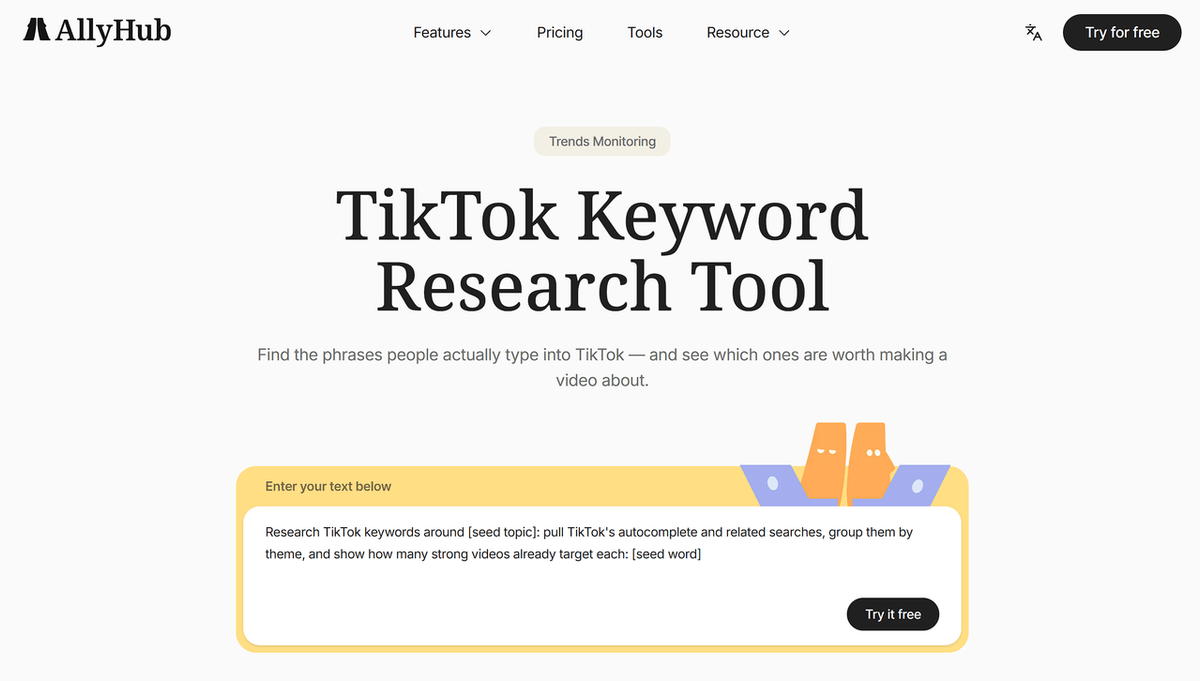
AllyHub helps automate that research workflow inside the browser. Instead of manually opening dozens of TikTok videos and taking notes, you can:
- Compare faceless competitors: Analyze selected accounts side by side, including public metrics, recent-video engagement, recurring topics, and content angles.
- Find patterns in individual videos: Check views, likes, comments, saves, shares, and engagement rates, then compare a video with the account's recent baseline to see whether it actually stands out.
- Turn comments into content ideas: Group comments and questions to find what viewers keep asking, then use those questions as briefs for tutorials, explainers, or follow-up videos.
- Study how successful videos are written: Extract spoken text from individual videos, creators, or hashtags to examine hooks, structure, and recurring talking points—then build your own version rather than copying the original.
- Research products for faceless e-commerce content: For TikTok Shop products, AllyHub can map price ranges, sales distribution, ratings, reviews, and gaps in product positioning before you decide which angles to test.
The important distinction: AllyHub doesn't replace the creative work. It shortens the research loop from scroll → collect → compare → analyze → brief to a repeatable workflow, so faceless creators can spend less time hunting for ideas and more time producing and testing them.
Try a simple workflow: Pick 5–10 faceless accounts in your niche, analyze their recent videos, pull recurring questions from the comments, and turn the clearest gaps into your next batch of scripts.
Frequently Asked Questions
How do I start a faceless TikTok account?
Choose a specific niche and repeatable video format, create a simple production workflow, and publish consistently. Start with formats that don't require original on-camera footage, such as screen recordings, tutorials, storytelling, POV demos, or text-led explainers.
What are the best niches for a faceless TikTok account?
Popular options include education, software and AI tools, personal finance, storytelling, gaming, product reviews, travel, and motivation. The best niche is one with enough audience demand, repeatable content ideas, and a realistic path to monetization.
Can faceless TikTok accounts make money?
Yes. Depending on location and eligibility, monetization options can include Creator Rewards, TikTok Shop, affiliate marketing, digital products, and e-commerce. Income varies widely by audience, content performance, and business model.
Can I use AI voiceovers for faceless TikToks?
Yes. AI voiceovers can be used for many faceless formats, including tutorials, explainers, storytelling, and product videos. Choose a natural-sounding voice and make sure the overall content provides original value rather than simply repackaging third-party material.
How do I grow a faceless TikTok account?
Focus on one niche and a small number of repeatable formats. Test different topics and hooks, monitor watch behavior and engagement, and use the results to refine future videos. Consistency matters, but publishing more videos won't compensate for weak or repetitive content.
Is faceless TikTok still worth it?
It can be, especially for creators who prefer not to appear on camera or want to build content around products, tutorials, or information rather than a personal brand. The main challenge is creating content that feels distinctive enough to earn attention without relying on a recognizable personality.