Starting a faceless TikTok account lets you grow without putting your face on camera. You can build an audience with voiceovers, screen recordings, B-roll, tutorials, or AI-generated visuals — making TikTok more accessible if you prefer to stay behind the scenes.
But faceless content comes with its own challenge: without a face to grab attention, your hook, visuals, and storytelling have to do more of the work. Many beginners also struggle with choosing a profitable niche, finding formats that actually perform, and creating content consistently.
The key is not to post random videos and hope they take off. A successful faceless TikTok channel starts with research: finding proven formats, analyzing what works, and turning those insights into a repeatable content system.
This guide walks you through the entire process — from choosing and validating a niche to creating videos, growing your account, and turning views into revenue.
Key Takeaways:
- Research before creating: Successful faceless TikTok accounts start with niche research, competitor analysis, and understanding what content already works.
- Choose a sustainable niche: Pick a topic you can consistently create content for, not just a trend that looks popular today.
- Keep your production workflow simple: A script, voiceover, visuals, and a basic editor like CapCut are enough to get started.
- Test, analyze, and improve: Your first videos are experiments. Use performance data to identify winning topics and formats.
- Monetize from the beginning: Affiliate marketing, TikTok Shop, and digital products can generate revenue before you qualify for creator programs.
What Is a Faceless TikTok Account (and Why It Works)
A faceless TikTok account is a channel where the creator doesn't appear on camera. Instead, videos use formats like stock footage, screen recordings, animations, text overlays, or voiceovers to deliver content.
Faceless content works because TikTok prioritizes watch time, completion rate, and engagement over whether a creator shows their face. If a video keeps viewers watching, it can reach a large audience regardless of who created it.
This makes faceless TikTok a scalable content model — not just an alternative for creators who don't want to appear on camera.
📌 Note: New accounts usually need time to gather data. Your first 20–30 videos are a testing phase, so focus on learning what works rather than judging results too early.
How to Start a Faceless TikTok Account [5 Steps]
Step 1: Research Before You Create
Before creating videos, you need to understand what already works: which niches have demand, what content formats are getting traction, and why certain accounts are growing while others fail.
A data-driven approach helps you avoid spending months creating content for a niche with low engagement or weak monetization potential. Use an AI TikTok research tool like AllyHub to analyze what successful creators are already doing.
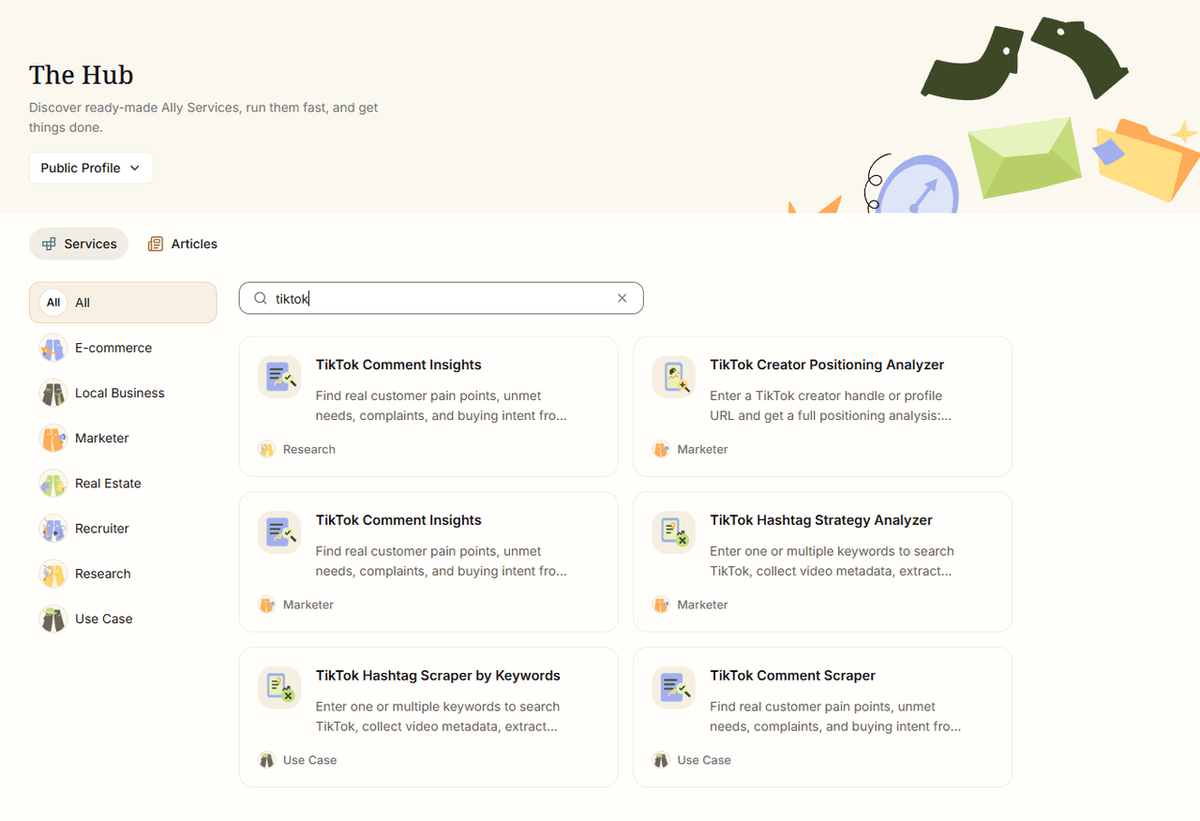
AllyHub helps you:
- Discover profitable faceless TikTok niches by analyzing successful accounts and content patterns
- Analyze competitor accounts to identify winning hooks, formats, topics, and engagement patterns
- Find viral TikTok ideas by studying posts that generate strong audience reactions
- Build your first content roadmap based on proven content structures instead of random guesses
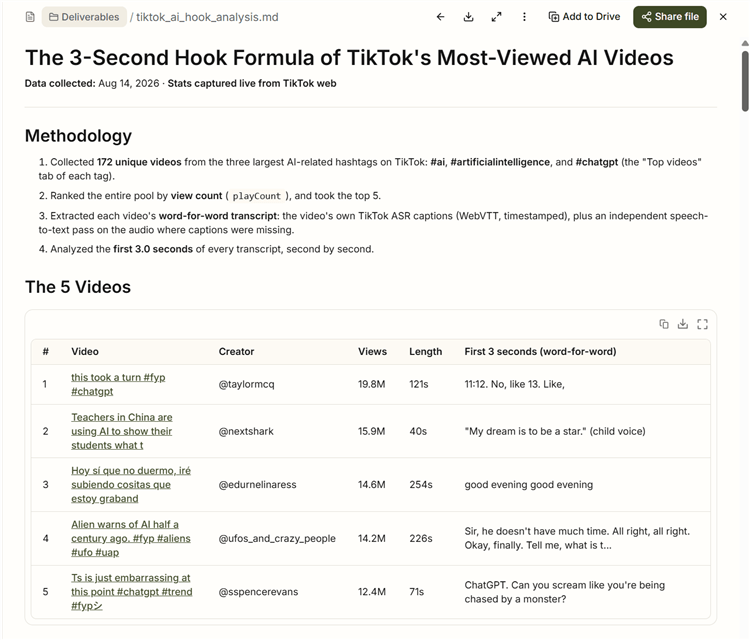
For example, ask AllyHub to "extract the transcripts of the 5 most viewed videos about AI, and analyze these 5 transcripts and tell me the exact 3-second hook formula they are using to keep viewers watching."
By extracting real, proven data directly from your browser, you build your content strategy on actual viral mechanics, not guesswork.
Step 2: Choose a Niche That Can Sustain You
This is the most important decision you'll make. The wrong niche makes every subsequent step harder — content ideas dry up, posting consistency breaks down, and monetization never clicks. The right niche makes your content almost self-selecting.
The single biggest mistake new faceless creators make is choosing a niche based on what's trending rather than what they can produce consistently. Trends fade. Your ability to keep publishing doesn't.
What Topics Work Well for Faceless TikTok Videos
The best niches for faceless content share two traits: they're information-dense (so you don't need a personality to carry the video) and they have evergreen demand (so you're not chasing a news cycle).
Niche | Why It Works Faceless | Content Format | Effort Level | Monetization Potential | Best Creator Type |
Personal finance & investing | Data and advice carry the content; no personality needed |
💡 Pro tip for e-commerce sellers and UGC creators: Product demo niches are ideal for faceless content because the product carries the visual weight. You can build an entire channel around your product category without ever appearing on camera — and use TikTok Shop affiliate links to monetize from day one. The content doubles as evergreen marketing material long after it's posted.
How to Validate Your Niche Before Committing
Before committing to a niche, validate it using both TikTok research and competitor analysis. Look for evidence that the audience exists, creators are growing, and monetization opportunities are available.
- Faceless videos are already performing well — search your niche and filter by "Most Liked" in the past 30 days. If the top results don't show a face, the format is proven in that niche.
- Mid-size accounts exist (10K–100K followers) — these show the niche is accessible, not just dominated by established players.
- Comments show follow-up questions — people asking "what app is this?" or "can you do a part 2?" are a content pipeline. That's months of video ideas already waiting for you.
- A monetization path exists — affiliate products, digital products, brand deals, or TikTok Shop. If you can't see how the niche makes money, don't start it.
Step 3: Set Up Your Account the Right Way
- Download TikTok and create a new account with an email address (not a phone number — easier to manage multiple accounts if needed).
- Choose a username that reflects your niche, not your name. Something like @dailyfinancetips or @techexplained is more searchable and brandable than a personal handle.
- Profile picture: Use a logo, icon, or niche-relevant image. Canva has free templates. Avoid a blank profile — it signals an inactive or spam account.
- Bio: State exactly what your channel is about in one sentence. Include a keyword your target audience would search. Example: "Daily personal finance tips — no fluff, just actionable advice."
- Add your link when you're eligible. For a standard personal account, you generally need 1,000 followers to add a clickable website link to your profile. Until then, you can mention your website or Linktree URL as plain text in your bio, but it won't be clickable.
📌 Note: TikTok's algorithm doesn't penalize new accounts for having no followers. Your first video has the same distribution potential as your hundredth. The "new account penalty" is a myth — what matters is content quality and consistency.
Use a Personal Account
TikTok no longer has a separate “Creator Account.” For most faceless creators, a Personal Account is the right choice and includes creator features such as analytics.
To check your account type: Profile → ☰ → Settings and privacy → Account.
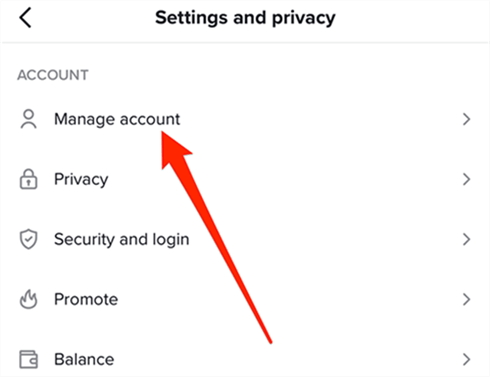
As your account grows, you may become eligible for TikTok One (formerly Creator Marketplace) for brand collaborations. Eligibility varies by region and account.
Avoid switching to a Business Account unless you're promoting a business, as it has different music and commercial-use restrictions.
Step 3: Understand Your Production Options (and Pick One to Start)
The production workflow for a faceless TikTok video follows a consistent pattern: script → visuals → voiceover → edit → post. For a full breakdown of each step, including scripting, visuals, voiceovers, and editing, see the guide below.
What matters at the starting stage is choosing the right visual method for your niche, not perfecting your editing workflow. Here's a quick reference:
Visual Method | Best Niche Fit | Barrier to Start |
Stock footage + voiceover | Finance, motivation, education, storytelling | Very low — free sources available |
Screen recording | Tech tutorials, app reviews, productivity | Low — free tools (OBS Studio) |
Best Free Stock Footage Sites for Faceless TikTok Videos
If you're starting with stock footage (the lowest-friction option), these sources cover most niches without licensing issues:
Step 4: Post Strategically From Day One
Creating good videos is only the beginning. Your first 30 days are about testing, learning, and finding what content works.
Treat your early posts as experiments: test different topics and formats, analyze the results, and focus on the patterns that drive the most engagement.
Build a Consistent Posting Schedule
When starting a faceless TikTok account, consistency matters more than perfection.
- Post 1 video per day for the first 30 days. This gives TikTok enough signals to understand your content category and audience. It also gives you enough data to identify which topics and formats perform best.
- Test different content formats within your niche. For example, try tutorials, list videos, product comparisons, storytelling, or reaction-style content to find your strongest format.
- Review your analytics weekly. Pay attention to watch time, completion rate, saves, shares, and comments — not just views. These signals show which content creates real audience interest.
Optimize Discoverability
Help the right viewers find your content by making your posts easy to understand for both users and TikTok's recommendation system.
- Use 3–5 relevant hashtags, rather than adding dozens of broad tags. Combine niche keywords (e.g., #personalfinance), specific topics (e.g., #budgetingtips), and content categories (e.g., #learnontiktok).
- Write clear captions with searchable keywords. Instead of generic captions, describe what viewers will learn or gain from the video.
- Engage with early comments. Replying to comments, especially shortly after posting, helps build conversations around your content and provides ideas for future videos.

Use Data to Improve Your Next Videos
Successful faceless TikTok creators don't rely on guessing. They use performance data to continuously refine their content strategy.
After your first 30–50 videos, identify:
- Which topics generate the highest engagement
- Which formats get the best completion rates
- Which videos attract followers instead of just views
- Which audience questions can become future content ideas
The fastest-growing accounts are usually not the ones that post the most — they're the ones that learn fastest from every post.
Step 5: Monetize Your Faceless TikTok Account
Monetization options by follower count:
Follower Range | Best Monetization Method |
0–1,000 | Affiliate links in bio (start immediately) |
1,000–10,000 | Affiliate marketing + digital product pre-sales |
10,000+ | TikTok Creator Marketplace (brand deals) |
Affiliate Marketing (Start on Day 1)
You don't need followers to add affiliate links to your bio. Sign up for:
- Amazon Associates — for product review channels
- Impact or ShareASale — for software and SaaS tools
- TikTok Shop Affiliate — for e-commerce products directly within TikTok
The key is to only promote products directly relevant to your niche. A finance channel promoting random Amazon products will underperform a finance channel promoting budgeting apps and financial tools.
TikTok Creator Rewards Program
TikTok's Creator Rewards Program (formerly the Creator Fund) pays per 1,000 qualified views. Requirements:
- 10,000+ followers
- 100,000+ video views in the last 30 days
- Videos must be 1+ minute long
- Account must be in good standing
⚠️ Warning: The Creator Rewards Program pays significantly less than affiliate marketing or digital product sales for most creators. Treat it as supplemental income, not a primary revenue strategy.
How AllyHub Helps You Run a Faceless TikTok Account
Research is only the first step. Once you know what to create, AllyHub can help automate the repetitive work involved in running a faceless TikTok account.
You can use it to:
- Write and refine scripts: Generate hooks, scripts, CTAs, captions, and hashtag ideas based on your content strategy.
- Mine audience insights: Analyze TikTok comments to uncover common questions, pain points, and content requests for future videos.
- Turn ideas into workflows: Create repeatable processes for tasks like script creation, content planning, competitor monitoring, and performance tracking.
- Organize your research: Extract and structure TikTok data into spreadsheets or reports, making it easier to manage your content pipeline.
- Automate browser-based tasks: Let AllyHub handle repetitive tasks across TikTok and other web tools instead of doing them manually every time.
The result is a more repeatable system: research what works → create content faster → learn from your audience → continuously improve.
FAQ on Starting a TikTok Account
Can I start a faceless TikTok account for free?
Yes. You can start with free tools like TikTok, CapCut, Pexels, and Pixabay. Free AI voice tools are also available. Paid tools become useful when you scale content production.
How long does it take to grow a faceless TikTok account?
There is no guaranteed timeline, but many creators see traction within 3–6 months of consistent posting. Growth depends on your niche, content quality, posting frequency, and how quickly you optimize based on data.
What's the best niche for a faceless TikTok account?
The best niche is one you can consistently create content for. Popular options include AI tools, personal finance, education, motivation, and product reviews. For e-commerce creators, product-focused content often offers the clearest path to monetization.
Do faceless TikTok accounts actually make money?
Yes. Common monetization methods include affiliate marketing, TikTok Shop, brand deals, digital products, and Creator Rewards. The best revenue opportunities usually come from niches with strong buyer intent, such as finance, tech, and products.
How do I create faceless TikTok content without it looking generic?
Focus on the script, storytelling, and a unique angle — not just the visuals. Strong hooks, useful information, and a consistent editing style can make faceless content stand out.
What are the best stock footage sites for faceless TikTok videos?
Free options include Pexels, Pixabay, Mixkit, and Coverr. For high-volume production, paid libraries like Storyblocks provide more variety. AI video tools can also help create custom visuals.
Can I use AllyHub to research content ideas for my faceless TikTok channel?
Absolutely. While you can do manual research, AllyHub operates as a digital intern right in your Chrome browser. It can analyze competitors' TikTok accounts, identify content patterns, and discover new content opportunities. Best of all, because it utilizes a ROTI (Return on Token Investment) framework, you can save your specific "competitor audit workflow" as a one-click Service. Next week, getting fresh viral video ideas takes just one click, and costs fewer tokens than the first run.