TikTok can put a single video in front of people who don't already follow you, which means even a small account can reach a much larger audience when a video resonates. But how do you increase the opportunities of that happening?
This guide breaks down seven methods that increase your chances to get videos viral — the hook, retention, interactions, formats, the posting system, the research that feeds all of it, and TikTok search.
Key Takeaways
- Viral is relative, not a fixed number: There's no official threshold — most creators call 100K+ views viral, but for a small account, 10–20x your average counts as viral regardless of the raw number.
- Retention matters: Watch time and completion are important signals in TikTok recommendations. But focus on keeping viewers interested rather than chasing a specific percentage.
- The first two seconds are the whole game: TikTok registers skips in the opening moments. Hook first, context second — show the outcome before you explain anything.
- Shares, saves, and rewatches outweigh likes: A rewatch rate above 15–20% and a save or share signal "worth keeping" far more than a double-tap.
- Search is a second distribution engine: keywords in your caption, on-screen text, and voice can keep a video paying for weeks after the FYP moves on.
- Try to make the hook, hold the viewer, bait one interaction, and post on a system — then let your data tell you which video to double down on.
Why Every Video Has a Real Chance to Go Viral
The most useful thing to understand about the algorithm is its shape.
TikTok says "videos are ranked based on a combination of factors". A useful way to think about TikTok distribution is as a series of recommendation opportunities. As people watch, skip, like, share, comment, and otherwise interact with a video, TikTok gets these signals about who might find it interesting. Strong signals can help the video reach more relevant viewers.
Two consequences follow: first, follower count doesn't gate your reach — a brand-new account can win the test and blow up. Second, your job is narrower than it feels. You don't need to "go viral." You need to win a small room, over and over, until the algorithm opens a bigger door.
Method 1: Win the First Two Seconds
The first one to three seconds decide whether your video gets an audience at all. Early skips are a negative signal because they indicate that viewers aren't staying to watch.
Here are tips for winning the first two seconds:
- Outcome first: show the finished work, the final dish, the before-and-after — then explain how.
- Pattern interrupt: open on something visually wrong or surprising that demands a double-take.
- Text as hook: put the promise in an on-screen caption ("I tried the viral 5-minute workout for 30 days — it didn't go how I expected") so value is visible even on mute.
- Cut the throat-clearing: no "hey guys," no logos, no "welcome back." Every frame before the hook is a frame you're bleeding viewers.
💡 Pro tip: Watch your own video's first three seconds with sound off and no context. If it doesn't make you curious, the hook isn't done yet.
Method 2: Make Retention Do the Heavy Lifting
Once someone's past the hook, the algorithm starts measuring watch time and completion — and in 2026, these are the strongest signals a video has. You can compare each video's retention with your own recent videos. Look for formats that consistently keep viewers watching longer and generate more rewatches.
And here are some techniques creators can use:
- Loop structure: end where you began, so the video restarts seamlessly and replays itself.
- Open loops: tease something unresolved early ("wait until the third ingredient") and pay it off at the end.
- Story arc: give every video a problem, a tension point, and a payoff — even in 15 seconds. Storytelling is the original retention device, and it works on any topic.
- Pacing: cut silences, tighten every sentence, and keep the information flow constant. Dead air is where viewers leave.
- Length that earns itself: a 7-second video with 90% completion beats a 60-second video with 40%. Shorter is safer until your retention data says otherwise.
And watch your rewatch rate — viewers replaying the video is a top-tier signal, with a rate above 15–20% considered strong.
Method 3: Make Audiences Engage with Content
Retention gets you tested, interactions get you pushed. But not all interactions weigh the same. TikTok treats them as signals of genuine interest. So no need to optimize every interaction at once. Give viewers one natural reason to share, save, comment, or rewatch.
- Rewatches and shares. A share means your video traveled to a conversation — that's the platform's favorite outcome.
- Saves signal reference value, which is why educational and "save this for later" content compounds.
- Comments count for more when they're conversations — questions, debates, tag-a-friend — than when they're "nice video."
Examples: Engineer one interaction per video. Ask the specific question you want answered in the comments. Give a reason to save ("screenshot this checklist"). Structure a payoff worth sharing. A video that earns a hundred saves beats one that earns a thousand likes.
Then show up: replying to early comments — with a follow-up question when you can — extends the thread and feeds the exact signal the algorithm is watching.
Method 4: Decide What to Post — 8 Formats That Keep Working
Trends change weekly; formats don't. These formats remain useful because they naturally create opportunities for curiosity, storytelling, retention, or interaction.
- Outcome-first transformations — the finished result in the first second, the journey after.
- Edutainment — a useful skill or fact, delivered with personality and zero lecture energy.
- POV — you play a character in a situation your audience instantly recognizes.
- Storytime — a real story with stakes, a twist, and an ending that lands.
- Myth-busting — "everything you've been told about X is wrong," with receipts.
- Listicle videos — "5 mistakes," "3 things," delivered rapid-fire with a pattern to follow.
- Behind the scenes — how the thing gets made, which builds parasocial trust that converts to followers.
- Duets and stitches — reply to a viral video with your own take; you borrow an existing conversation, and its comment section comes with it.
Method 5: Run Your Account as a System
Virality rewards systems. Here's the weekly loop that makes the methods repeatable:
- Batch ideas around one format and one hook pattern, so you're testing variables, not starting from zero each time.
- Make it a series — a recurring premise ("Friday fixes," "day 3 of...") turns one video into a content engine. Return viewers finish more of your videos, and that's a retention signal the algorithm notices.
- Post consistently — Post on a schedule you can sustain without sacrificing quality.
- Read the data at 48 hours in TikTok Studio: completion rate, rewatch rate, shares, and saves — not views.
- Double down on what worked: if a video hits 60%+ completion, that's a format and topic to repeat within the week.
- Use original audio when it adds something to the video.
Method 6: Research What's Already Winning Before You Film
Behind every successful video sits the same truth: the creators who go viral consistently aren't just better at hooks — they're better at research. They film what their audience is already asking about, remix what their niche's top creators proved works this week, and catch topics while they're heating up — not after the weekly trend report drops.
You can maunally open TikTok search, type your niche's keywords, read the top videos and their comment sections, write down the questions that keep appearing, cross-check the Creative Center's trending hashtags, and repeat for a few hours every week. Most creators quit this part first — and it's exactly the part that compounds.
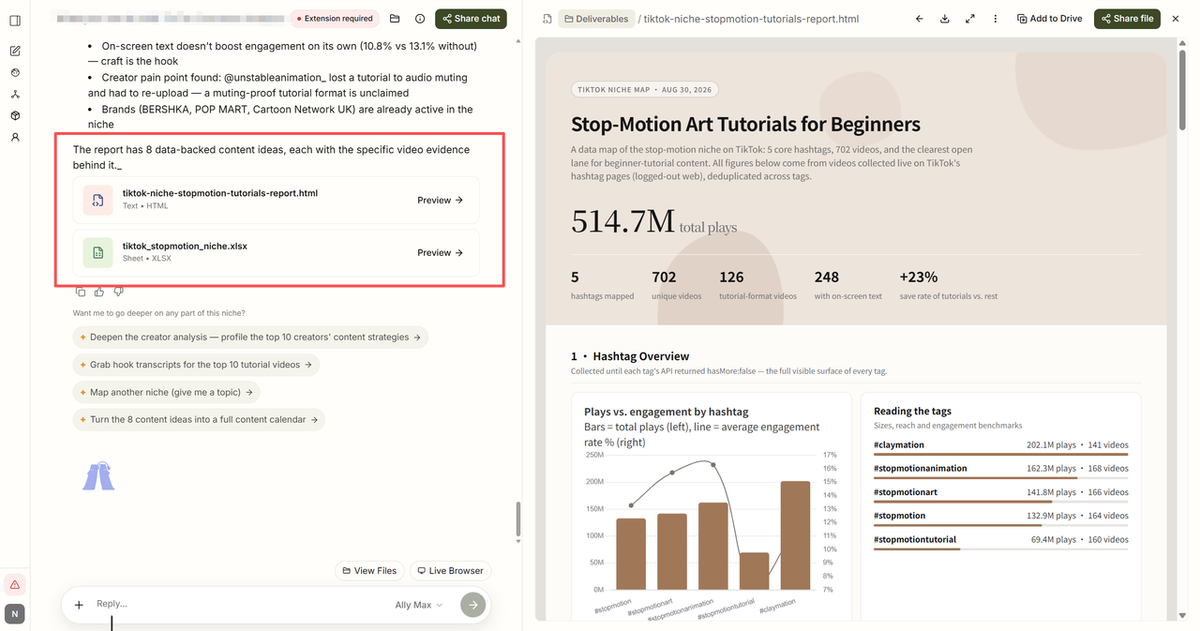
That research is where a browser-native AI autopilot like AllyHub can save time. Instead of manually jumping between TikTok searches, competitor profiles, comment sections, and other sources, you can use AllyHub to collect relevant research, organize recurring topics and audience questions, and turn the findings into hook ideas, even a structured report.
Here I asked AllyHub to map a niche about stop-motion. And I got a detailed report, including content ideas, hashtag overview, top videos, winning formats, and more:
Start from the free tier of AllyHub now.
Method 7: Optimize for TikTok Search
TikTok is a search engine now. TikTok search can give useful content another discovery path beyond the For You feed, especially when the video clearly matches a query people are searching for.
The optimization is invisible to viewers:
- Keywords in the caption: write it like someone searching, not like a poet. "3 banana bread mistakes I made" beats "this might surprise you."
- Keywords on screen: TikTok reads on-screen text. Make the first frame say what the video is about.
- Keywords in your voice: say the phrase out loud — TikTok's search understands spoken words, so a tutorial that never names its topic is half-invisible.
- Hashtags that match the search: three to five relevant ones, chosen for what people type, not for what's trending.
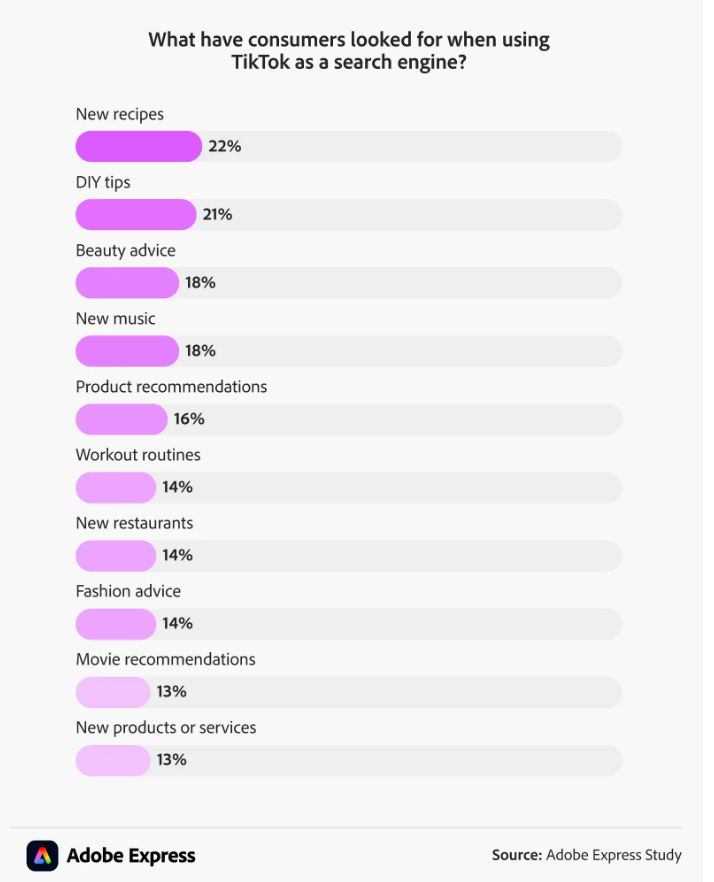
Method 6 feeds this one directly: the questions you compile from audience research are literally the search terms people type. If your video answers a question people are already asking, your content may be recommeded.
How Many Views Do You Need to Go Viral on TikTok?
TikTok has no official "viral" view count, and most creators define it relative to their own baseline. Here's data in practice:
- New or small account: if your average is 500, 20K views can be viral.
- Established account: 100K to 1M views is the common "this went viral" zone.
- Unambiguous virality: 1M+ views within a few days, with comments and shares piling up.
- Blockbuster: 5M+ views — the kind that becomes a cultural moment.
The relative definition matters more than the number. A video that 10x's your baseline tells you your content just worked with a cold audience — that's the signal to analyze and repeat a niche, whether it's 30K or 3M views.
The Myths Keeping Good Creators Stuck at 200 Views
Some of the most repeated TikTok advice is actively wrong. Skip these:
- "Delete and repost a flopped video to reset its chances." Re-posting doesn't reset anything — the algorithm has already evaluated the content.
- "Buy views to kickstart the algorithm." Fake engagement destroys your retention signal, which is the exact metric that matters.
- "You need followers to go viral." The test-audience model means reach is decided by the video, not the account. New accounts go viral daily.
- "Business accounts get suppressed." Account type doesn't gate reach — content resonance does.
- "Hashtags are dead." Hashtags matter less for the FYP than they used to, but they still matter for search discoverability, which keeps paying for weeks after a video stops trending.
What Makes a TikTok Go Viral?
A TikTok is more likely to spread when viewers choose to keep watching, finish or replay it, and interact with it through shares, comments, likes, or other actions. TikTok also uses video information such as captions, sounds, and hashtags to understand what the content is about. There is no single viral formula or engagement threshold. The practical goal is to create a video that is immediately understandable, worth watching through, and relevant enough to share or search for.
FAQ: How to Go Viral on TikTok
How long does it take for a TikTok to go viral?
There's no fixed window. Many videos spike in the first few hours, but others get re-tested days or weeks later — especially as search traffic finds them. The 48-hour data check is for reading signals, not a deadline: a video can sit quietly and still get pushed later.
Do I need trending sounds to go viral?
No. Trending audio can help a video get sampled early, but TikTok has rebalanced toward original sound — and original audio becomes an asset you own. Use a trending sound as a layer when it genuinely fits the video; don't treat it as a requirement.
Should I start a new account if my videos keep flopping?
The algorithm evaluates each video on its own signals, not your account history — a fresh account won't fix a weak hook. Fix the variables first: the first two seconds, retention, and one clear interaction. Accounts of any age go viral once the fundamentals are right.
How do I post consistently without running out of ideas?
Build an idea pipeline instead of relying on inspiration: batch ideas weekly, mine your audience's repeated questions, and track what your niche's top creators proved works. The research side — monitoring, tracking, compiling — can be automated with a browser AI autopilot like AllyHub, so you spend your limited hours filming instead of hunting for the next idea.
What's the best time to post on TikTok?
There's no universal best hour — your audience's activity beats any viral chart. Check TikTok Studio analytics for when your followers are online, post an hour or two before that window, and let retention data decide, not the clock. Consistency outweighs timing every time.