Creating content around trends isn't enough to get discovered on TikTok. Users also search for specific answers, products, tutorials, and recommendations—and your videos need to match those searches.
That’s where TikTok SEO comes in. By targeting relevant search queries and using them naturally across your video content, you can make it easier for TikTok to understand your topic and surface your videos in search results.
This guide covers a practical TikTok SEO workflow:
Find relevant keywords → Create content that answers the query → Optimize search signals → Track performance
From TikTok keyword research to video optimization, these steps can help turn TikTok search into a more consistent source of discovery.
What Is SEO on TikTok?
SEO on TikTok (Search Engine Optimization) is the process of optimizing your videos, profile, and metadata so that TikTok's search algorithm understands your content's topic and ranks your videos at the top of search results when users query relevant keywords.
TikTok SEO vs. Traditional SEO
While traditional web SEO (like Google SEO) focuses on indexing text-heavy webpages, TikTok SEO centers on video context, multi-modal signal extraction, and user retention metrics.
Metric / Dimension | Traditional SEO (Google) | TikTok SEO (TikTok Search) |
Primary Media Format | Web pages, articles, text documents | Short-form video (visual + audio) |
Primary Input | Text queries entered into search engines |
What Can TikTok SEO Help With?
Implementing a strategic TikTok SEO workflow delivers several strategic advantages:
- TikTok Search Visibility: Rank at the top of search results for high-intent keywords that your target customers search every day.
- Content Discovery: Reach audiences who aren't currently following you but are actively seeking solutions in your niche.
- Evergreen Traffic: Unlike standard FYP content that decays after 24–48 hours, search-optimized videos accumulate views for months as search volume continues.
- Product and Service Discovery: Connect with consumers during their decision-making process when commercial intent is highest.
- Qualified Profile Visits: Drive targeted traffic to your profile, bio links, landing pages, or TikTok Shop listings.
TikTok SEO vs. FYP Optimization
It is essential to understand that search visibility and For You Page (FYP) recommendation distribution overlap, but they operate on distinct mechanisms:
- FYP Optimization: Relies heavily on rapid initial viewer reactions, real-time engagement velocity, and broad interest clustering.
- Search Optimization: Relies on topical relevance and explicit keyword matching to fulfill specific user intent.
Key Point: SEO helps TikTok’s algorithm accurately understand what problem or question a video answers; subsequent viewer retention and engagement signals determine whether TikTok continues ranking that video at the top of search results.
How Does TikTok SEO Work?
TikTok's search ranking model evaluates three core layers to match videos with user search queries: Search Relevance, Search Intent, and Viewer Signals.
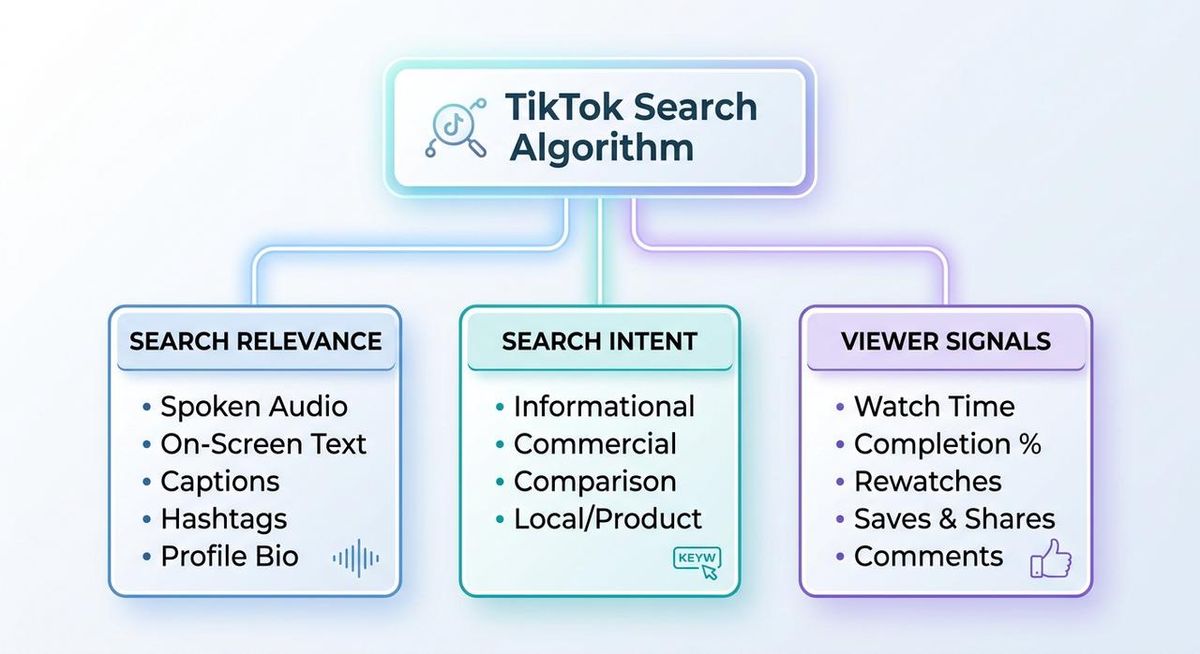
Search Relevance
To rank your video, TikTok must first extract and index what the video is about. TikTok processes multi-modal inputs from your content, including:
- Spoken words: Automated speech-to-text transcription extracts spoken keywords from your audio track (especially within the first 3–5 seconds).
- On-screen text: OCR (Optical Character Recognition) scans text overlays, stickers, and cover text.
- Caption: Natural language processing scans text in your video caption for target keywords and semantic context.
- Hashtags: Categorization tags help index your content into broader topic categories.
- Profile / Topic context: Your account's historical niche focus, bio, and content categories add baseline contextual trust.
Search Intent
Ranking high requires matching your video’s structure to the specific motivation behind the user's search query. Common search intent categories on TikTok include:
- Informational: Searching for step-by-step guidance (e.g., "how to edit TikTok videos").
- Commercial: Evaluating tools or solutions (e.g., "best editing app for TikTok").
- Comparison: Weighing alternative options (e.g., "CapCut vs VN editor").
- Local: Looking for geographical recommendations (e.g., "best cafes in Jakarta").
- Product: Inspecting real-world items before buying (e.g., "TikTok Shop skincare review").
Viewer Signals
Keyword placement alone will not keep your video at the top of search results. Once TikTok serves your video for a search query, it measures how effectively your video satisfies the user. Key viewer satisfaction signals include:
- Watch time & Completion rate: Did the user watch long enough to get their answer?
- Rewatches: Did the user rewatch sections to absorb detailed information?
- Shares & Saves: Did the user bookmark the video as a reference or share it with others?
- Comments: Did the viewer engage in discussion or express satisfaction with the answer?
Note: No single metric guarantees a #1 ranking. TikTok balances search relevance with overall content satisfaction.
How to Do SEO on TikTok: A Step-by-Step Strategy
To turn search intent into reliable views, follow this structured 6-step TikTok SEO workflow.
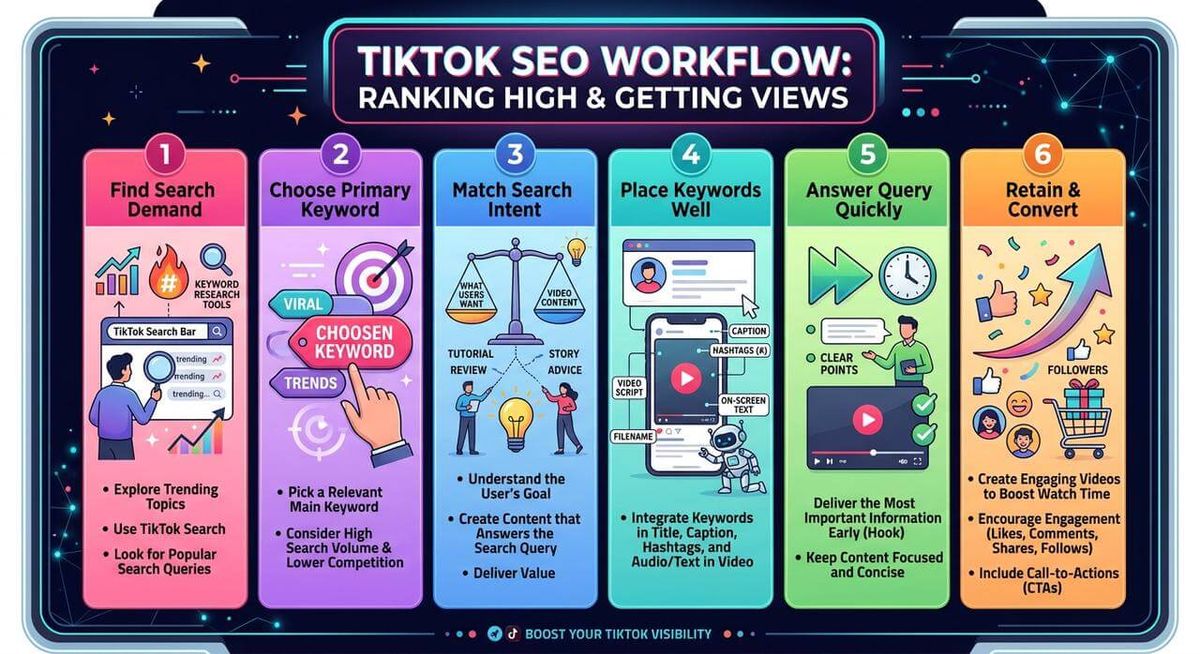
Step 1: Find What Your Audience Searches For
Effective SEO begins with discovering real user search queries rather than guessing what people ought to search.
- TikTok Search Autocomplete: Type seed words into TikTok’s search bar and note the suggested terms.
- Creator Search Insights: Access TikTok’s native research tool to inspect high-volume search terms and search gaps in your niche.
- TikTok Creative Center: Analyze broader trending keyword patterns and regional interest shifts.
- Audience Comments & Questions: Review questions in your own or competitors' comment sections.
Practical Rule: Always adopt the exact phrasing your audience uses when searching, not official industry terminology or internal brand jargon.
Step 2: Choose One Primary Keyword
Avoid trying to optimize a single video for five unrelated topics. Select one main primary keyword per video, then build a tightly focused cluster around it:
- Primary Keyword: 1 main phrase representing the video's core focus.
- Keyword Variations: 2–3 close secondary terms.
- Question Variation: 1 explicit question phrase.
Keyword Cluster Example:
- Primary Keyword: TikTok SEO
- Variations: TikTok SEO strategy, TikTok keyword research, how to rank on TikTok
- Question: How do you rank on TikTok?
Step 3: Match the Keyword to Search Intent
Before filming, ask yourself: "What exact format does a searcher expect when typing this query?"
Match your video structure to the expected intent:
- How-to / Tutorial: Step-by-step screen recording or live demonstration.
- Comparison: Side-by-side breakdown highlighting key differences.
- Product Review: Real-world testing with pros and cons.
- Listicle: Top 3–5 actionable recommendations with clear visual hooks.
Matching intent prevents creating a broad, vague video for a highly specific tactical search.
Step 4: Put the Keyword Where It Makes Sense
Seamlessly integrate your primary and secondary keywords into all key contextual touchpoints:
- Spoken Audio: Clearly speak your primary keyword within the first 3 to 5 seconds.
- On-Screen Text: Feature the target query in your opening text hook and cover text.
- Caption: Write a natural 2–3 sentence caption incorporating your primary keyword and supporting semantic variations.
- Hashtags: Add 3–5 hyper-relevant hashtags (#TikTokSEO, #TikTokStrategy) rather than spamming 20 generic tags.
- Profile / Bio: Ensure your profile bio explicitly states your niche so overall account authority aligns with the topic.
Important: Never stuff keywords unnaturally into audio or captions. Over-optimization leads to poor user retention and can trigger spam filters.
Step 5: Answer the Search Query Immediately
Short-form search users leave within seconds if you don't answer their question right away. Deliver maximum value in the first 3 seconds, then expand on the details:
- 0–3s (The Direct Answer): Give the solution upfront without fluff.
- Example: "To make faceless TikTok videos, you only need three tools: ChatGPT, ElevenLabs, and CapCut."
- 3–30s (Step Breakdown): Show the exact workflow and screen recordings of how to use those tools.
- 30–45s (Visual Proof): Show a quick clip of the final result to build credibility.
- 45–60s (Key Takeaway): Highlight the most important rule (e.g., "Keep visual cuts under 2 seconds") and end with a clear CTA.
Step 6: Optimize for Both Search and Retention
SEO gets users to click on your video from search results, but your video structure must hold their attention. Focus on:
- Immediate Context: Signal what the video covers within the first 2 seconds.
- Pacing & Visual Shifts: Use text overlays, B-roll, or screen zooms every 3–5 seconds to sustain retention.
- Satisfying Payoff: Ensure the viewer gets a complete answer before scrolling away.
How to Find the Best Keywords for TikTok SEO with AllyHub
AllyHub can streamline the research behind a TikTok SEO strategy, from finding relevant search terms to analyzing the content competing for those terms. Keyword research is a key starting point.
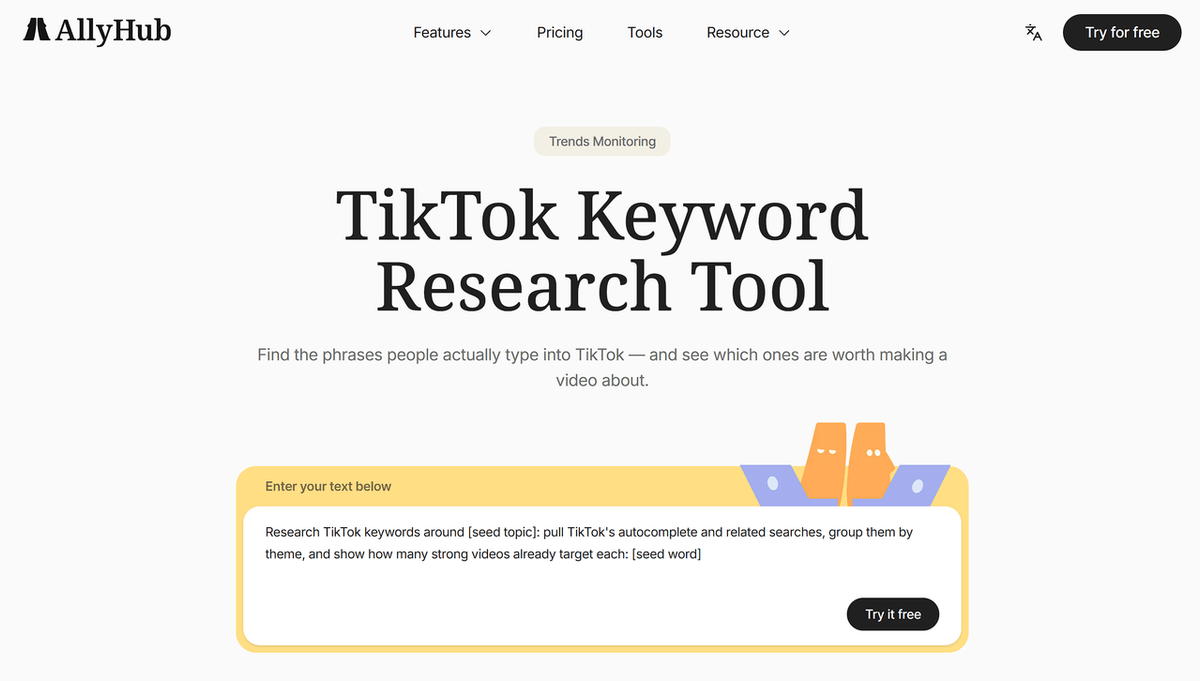
- Find Relevant Search Terms: Use AllyHub to research a seed topic and uncover related TikTok keywords and search queries. Instead of relying only on broad terms, identify more specific queries that match what the target audience is looking for.
- Connect Keywords With Content: Keyword data becomes more useful when paired with content research. AllyHub can analyze relevant TikTok videos to help identify how creators are covering the topic, what angles they use, and which content patterns are worth exploring.
- Turn Research Into SEO Opportunities: Use the combined keyword and content insights to choose topics with strong relevance and clear search intent. These keywords can then inform the video's topic, spoken content, on-screen text, caption, and hashtags.
AllyHub TikTok SEO workflow:
Keyword Research → Content Analysis → Search Intent → Video Optimization
This makes TikTok SEO research more actionable: rather than simply collecting keywords, you can connect search demand with the content already appearing on TikTok.
Where Should You Put TikTok SEO Keywords?
To maximize search indexation without degrading viewer experience, place keywords strategic points across your video assets:
On-Page / Video Element | Primary SEO Purpose | Best Practice Placement |
Spoken Audio | Speech-to-text algorithm indexation | Mention target query clearly within the first 3–5 seconds. |
On-Screen Text | OCR text scanning & immediate hook |
Goal: Achieve semantic consistency across audio, visual, and textual signals so TikTok’s algorithm gets a unified topic signal.
TikTok SEO Strategy for Different Content Types
Content Type | Target Search Queries | SEO Focus |
Educational | How-to, tutorials, step-by-step | Clear question hook + structured visuals |
Product Reviews | [Product] review, [A] vs [B], Is [Product] worth it? |
Best TikTok SEO Tools
Leverage these TikTok SEO tools to research demand, write search-optimized scripts, and analyze competitive intelligence:
Tool | Primary Best Use Case | Key Features |
TikTok Search Autocomplete | Real-time keyword discovery | Uncovers exact query phrasing used by active searchers. |
Creator Search Insights | Demand & search gap analysis |
FAQs on TikTok SEO
Do hashtags help TikTok SEO?
Yes. Relevant hashtags can provide additional context about your video's topic, but they should support—not replace—keyword optimization. Use a small number of highly relevant hashtags rather than unrelated or excessive tags.
Does TikTok SEO help videos get on the FYP?
TikTok SEO primarily helps your content appear in relevant search results. Strong viewer engagement and retention can also contribute to broader distribution, including the For You feed, but search optimization alone does not guarantee FYP reach.
How to Measure TikTok SEO Performance?
Track metrics that show whether your videos are being discovered and watched through search, such as search traffic, views from search, watch time, and engagement. Compare these metrics across videos targeting different keywords to identify which topics perform best.
How long does TikTok SEO take to work?
There is no fixed timeline. Search visibility can vary based on the query, competition, content relevance, and viewer response. Monitor performance over time rather than expecting a specific ranking period.
Conclusion: Create Content Around What People Search For
TikTok SEO starts with understanding what your audience searches for and creating content that directly answers those queries.
Find Keywords → Match Search Intent → Optimize Videos → Measure & Improve
The goal isn't to game TikTok's algorithm. It's to make useful content easier for the right audience to discover through search.