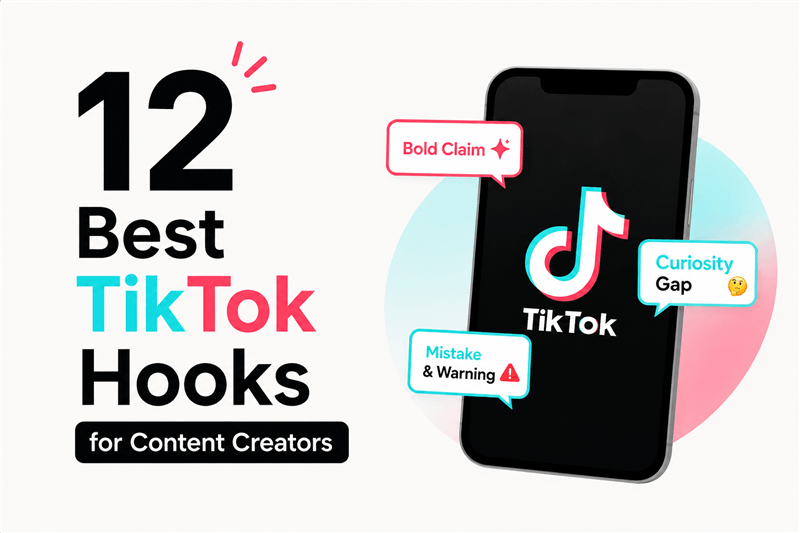
The first 1–3 seconds dictate your completion rate on TikTok. The best TikTok hooks create an immediate reason to keep watching — whether that's curiosity, a bold claim, a problem, a result, or a visual surprise.
This guide breaks down 12 of the best TikTok hooks, with examples, the niches they work best for, and simple formulas you can adapt to your own videos. You'll also learn how to choose the right hook, write one in seconds, and test different openings to find what actually works for your audience.
Key Takeaways
- Best overall: Bold Claim — creates immediate tension and works across many niches.
- Best for new accounts: Direct Call-Out — speaks directly to a specific audience.
- Best for faceless creators: Pattern Interrupt — uses movement, visuals, or sound instead of personality.
- What makes a hook work: Relevance, specificity, curiosity, and a clear payoff.
- Best approach: Test several hooks and use your retention data to identify the strongest ones.
Why TikTok Hooks Matter for Content Creators
A TikTok hook is the opening line, visual, or action that gives viewers a reason to stop scrolling and keep watching.
TikTok recommends introducing the value proposition early and using attention triggers such as suspense, surprise, emotion, movement, sound, and text overlays. Its Creative Codes framework uses a simple structure: hook → body → close.
The key is not to create a clever opening for its own sake. Your hook should make a clear promise and quickly deliver on it.
Quick Comparison Table
Hook | Best For | Why It Works | Example Line |
Bold Claim | Saturated niches | Tension forces a snap judgment | "Posting every day is killing your account." |
Question |
Top 12 Best TikTok Hooks
The Bold Claim Hook — Say Something People Will Argue With
Open with a strong, counterintuitive statement that challenges conventional advice. The viewer now has to decide whether you're wrong — and watching is the fastest way to find out.
Try these lines:
- "Posting every day is killing your account."
- "You don't need more followers — you need better hooks."
- "The 'best time to post' is a myth, and I can prove it."
Best for: Creators in saturated niches (marketing, fitness, personal finance) where every video sounds the same.
Limitations: The claim needs a real argument behind it. A baseless hot take becomes clickbait, and the comments will punish you for it.
The Question Hook — Open a Loop the Viewer Wants Closed
Start with a question your target viewer feels immediately. Questions create an open loop: the brain wants closure, and the only way to close the loop is to keep watching.
Try these lines:
- "Why do videos with terrible editing still go viral?"
- "How much would you charge for a 100K-view video?"
- "What if your next TikTok did 10× your normal views?"
Best for: Educators, coaches, and e-commerce sellers who can answer the question with real value.
Limitations: Yes/no questions fail — viewers answer "no" in their head and scroll. The question must be unanswerable without watching.
The Mistake & Warning Hook — Tap the Fear of Doing It Wrong
The "stop doing X" pattern. Loss aversion is stronger than the hope of gain: people will watch to avoid a cost they believe they're already paying.
Try these lines:
- "You're using hashtags wrong, and it's capping your reach."
- "Stop posting at 6pm — here's what it's costing you."
- "This one mistake is why your videos die at 300 views."
Best for: How-to and growth content, MCNs training creators, and sellers whose buyers keep repeating the same mistakes.
Limitations: It's the most overused pattern on TikTok, so the specific mistake has to be fresh. Fear without a real fix reads as bait.
The Curiosity Gap Hook — Promise Something, Hold It Back
Reveal just enough to be interesting, and withhold the answer. The gap between what viewers know and what they want to know does the pulling.
Try these lines:
- "The TikTok feature nobody is talking about yet."
- "I found a one-sentence hook formula that got 2M views."
- "What happened after I posted at 3am surprised me."
Best for: Storytelling, faceless accounts, and niche creators with genuinely unusual findings.
⚠️ Warning: This is the highest clickbait-risk hook. If the reveal is weak, completion rates crater and the algorithm buries the video. Pay it off within 10–15 seconds.
Limitations: The gap must close with something worth the wait, or the curiosity you bought turns against you — and with it, your reach.
The Numbered List Hook — Give the Payoff a Price Tag
"3 mistakes", "5 hooks", "7 tools". A number promises a specific, finite, scannable payoff — the viewer knows exactly how much value is on the table.
Try these lines:
- "3 hooks that doubled my average watch time."
- "5 things I'd do if I started a faceless account today."
- "7 niches nobody is competing for in 2026."
Best for: Educational content and UGC creators, where the structure of the video matches the promise.
Limitations: Works only if the video delivers the count quickly. A "5 things" video with a 40-second intro breaks its own promise.
The POV & Relatable Scenario Hook — Make Them Feel Seen
"POV: you're a small creator..." Open with the viewer's exact situation. Recognition stops the scroll because it feels like the video is about them specifically.
Try these lines:
- "POV: you posted your best video and it got 200 views."
- "To the creator who's about to quit at 900 followers."
- "If you sell products on TikTok Shop, this is for you."
Best for: Solo and niche creators building community, and sellers speaking to a specific buyer problem.
Limitations: Only lands when the scenario is precise. "POV: you want more views" targets everyone and stops no one.
The Results-First Hook — Lead With the Proof
Start with the outcome, then explain how it happened. The result is the promise — proof sells harder than any adjective.
Try these lines:
- "I grew from 0 to 50K followers in 90 days — here's the hook I used."
- "This video made $4,200 from TikTok Shop in one week."
- "I tested 30 hooks so you don't have to — only 6 worked."
Best for: Business, marketing, and finance creators, UGC creators with case studies, and sellers with real numbers.
Limitations: Results must be real and provable — fabricated numbers destroy trust permanently. A big result also sets retention expectations the video must satisfy.
The Direct Call-Out Hook — Name Your Viewer
"Calling all...", "If you're a...", "Attention [niche]." Direct address filters the feed: the right viewer stops, the wrong viewer leaves — which is fine, because TikTok tests new videos with niche audiences first anyway.
Try these lines:
- "Calling all faceless creators who hate showing their face."
- "If you sell on Etsy, stop scrolling."
- "Attention TikTok Shop sellers running your first campaign."
Best for: New accounts — it's the fastest way to train the algorithm on exactly who should see your content.
Limitations: It shrinks the audience pool by design. Name a niche too small and reach caps out early.
The Before/After Transformation Hook — Show the Change First
Show the end state in the first two seconds: the glow-up, the messy-to-clean edit, the empty-to-sold-out store. Visual proof is faster than any sentence.
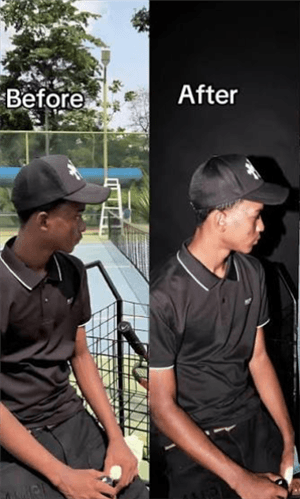
Try these shots:
- "From 300 views to 3M — watch the difference."
- The product in cluttered lighting, then in a clean studio shot.
- "My first video vs. my 100th."
Best for: Lifestyle, beauty, home, fitness, and e-commerce product demos — any niche where the transformation is visible.
Limitations: Needs strong visual contrast in the first frames. Weak before/after footage undercuts the whole video, and audio-only transformations don't hit the same way.
The Pattern Interrupt Hook — Break the Scroll With Motion or Sound
Unexpected movement, a strange angle, sudden silence, a jarring sound effect, an object sliding across the frame. It breaks the feed's visual rhythm, and the eye stops before the brain gets a vote.
Try these moves:
- Start mid-action with no greeting.
- Throw a prop at the camera.
- Hold two seconds of dead silence before speaking.
Best for: Faceless creators who can't lean on personality, and sellers whose niche feed looks visually identical from video to video.
Limitations: Interruption without a message is just noise. It buys you one second — use it to deliver the promise, or viewers bounce immediately.
The Trend & Audio Hook — Ride What's Already Working
Trending sounds, formats, and templates come with demand already baked in, and TikTok's system actively distributes videos that use them. The trend itself is the hook.
Try these moves:
- Put a trending audio remix under your niche's take.
- Apply the current meme format to your industry.
- Use a trend-specific text overlay in the first frame.
Best for: MCNs and new media operators managing volume output, and creators who want baseline reach while testing original hooks.
Limitations: Trends expire fast and get crowded — by day three, the feed is saturated. Trend reach also skews broad rather than toward buyers, so treat it as reach, not conversion. The TikTok Creative Center shows which sounds and formats are climbing right now.
The Secret Reveal Hook — Insider Knowledge Nobody Shares
"What [the pros] don't tell you." People are drawn to asymmetric information — knowing something others don't.
Try these lines:
- "The TikTok feature most sellers never open."
- "What my MCN won't tell creators about brand deals."
- "The real reason your Shop listing converts — it's not the price."
Best for: Niche experts, sellers with platform experience, and MCN operators sharing operational knowledge.
Limitations: Needs genuine insider knowledge behind it. Fake "secrets" are the most-reported hook format — if you're not an insider, frame it as "what I learned from testing" instead.
How to Create a Hook on TikTok
A good TikTok hook doesn't need to follow a single formula. Start with a clear audience, problem, promise, or result, then turn it into a short opening that gives viewers a reason to keep watching.
A simple five-step formula
- Name the viewer or situation. Be specific: "faceless creators," "TikTok Shop sellers," or "creators stuck under 1,000 views."
- Choose one pain point or promise. Focus on either what viewers want or what they want to avoid.
- Add specificity. Use a number, result, contrast, or concrete detail when it strengthens the hook.
- Cut the filler. Skip greetings and introductions. Start with the most important word or idea.
- Make the hook match the payoff. Whatever you promise in the opening needs to be delivered in the video.
Automate TikTok Hook Writing With AllyHub
The 12 templates above give you a starting point for writing stronger TikTok hooks. But finding the right angle for your niche usually takes more than picking a formula—you also need to study what is actually getting attention.
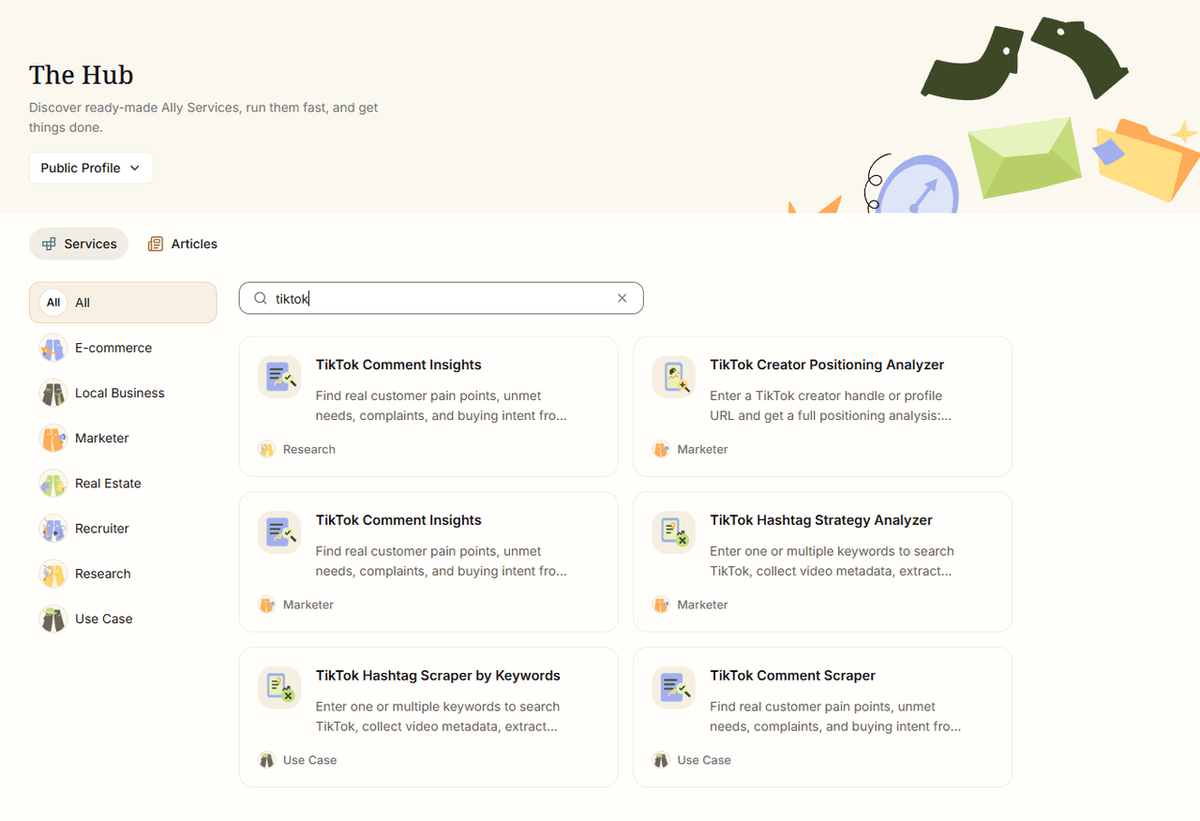
Instead of manually scrolling through hundreds of TikToks and saving hooks, use a browser-native AI agent like AllyHub to automate the research-heavy part. It can collect TikTok posts, creators, comments, and search data, then use those insights to identify recurring hook patterns and generate new variations for your topic.
- Research real TikTok content: Find patterns from creators and posts in your niche instead of relying on generic hook formulas.
- Spot audience language: Analyze searches and comments to uncover the questions, pain points, and phrases your audience actually uses.
- Generate variations faster: Turn one proven angle into multiple hooks to test.
- Go from research to script: Once a hook works, turn the idea into a complete TikTok script without starting from scratch.
A Simple Hook-Writing Workflow
Step 1. Research: Find relevant creators, posts, searches, and comments.
Step 2. Analyze: Identify recurring hook structures, angles, and audience pain points.
Step 3. Generate: Create multiple hooks based on the strongest patterns.
Step 4. Test & refine: Keep the strongest hooks and turn winning ideas into full scripts.
Example prompt:
Analyze high-performing TikTok content in [niche] and identify 5 recurring hook patterns. Then create 10 hooks for [topic] targeting [audience].
Keep each hook short, natural for spoken TikTok content, and focused on [pain point / desired result]. Avoid generic or exaggerated claims.
Format as: Hook | Hook Type | Angle | Why It Works
The goal isn't to let AI replace hook strategy. It's to automate the research and variation work, so more time goes into testing which hooks actually resonate with the audience.
FAQ: Best TikTok Hooks
What is a TikTok hook?
A TikTok hook is the opening moment of your video — the first line, visual, or action — designed to stop someone mid-scroll. It tells viewers within the first 1–3 seconds what they'll get by staying, whether that's a tip, an answer, or a feeling.
How long should a TikTok hook be?
As short as possible: aim for the first 1–2 seconds, and never longer than 5. TikTok's research shows 63% of the highest-CTR videos deliver their key message within the first 3 seconds — if your hook hasn't landed by then, most viewers have already decided to leave.
What makes a TikTok hook effective?
Four things: specificity (names the viewer or the situation), a clear promise (a tip, answer, or payoff), speed (no greeting, no filler), and a fast payoff (the promise is delivered within 10–15 seconds so retention holds).
What is the best TikTok hook for a new account?
The Direct Call-Out. "Calling all [specific niche]" filters for exactly the right viewer and trains the algorithm on who should see your content — the fastest way for a small account to build a niche audience.
How do I find hooks that actually work for my specific niche?
Do not guess or invent hooks. Go to your top 3 competitors and read the comments on their most viral videos—the questions their audience is asking are your next hooks. If manually reading 500 comments sounds miserable, use AllyHub to scrape the entire comment section instantly and have the AI summarize the top 3 viewer pain points. Start your next video by addressing those exact pain points.
Do TikTok hooks still matter in 2026?
More than ever. As the feed gets more competitive, early retention has become the algorithm's strongest signal. A strong hook doesn't just win views — it's what allows a good video to reach the audience it deserves.